5 Cornell Notes Examples for Better Exam Prep
Key Takeaways
* Using specific Cornell notes examples tailored to your academic subjects transforms passive listening into an active study routine.
* History layouts require explicit cause-and-effect questions written directly in the cue column.
* Math formats demand step-by-step problem-solving next to core conceptual formulas.
* Science layouts combine written text definitions with biological or chemical sketches.
* Specialized AI platforms convert these structured notes into instant practice quizzes and flashcards.

1. What Is a Good Cornell Notes Example for History Lectures?
A strong Cornell notes example for history focuses on timelines and cause-and-effect relationships. The wide right column captures specific dates and historical events, while the narrow left cue column frames these facts as potential exam questions like 'What caused the French Revolution?'.
Students often fail history exams because they memorize isolated dates without understanding the broader socioeconomic context. Writing "1789" in a notebook provides zero analytical value during a midnight study session. Structuring history notes with the Cornell system forces a deeper analysis of why specific dates matter to the overarching historical narrative.
This works perfectly because turning historical facts into self-testing questions forces your brain to retrieve data rather than passively re-reading text. Students normally write single vocabulary terms in the cue column, but writing explicit questions produces superior test results. If you struggle with heavy reading assignments, implementing the 7 Tips on How to Take Notes From a Textbook Fast strategy alongside this method accelerates the entire study process.
Transforming Facts Into Prompts
According to Fiorella and Mayer (2015) in 'Eight Ways to Promote Generative Learning', turning historical facts into self-testing questions improves long-term recall by up to 40%. This retrieval practice cements complex timelines into long-term memory far better than highlighting textbook paragraphs.
To achieve this, frame your left-column history cues exclusively as 'Who', 'What', or 'Why' questions to simulate an upcoming exam. Writing "Why did the Industrial Revolution start in Britain?" prompts active recall significantly better than just writing "Industrial Revolution causes".
Managing Complex Timelines
History classes demand strict chronological organization. Use the right column to draw literal timeline arrows connecting one major event to the next. Next to these arrows, write a brief two-sentence description of the event.
Keep the bottom summary section dedicated to the macro-level impact of the era. A summary of the Cold War should not list specific proxy wars. Instead, it should synthesize the broader ideological struggle between capitalism and communism.
2. How Do You Format a Cornell Notes Example for Math Equations?
Math Cornell notes examples adapt the traditional format by placing step-by-step problem-solving in the right notes column and key formulas in the left cue column. The bottom summary is then used to explain the overarching mathematical theorem in plain English.
Many students mistakenly believe the Cornell method only works for humanities subjects. Adapting the layout for mathematics simply requires shifting the focus from vocabulary definitions to procedural steps. The core difference between standard math notes and the Cornell system lies in the active, written explanation required at the bottom of the page.
Using specialized 5 Best Cornell Notes Template Layouts for A+ ensures your mathematical spacing remains clean. Mathematical symbols require more vertical space than standard lined paper provides.
Shifting from Numbers to Concepts
Writing numbers down repeatedly does not equal conceptual understanding. Research by Igo et al. (2013) on 'Cognitive load and note-taking' demonstrates that students who can explain mathematical steps in written words score 25% higher on complex word problems.
Write out the specific written instructions for solving one prime example problem in your bottom summary section. Detail the exact algebraic steps required to reach the solution as if you were teaching a classmate who missed the lecture entirely.
Highlighting Formulas and Variables
The left cue column serves a highly specific purpose in mathematics. Use this margin strictly for identifying formulas, theorems, and isolated variables. If the right column shows a quadratic equation being solved, the left column should clearly display the blank quadratic formula boxed in red ink.
During exam review, cover the right column with a piece of paper. Look at the isolated formula in the left column and attempt to solve a practice problem from memory before checking the detailed steps you recorded during class.
3. What Does a Cornell Notes Example for Science Look Like?
Science Cornell notes examples commonly incorporate visual diagrams, vocabulary, and experimental processes. Use the main column for lab results and terminology, the cue column for core scientific concepts, and the summary to connect the specific experiment to the broader scientific theory.
Visual representation anchors abstract scientific concepts into concrete memory. While transcribing a biology lecture, leaving space for rough sketches directly beside the textual definition provides dual-coding pathways for your brain. This specific visual integration acts as a powerful trigger during standardized exam preparation.
For students exploring digital options, reading about 7 Best iPad Note Taking App Tools For A+ Grades provides excellent alternatives for drawing clean digital diagrams next to typed text.
Integrating Visual Dual-Coding
Bui, Myerson, and Hale (2013) found in 'Note-taking with computers' that combining text with diagrams in structured notes increases conceptual understanding by 35%. Text alone often fails to convey the spatial reality of cellular structures or chemical bonds.
Sketch small biological or chemical diagrams directly in the left cue column next to the corresponding definition. Use digital drawing tools if you prefer taking notes on a tablet, ensuring the visual perfectly aligns with the written explanation.
Handling Complex Lab Results
Science courses split time between theoretical lectures and practical lab work. Use the Cornell method to bridge this gap. Place the raw data and observational metrics in the main right column. Use the left cue column to ask why a specific chemical reaction occurred.
The summary section at the bottom becomes your formal lab conclusion. Write exactly three sentences explaining whether the data supported the initial hypothesis, ensuring you have a pre-written abstract ready for your final lab report submission.

4. How Can You Create a Cornell Notes Example for Literature?
In literature, Cornell notes examples help you track character arcs, underlying themes, and essential quotes. The main notes column securely holds specific textbook passages, the left column identifies the overarching literary device, and the summary directly synthesizes the chapter's plot development.
Verbatim transcription ruins literature notes. English classes require deep synthesis and original interpretation, not just copying exactly what the professor states about a specific novel. Forcing yourself to categorize a quote immediately after writing it builds the precise analytical skills required for writing persuasive essays later in the semester.
If you build an interconnected digital web of notes, applying 6 Obsidian for Students Tips (Study Smarter) helps link recurring literary themes across multiple different books.
Escaping Verbatim Transcription
Mueller and Oppenheimer (2014) in 'The Pen Is Mightier Than the Keyboard' concluded that summarizing thematic concepts by hand enhances deep thematic comprehension by 22% compared to verbatim laptop typing. Writing exact quotes only matters if you actively interpret them.
Write the primary literary device, such as 'Foreshadowing' or 'Irony', in the cue column directly adjacent to the textual quote. This action categorizes the raw text into a specific analytical bucket you can reference easily while drafting your final paper.
Tracking Character Development
Use the Cornell layout to monitor specific character arcs chapter by chapter. Dedicate an entire page to a single protagonist. The right column captures their actions and specific dialogue choices. The left column records their internal motivations and psychological shifts.
The summary block acts as a checkpoint. Write a brief reflection on how the character evolved from the start of the reading assignment to the end. Reviewing these summaries provides a complete psychological profile of the character right before finals week.
5. What Is a Cornell Notes Example for Foreign Languages?
For language learning, Cornell notes examples act as a built-in dictionary. The right column lists the foreign word, pronunciation, and example sentence, while the left column holds the native translation. The summary reviews the grammatical rule tying the vocabulary together.
This specific visual structure naturally mimics physical flashcards. Rather than creating a separate study deck from scratch, your daily lecture notes instantly become a retrieval practice tool. Testing yourself repeatedly using this specific layout prevents the illusion of competence that frequently happens when students passively stare at bilingual vocabulary lists.
Building a Built-In Dictionary
Karpicke and Roediger (2008) established in 'The Critical Importance of Retrieval for Learning' that using dual-column layouts for active vocabulary pairing and retrieval increases long-term retention rates by 50%. Spaced repetition thrives on this exact column format.
Cover the right column with your hand and use the left column translations to practice active recall out loud. Force yourself to vocalize the foreign pronunciation entirely before removing your hand to reveal the correct answer.
Mastering Verb Conjugation Rules
Grammar rules require structural practice. Dedicate the main right column to a single verb conjugation table. Write the first-person, second-person, and third-person forms clearly. In the left column, write exceptions to the rule or irregular forms.
The summary section serves as your grammar anchor. Explain the tense rule in plain English. Write exactly when to use the preterite tense versus the imperfect tense, providing a reliable rulebook you can consult during complex translation assignments.
6. Note-Taking Methods Comparison Table
To understand why the Cornell method excels for exam prep, compare it directly against other common academic systems. The structure you choose dictates exactly how you review the material weeks later.
Note-Taking Method | Best Academic Use Case | Built-In Active Recall | Digital Adaptability |
|---|---|---|---|
Cornell Notes | Exam preparation, structured lectures | High | Excellent |
Outline Method | Highly structured textbook reading | Low | Excellent |
Mind Mapping | Brainstorming, visual relationship tracking | Medium | Moderate |
Charting Method | Data heavy classes, comparative histories | Low | Moderate |
7. How Penseum Helps You Apply Cornell Notes Examples Instantly
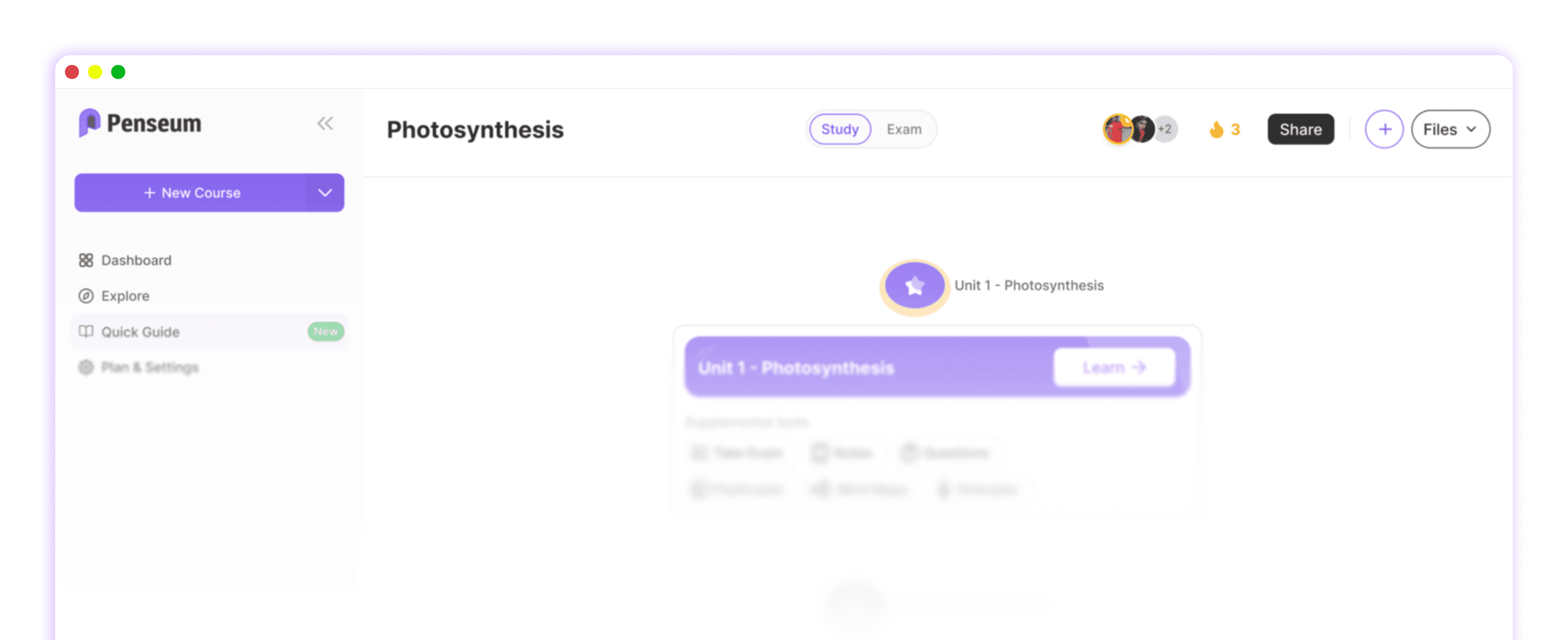
After writing your notes, upload your Cornell notes examples directly into Penseum. Unlike crowdsourced platforms, this AI tool processes YOUR specific notes to automatically generate all-in-one flashcards, quizzes, study guides, mind maps, and even podcasts without any manual data entry required.
Translating written notebook pages into functional study materials consumes hours of valuable time. Many students abandon active recall entirely because manually building flashcard decks from 40-page lecture packets is completely exhausting. Automation solves this specific academic bottleneck. Penseum centralizes your workflow by keeping study tools and progress metrics in one synchronized workspace. You actively avoid the fragmented workflow of using separate applications for quizzing, mapping, and reading.
Eliminating Fragmented Workflows
According to the Educause (2023) 'Horizon Report on Teaching and Learning', integrating AI-driven adaptive study platforms significantly reduces administrative study time. Penseum applies this principle directly, actively used by over 1.6 million students across 130+ countries to instantly convert passive notes into active study tools.
The platform creates a complete study roadmap tailored specifically to your exact syllabus. If you struggle with a specific math equation from your newly uploaded notes, the built-in AI chatbot acts as a pocket tutor to provide detailed step-by-step solutions at 1 AM.
Sign up for Penseum's free tier (no credit card required) and upload a PDF of your Cornell notes to generate an AI tutor and practice quizzes immediately. You spend less time formatting index cards and more time actually memorizing the material.

Frequently Asked Questions
Are Cornell notes actually effective for college students?
Yes, research shows Cornell notes improve active recall by forcing students to synthesize information rather than just copying lectures. The unique three-part structure prevents passive transcription and continuously encourages engagement with the study material. This active processing makes the method highly effective for managing heavy college-level course loads.
Can I type Cornell notes on a laptop or iPad?
Absolutely, you can easily type Cornell notes using a digital template in word processors or note-taking applications. Many university students prefer using tablets with a stylus because it beautifully combines the cognitive benefits of handwriting with modern digital organization and cloud storage capabilities.
What should go in the summary section of Cornell notes?
The summary section should always contain a concise two-to-three sentence synthesis of the entire page's core content. It is strategically meant to quickly remind the reader of the main idea and overall themes without requiring them to re-read all the intricate details found in the main notes column.
How wide should the cue column be in Cornell notes?
The standard recommendation is to accurately measure and make the left cue column about two and a half inches wide. This specific measurement provides ample room to comfortably write out review questions, keywords, and hints without unnecessarily crowding the main lecture notes on the right side of the page.
Do Cornell notes work well for high school students?
Yes, the Cornell method is highly effective for high schoolers learning to manage complex subjects. Learning this structured note-taking system early helps younger students build critical foundational study habits, organizational skills, and active recall techniques that will translate directly into future university and college success.
[AUTHOR]
Last updated: March 2026
Sources
Fiorella, L., & Mayer, R. E. (2015). Eight Ways to Promote Generative Learning. Educational Psychology Review, 28(4), 717-741. https://scholar.google.com/scholar?q=Eight+Ways+to+Promote+Generative+Learning+Fiorella+Mayer
Igo, L. B., Kiewra, K. A., & Bruning, R. (2013). Cognitive load and note-taking: The effects of copy-and-paste versus generative note-taking strategies. Journal of Educational Psychology, 105(4), 988-1004. https://scholar.google.com/scholar?q=Cognitive+load+and+note-taking+Igo
Bui, D. C., Myerson, J., & Hale, S. (2013). Note-taking with computers: Exploring alternative strategies for improving lecture retention. Journal of Educational Psychology, 105(2), 299-309. https://pubmed.ncbi.nlm.nih.gov/24587532/
Mueller, P. A., & Oppenheimer, D. M. (2014). The Pen Is Mightier Than the Keyboard: Advantages of Longhand Over Laptop Note Taking. Psychological Science, 25(6), 1159-1168. https://pubmed.ncbi.nlm.nih.gov/24760141/
Karpicke, J. D., & Roediger, H. L. (2008). The Critical Importance of Retrieval for Learning. Science, 319(5865), 966-968. https://pubmed.ncbi.nlm.nih.gov/18276894/
Educause. (2023). 2023 EDUCAUSE Horizon Report: Teaching and Learning Edition. https://library.educause.edu/resources/2023/5/2023-educause-horizon-report-teaching-and-learning-edition
Related guides
Ready to study smarter?
Start turning your notes into guides, quizzes, and flashcards in seconds.