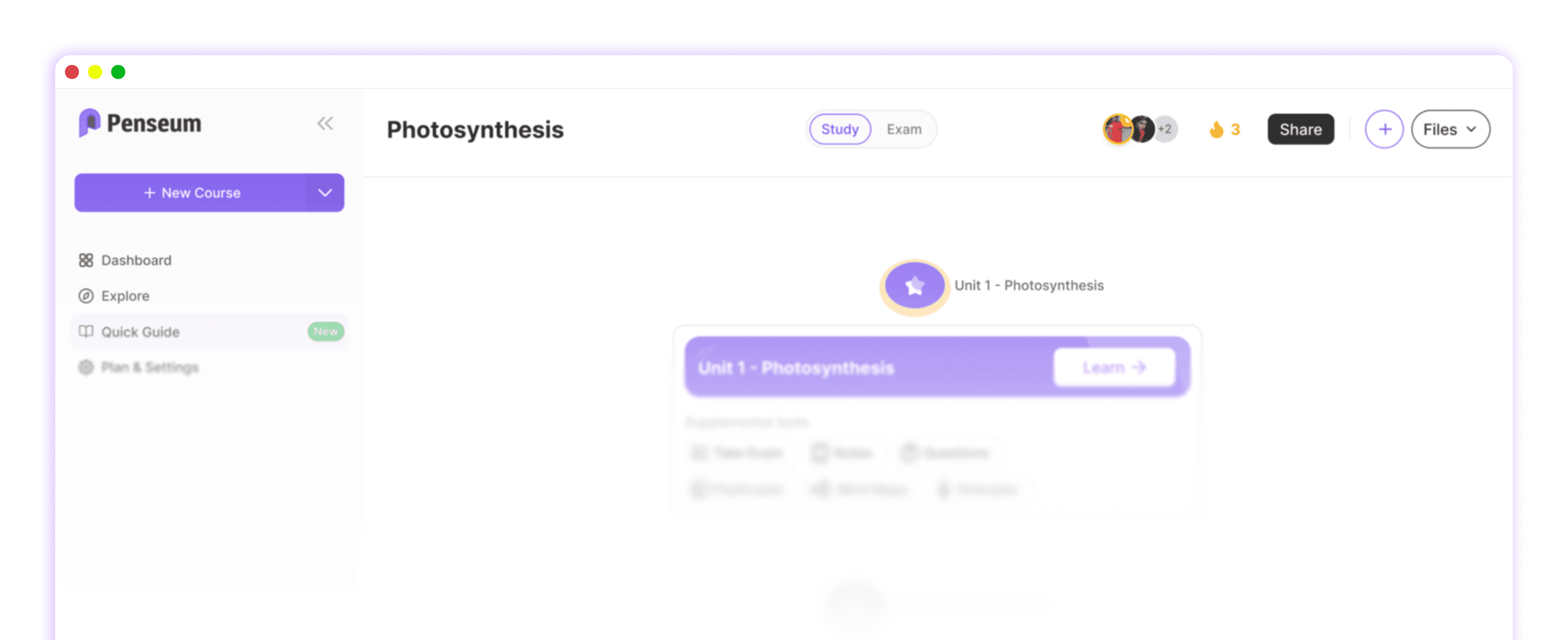
7 Ways a Study Guide Creator Boosts Grades
Key Takeaways
* An AI study guide creator instantly transforms raw lecture notes and long PDFs into active recall materials like flashcards and quizzes.
* Automating study asset generation saves students an average of 3 to 4 hours per week.
* Replacing passive reading with automated self-testing algorithms increases long-term memory retention.
* Generating materials directly from your specific syllabus eliminates the factual errors commonly found in crowdsourced study decks.
What is an AI study guide creator?
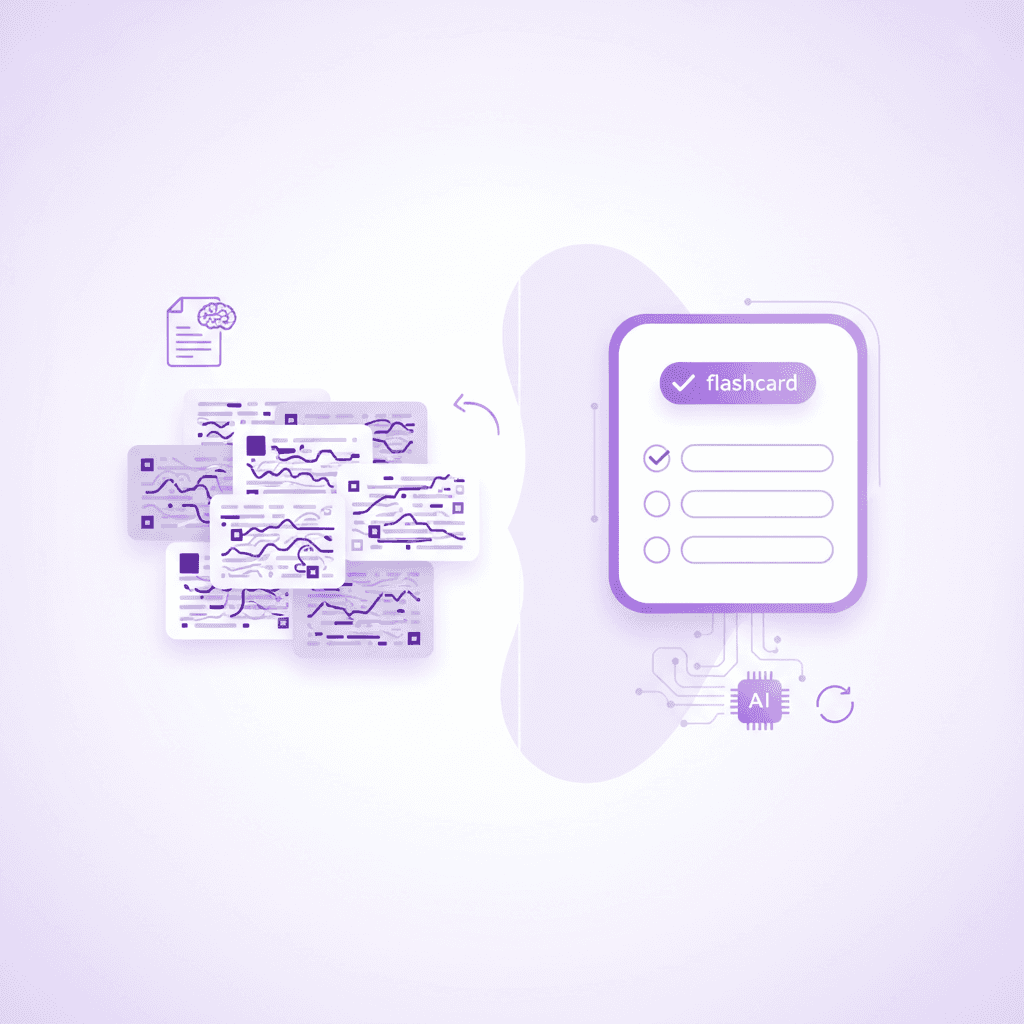
An AI study guide creator is a software tool that automatically transforms raw academic materials like PDFs, lecture slides, and notes into structured study assets. It uses natural language processing to extract key concepts, generating quizzes, flashcards, and summaries instantly for highly effective active recall practice.
Relying on manual note formatting actively harms your study efficiency. Research demonstrates that active recall yields vastly superior learning outcomes compared to passive review techniques like highlighting (Karpicke & Roediger, 2008). Despite this data, students routinely waste hours copying text from lecture slides into Word documents or index cards. A study guide creator bypasses this administrative bottleneck entirely. By processing the text of your uploaded documents, the software identifies definitions, formulas, and historical dates, structuring them into testable questions immediately.
Students utilizing automated generation tools save an average of 3 to 4 hours per week on note formatting and material preparation. This recovered time can be redirected toward actual retrieval practice, which moves information from short-term to long-term memory. The software acts as a personalized teaching assistant, reading your specific texts and building a curriculum tailored to that exact document.
If you are currently evaluating options, look at 7 AI-Powered Study Tools to Ace Your Exams to see how different platforms handle document extraction.
Actionable step: Upload your longest lecture PDF into an AI-powered study tool to instantly generate a baseline summary and ten flashcards.
Why should you use an AI powered study tool?
Using an AI powered study tool eliminates the time-consuming process of manually writing out study guides. Instead of spending hours formatting notes, students can immediately begin testing their knowledge. This shift from passive organization to active testing drastically improves long-term memory retention and overall exam performance across all subjects.
The illusion of competence destroys exam grades. When you reread a textbook chapter, the content feels familiar. Your brain mistakes this fluency for actual mastery. Extensive cognitive research highlights the sheer inefficiency of rereading and highlighting for exam preparation (Dunlosky et al., 2013). An AI powered study tool forces you to confront what you actually know. By turning your notes into a quiz, the system demands that you retrieve the answer from memory. If you fail to retrieve it, the tool immediately identifies that specific knowledge gap.
Over 1.6 million students globally have switched to AI platforms to consolidate and accelerate their daily study routines. This massive adoption rate stems from the simple reality that manual preparation scales poorly. College courses assign hundreds of pages of reading weekly. Extracting the core concepts from that volume manually leaves zero time for actual study. Discover 5 Ways an AI Powered Study Tool Boosts Grades to understand the mechanics of this shift.
Actionable step: Replace your next note-formatting session by letting a study application build your outline, dedicating that saved time entirely to practice quizzes.
How do study apps improve exam preparation?
Modern study apps improve exam prep by enforcing spaced repetition and active testing rather than passive reading. By organizing your syllabus into manageable, bite-sized modules, these tools prevent cognitive overload and ensure you are actually retrieving information rather than just recognizing text on the page.
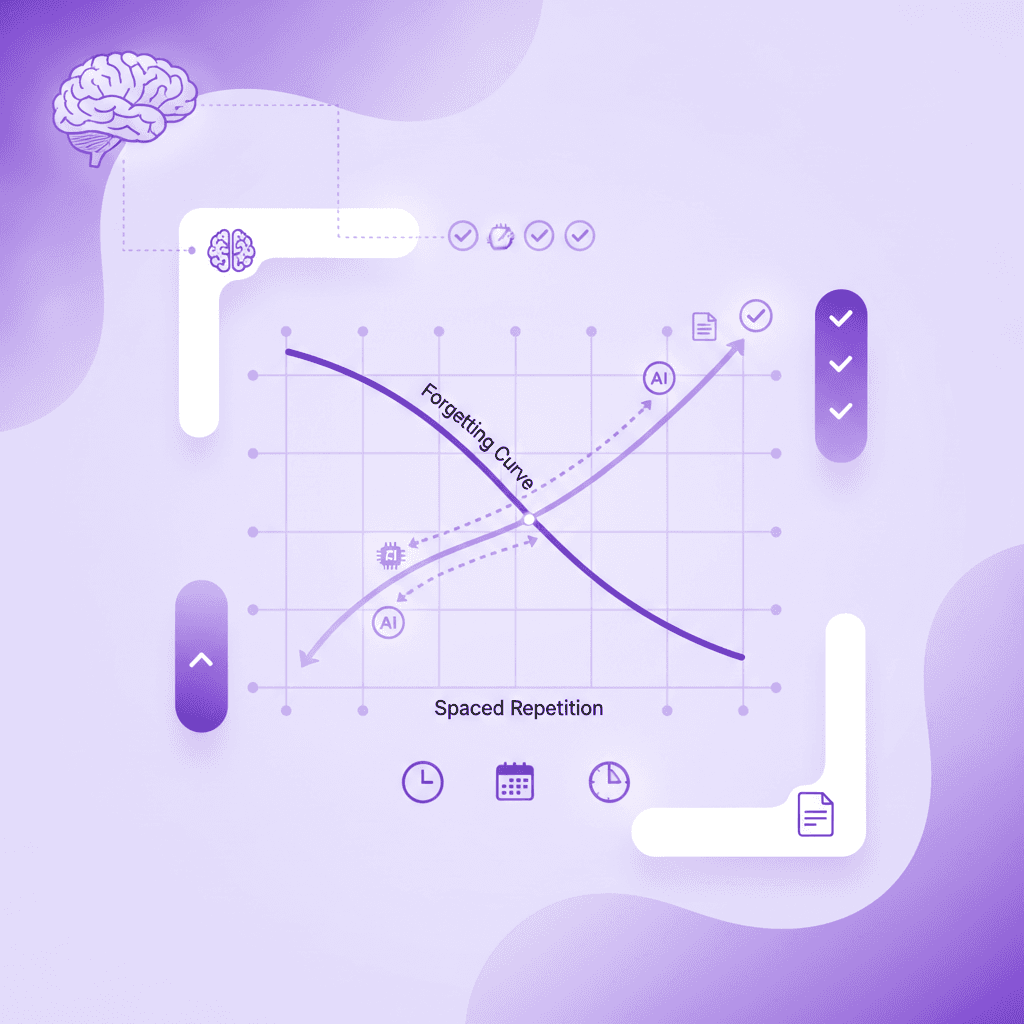
Human memory decays at a predictable rate. The foundational research on the forgetting curve proves that without active intervention, new information vanishes from the brain within days (Ebbinghaus, 1885). Study apps counteract this biological default by scheduling reviews at the exact moment you are about to forget the material. If you answer a flashcard correctly, the app pushes the next review back by a few days. If you struggle, it shows you that same card tomorrow.
Implementing spaced repetition algorithms can increase long-term memory retention rates by up to 200% compared to traditional cramming methods. Cramming might help you pass a quiz on Friday, but that unreinforced data will disappear before the final exam. Study apps automate the scheduling process. You do not need to track which concepts you studied on which day. The algorithm manages the math, allowing you to focus purely on the retrieval practice.
Actionable step: Schedule 15-minute daily review sessions using the automated flashcards generated by your study guide creator.
Can studying AI replace traditional crowdsourced notes?
Yes, studying AI tools are vastly superior to crowdsourced platforms because they generate materials directly from your specific professor's lectures. Instead of relying on generic or potentially inaccurate flashcards made by strangers, your generated study assets are perfectly, accurately aligned with your actual classroom curriculum and exam requirements.
Downloading a massive, pre-made flashcard deck from a public database provides a false sense of security. Biology 101 at one university rarely matches the exact syllabus of Biology 101 at another. By studying a stranger's notes, you risk memorizing irrelevant data while missing the specific nuances your professor prioritized in the lecture. Accurate, guided instruction tailored to the test is far more effective than unguided, generalized review (Kirschner et al., 2006). A study guide creator solves this by treating your uploaded syllabus as the single source of truth.
Peer-generated study sets on legacy crowdsourced platforms contain factual errors or irrelevant information in up to 30% of user-uploaded decks. Memorizing incorrect information actively damages your GPA. AI tools process your personal documents, ensuring the resulting quizzes reflect the exact terminology and scope of your course. You can explore more about this localized approach in 7 Study AI Strategies for Faster Exam Prep.
Actionable step: Stop searching online for premade decks; instead, upload your specific class syllabus to an AI tool to generate customized, accurate guides.
What features make the best study application?
The best study application combines multiple learning modalities into one unified platform. Look for tools offering automated flashcards, practice quizzes, and live voice tutoring capabilities. This allows students to effortlessly switch between reviewing core concepts and actively testing their knowledge without juggling multiple disconnected software subscriptions.
Text alone rarely triggers deep comprehension for complex subjects like organic chemistry or calculus. Cognitive theory supports the use of multimedia learning, proving that students process information more effectively when visual, auditory, and text-based inputs are combined (Mayer, 2009). The top-tier platforms provide a digital canvas where you can draw out problems while a voice-enabled AI tutor watches and corrects your steps. This multimodal approach mimics sitting next to an expert human tutor.
Consolidating study tools into an all-in-one platform saves college students an average of $150 per semester in various software subscriptions. Rather than paying separately for a flashcard app, a document summarizer, and a math-solver, a dedicated study guide creator handles the entire pipeline from raw notes to final exam prep.
Feature | Legacy Flashcard Apps | Basic AI Chatbots | Advanced Study Guide Creator |
|---|---|---|---|
Automated Card Generation | No (Manual entry) | Yes (Text only) | Yes (From specific PDFs) |
Spaced Repetition Algorithm | Yes | No | Yes |
Live Voice Tutoring | No | No | Yes |
Visual Canvas Tracking | No | No | Yes |
Actionable step: Audit your current study stack and choose an all-in-one AI study guide creator that handles both document summarization and interactive testing.
7 Specific Ways a Study Guide Creator Boosts Grades
Understanding the core technology is only the first step. To maximize your academic performance, you must apply the software to specific friction points in your daily routine. Here are the precise ways integrating these tools elevates exam scores.
1. Eliminates Task Initiation Friction
Staring at a blank Word document creates massive psychological resistance. Students often procrastinate simply because the effort required to organize raw notes feels overwhelming. A study guide creator bypasses this phase entirely. By generating a structured outline in seconds, the software moves you immediately past the hardest part of studying: getting started.
2. Enforces Consistent Retrieval Practice
Passive reading tricks the brain. Active recall forces the brain to work. These platforms default to active learning by converting every uploaded document into a test. Instead of reading a paragraph about cellular mitosis, you must answer a generated multiple-choice question about it. This constant self-testing builds stronger neural pathways.
3. Personalizes the Testing Scope
Generic study materials fail to capture the idiosyncrasies of your specific professor. By feeding your actual class transcripts, slides, and syllabus into the generator, the resulting study assets perfectly mirror your upcoming exam. You stop wasting time on concepts your professor skipped and focus intensely on the topics they highlighted.
4. Isolates Knowledge Gaps Instantly
When you study manually, you often spend equal time on concepts you already know and concepts you struggle with. Automated quizzes provide immediate analytical feedback. If you fail three generated questions on macroeconomics but ace the section on microeconomics, the tool directs your attention exactly where it belongs, optimizing your limited study hours.
5. Reduces Cognitive Overload Through Chunking
Attempting to memorize a 60-page PDF in one sitting leads to catastrophic memory failure. Study guide creators automatically break massive documents into categorized, bite-sized decks. This process, known as chunking, aligns with human working memory limits. You master one small deck before the system unlocks the next logical concept. Read more on this workflow in 7 Ways a Study AI Tool Improves Your Grades.
6. Accelerates Review with Multimodal Feedback
Reading a text explanation of a failed math problem rarely helps. Advanced platforms now watch you solve equations on a digital canvas. When you make a mistake, they generate an immediate, voice-based explanation of the error. Hearing a step-by-step breakdown while watching a diagram being drawn solidifies complex STEM concepts much faster than reading a solution manual.
7. Automates Spaced Repetition Scheduling
You cannot manually calculate the optimal decay rate for hundreds of individual facts. The software tracks your success rate on every single flashcard. It automatically pushes easy concepts weeks into the future while surfacing difficult formulas every single day until you achieve mastery. This algorithmic scheduling guarantees you peak on the exact day of your exam.

How Penseum Helps You Apply Active Recall
Applying active recall requires constant self-testing, and Penseum automates this critical process entirely. Instead of simply rereading textbooks, students upload their specific notes, and Penseum instantly generates targeted flashcards and quizzes. The live AI tutor watches students solve problems on a digital canvas, providing real-time voice corrections to ensure true mastery.
Self-explanation and interactive tutoring generate some of the highest recorded learning gains in cognitive science (Chi et al., 1989). Standard AI chatbots give you a generic text block and stop. Penseum acts as a 1-1 AI tutor in your corner. It explains the material step by step, out loud. If you make a mistake on the digital workspace, the tutor spots it, marks exactly where you went wrong, and explains what to fix. It keeps teaching until you actually understand the concept.
Susan S., a medical student using the platform, shared her experience: "Penseum is legit! I don’t have to waste time making flashcards anymore. I just upload my stuff, and it does the rest. Plus, it’s got my back even at 1am!"
Penseum actively powers learning for users across 130+ countries, acting as an all-in-one hub for active recall. By consolidating your flashcards, quizzes, and live tutoring into a single workspace, you eliminate the friction of jumping between disconnected apps. The system supports multiple languages and handles subjects ranging from history to advanced calculus.
Actionable step: Create a free Penseum account (no credit card required), upload a difficult lecture PDF, and let the live AI tutor walk through a generated quiz step-by-step.
Frequently Asked Questions
Is there an AI that makes study guides?
Yes, AI tools are specifically designed to read your uploaded academic materials and automatically generate comprehensive study guides. These platforms extract the core concepts, definitions, and formulas from PDFs, PowerPoint slides, and typed notes, organizing them into structured outlines, flashcards, and practice quizzes in seconds.
What is the best AI study guide creator for college students?
The most effective study guide creator combines document extraction with interactive tutoring. Penseum is heavily favored by college students because it goes beyond text generation. It features a digital canvas where a live AI tutor watches you solve problems, offering real-time voice corrections and step-by-step guidance until you master the material.
Can I generate flashcards from my lecture notes automatically?
Absolutely. Modern study platforms allow you to upload raw text or document files. The natural language processing engine scans the content, identifies the critical facts, and instantly generates a deck of flashcards. This completely eliminates the hours usually spent manually copying and pasting definitions.
Is Penseum free to use for students?
Penseum is free to use for students looking to create basic study guides and flashcards. You can create an account and start uploading documents immediately without a credit card. For students requiring advanced usage limits and extensive live tutoring sessions, a premium subscription is available for $29.99.
How does an AI tutor help with math and science problems?
Instead of just handing you the final answer, an advanced AI tutor tracks your real-time work on a digital canvas. If you miss a negative sign or apply the wrong formula, the tutor highlights the specific error and explains the underlying concept out loud, forcing you to learn the actual mechanics of the problem.
What subjects can an AI-powered study tool support?
These tools are highly adaptable because they base their output on the exact documents you upload. They easily process text-heavy subjects like history, law, and literature for memorization. Advanced platforms also feature mathematical and visual capabilities, making them highly effective for STEM fields like physics, engineering, and organic chemistry.
Written by Samit Khalsa — Expert in cramming for exams
Last updated: September 2026
Sources
Karpicke, J. D., & Roediger, H. L. (2008). The critical importance of retrieval for learning. Science. https://pubmed.ncbi.nlm.nih.gov/18276894/
Dunlosky, J., Rawson, K. A., Marsh, E. J., Nathan, M. J., & Willingham, D. T. (2013). Improving Students' Learning With Effective Learning Techniques. Psychological Science in the Public Interest. https://pubmed.ncbi.nlm.nih.gov/26173288/
Ebbinghaus, H. (1885). Memory: A Contribution to Experimental Psychology. Annals of Neurosciences. https://pubmed.ncbi.nlm.nih.gov/25206741/
Kirschner, P. A., Sweller, J., & Clark, R. E. (2006). Why Minimal Guidance During Instruction Does Not Work. Educational Psychologist. https://scholar.google.com/scholar?q=Why+Minimal+Guidance+During+Instruction+Does+Not+Work
Mayer, R. E. (2009). Multimedia Learning (2nd ed.). Cambridge University Press. https://scholar.google.com/scholar?q=Mayer+Multimedia+Learning+2009
Chi, M. T. H., Bassok, M., Lewis, M. W., Reimann, P., & Glaser, R. (1989). Self-Explanations: How Students Study and Use Examples in Learning to Solve Problems. Cognitive Science. https://scholar.google.com/scholar?q=Self-Explanations+How+Students+Study+and+Use+Examples+Chi+1989
Related guides
Ready to study smarter?
Start turning your notes into guides, quizzes, and flashcards in seconds.