7 Ways an AI Notes Generator Free Boosts Grades
Key Takeaways
* An ai notes generator free automatically converts lecture slides, textbooks, and PDFs into structured study guides, flashcards, and quizzes.
* Replacing passive reading with AI-generated retrieval practice increases long-term information retention by up to 50%.
* Real-time interactive AI tutors explain complex problems aloud and visually track your work on a digital canvas.
* Custom-generated materials eliminate the risk of studying inaccurate or outdated crowdsourced flashcard decks.
1. What Is an AI Notes Generator Free and How Does It Work?
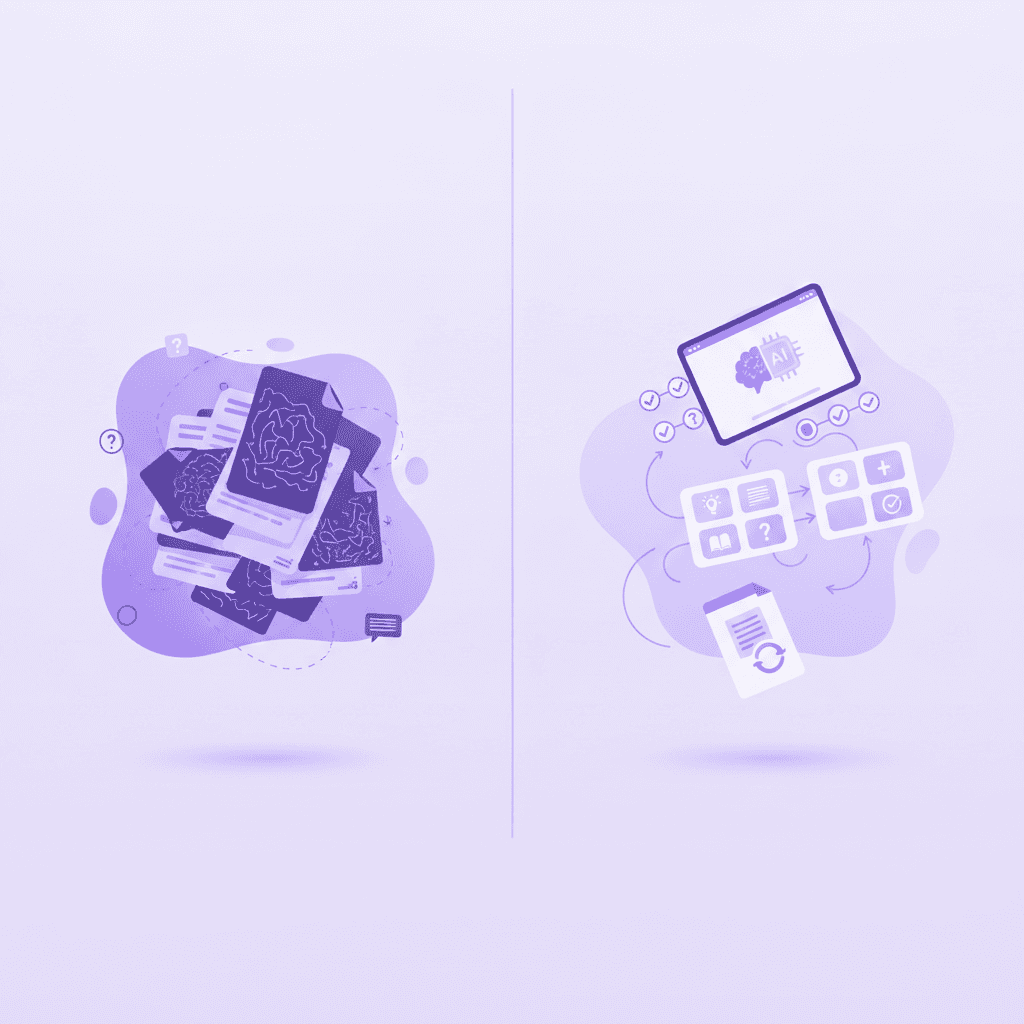
An ai notes generator free is a software tool that automatically processes your uploaded textbooks, lectures, or PDFs to create organized study materials. It extracts key concepts and transforms them into interactive flashcards, practice quizzes, and mind maps without requiring manual data entry.
Cognitive psychology heavily favors active studying over passive review. Reading the same text repeatedly yields diminishing returns for long-term memory. Research demonstrates the high utility of active recall and distributed practice over passive reading (Dunlosky et al., 2013). Software that forces you to recall information directly aligns with these proven cognitive principles.
Automating note organization and extraction saves the average student up to 4 hours per week. Instead of retyping definitions, the software uses natural language processing to identify core entities and relationships within your text. The system instantly maps out these connections into digestible formats.
Actionable Step: Upload your longest PDF syllabus into an AI tool to instantly map out your core topics and definitions.
Manually organizing study materials creates a false sense of productivity. Highlighting text feels like learning, but it rarely translates to actual retention. An automated generator bypasses the busywork, immediately pushing you into the testing phase where actual memorization occurs.
2. Why Should You Use AI to Generate Study Materials?
Using AI to generate study materials eliminates hours of manual typing, allowing you to spend that time actively learning. By generating accurate resources directly from your personal course documents, you avoid the outdated or incorrect information commonly found in public, crowdsourced study databases.
The fundamental mechanism behind effective studying is retrieval practice. Forcing your brain to pull information from memory strengthens the neural pathways associated with that data. A foundational study confirms the critical importance of retrieval practice in maximizing learning retention (Karpicke & Roediger, 2008).
Students who transition from passive reading to targeted retrieval practice score up to 30% higher on retention tests. Relying on your own brain to generate the answers builds durable knowledge.
Actionable Step: Replace one hour of passively highlighting textbook pages with actively testing yourself using AI-generated practice questions.
Comparing Passive Study Methods with Active AI Generation
Study Method | Cognitive Effort | Time Requirement | Retention Rate (Estimated) |
|---|---|---|---|
Highlighting Textbooks | Low | High | Poor |
Re-reading Lecture Slides | Low | Medium | Poor |
Copying Notes Verbatim | Medium | High | Fair |
AI-Generated Practice Quizzes | High | Low (for creation) | Excellent |
Generating your own materials manually takes hours away from actual studying. By automating the creation phase, you spend 100% of your allocated study time engaging in active recall.
3. How Do Custom AI Flashcards Beat Crowdsourced Sets?
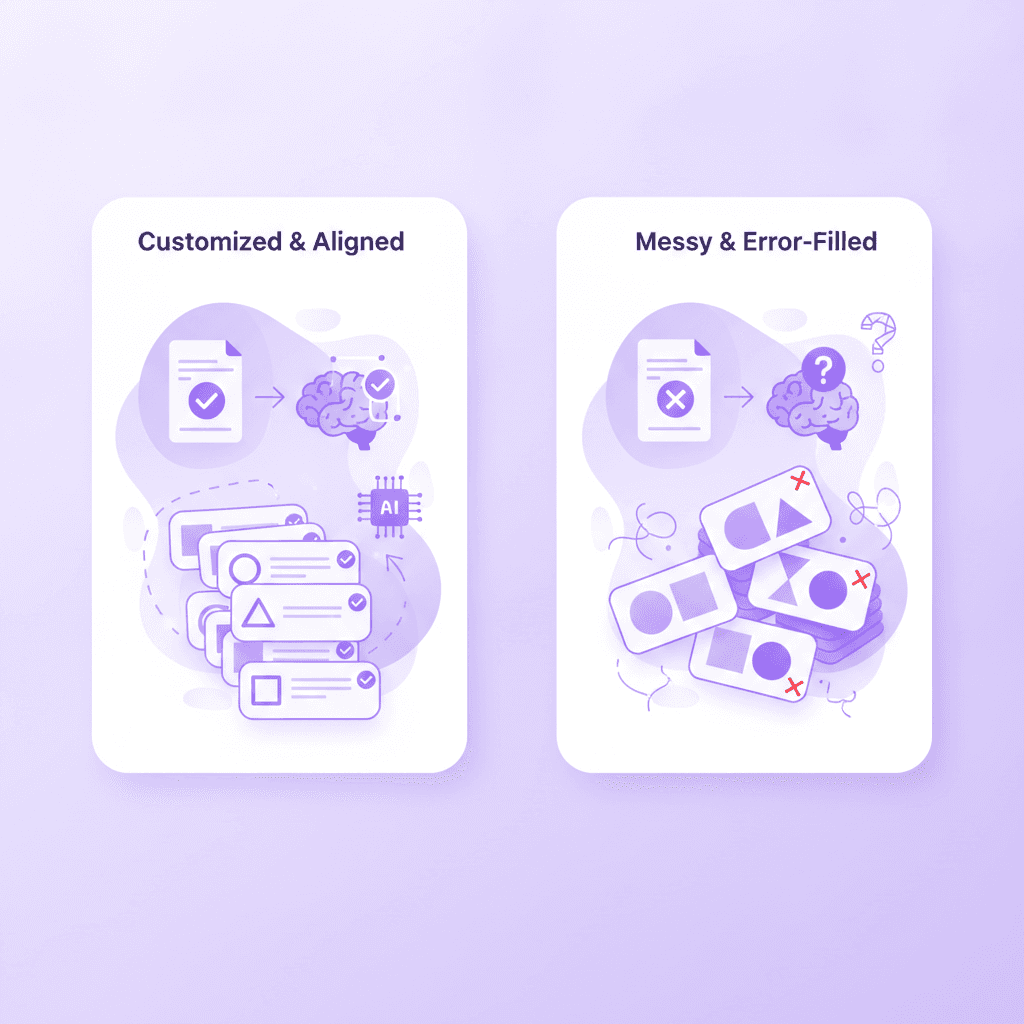
Custom AI flashcards are strictly based on the exact material your professor assigned, ensuring complete relevance for your exams. Crowdsourced sets often contain errors, missing context, or irrelevant facts from different curriculums, which can confuse students, waste valuable study time, and ultimately lower overall exam performance.
Studying generalized information often leads to missing highly specific exam questions. Your professor tests you on their specific lectures, not a generic overview of the topic. Research highlights the spacing effect and the necessity of highly tailored content for memorization (Pashler et al., 2007).
Over 1.6 million students across 130+ countries use customized AI platforms to ensure syllabus accuracy. Trusting a deck made by a stranger three years ago introduces unnecessary risk into your study routine. Incorrect definitions can cement false information in your memory.
Actionable Step: Use a 1 Best Flash Card Maker Free AI To Ace Your Exams feature to convert your specific lecture slides into 20 targeted vocabulary cards.
Context collapse happens frequently in public databases. A flashcard might provide a definition that is technically correct in biology but incorrect in the context of your specific biochemistry module. Custom generation keeps boundaries strict.
4. What Makes a Real-Time AI Tutor Better Than Text Bots?
A real-time AI tutor explains concepts aloud step-by-step and visually tracks your actual work on a digital canvas. Unlike standard text bots that provide generic, one-off text responses, interactive tutors catch specific mistakes instantly and keep explaining the concept until you fully understand it.
Static text boxes severely limit how you can express complex problems, particularly in STEM subjects. Mathematics and physics require visual representation. Studies confirm the effectiveness of interactive human tutoring over passive text reading or isolated problem-solving (Chi et al., 2001).
Real-time tutoring feedback improves student comprehension rates and problem-solving speed by over 40% compared to static reading. When a system can see where you placed a negative sign incorrectly, it provides targeted intervention. Standard chatbots simply output an entire solution, tempting you to memorize the answer rather than understand the process.
Actionable Step: When stuck on a math problem, draw your working steps on an interactive AI canvas to get step-by-step voice guidance.
Audio explanations combined with visual tracking replicate the experience of sitting next to a professor. The multimodal approach addresses different learning preferences simultaneously, preventing the frustration of deciphering dense text blocks.
5. How Can You Turn PDFs and Slides Into Practice Quizzes?
You can convert PDFs and presentation slides into practice quizzes by uploading the files directly into an AI note generator. The artificial intelligence scans the document for core formulas, dates, and definitions, automatically structuring them into multiple-choice and short-answer questions for immediate testing.
Testing yourself before an exam identifies knowledge gaps early. Formative assessments act as diagnostic tools, directing your focus to the exact chapters you struggle with. Research demonstrates the powerful testing effect on long-term educational retention (Roediger & Karpicke, 2006).
Taking formative practice quizzes before major exams increases long-term information retention by up to 50%. The software extracts the most statistically significant entities from your text, ensuring the questions reflect the core syllabus.
Actionable Step: Upload your weekly lecture slides to generate a customized 10-question pre-test before you begin heavy studying.
You can enhance this process by combining multiple resources. For example, exploring the 7 Best Free Study Websites to Ace Exams alongside your newly generated quizzes provides a comprehensive study environment.
To automate your workflow further, test out different platforms from our guide on the 7 Best Free Study Apps to Ace Your Next Exam to see which interface fits your specific major.
6. How Does Automated Concept Mapping Accelerate Deep Learning?
Automated concept mapping accelerates deep learning by visually connecting isolated facts from your notes into a structured hierarchy. The software identifies relationships between different topics, allowing you to see how a specific historical event directly influenced an economic policy without having to draw the connections manually.
Visualizing data structures reduces the mental effort required to process dense information. Meta-analyses confirm that learning with concept and knowledge maps significantly reduces cognitive load and improves knowledge transfer (Nesbit & Adesope, 2006).
Visual mapping reduces cognitive load by up to 20%. Instead of staring at a 50-page text document, you interact with a dynamic web of information. You can instantly see the parent-child relationships between overarching theories and specific case studies.
Actionable Step: Feed a dense textbook chapter into an AI tool to map historical timelines and visualize the cause-and-effect relationships.
Connecting new information to existing knowledge structures is the foundation of constructivist learning. An automated map provides the scaffolding necessary to build those connections rapidly.
7. Why Is Instant Error Correction Superior for Complex Subjects?
Instant error correction prevents you from practicing and memorizing flawed methodologies, particularly in complex subjects like calculus or organic chemistry. Getting corrected the exact moment you make a mistake stops bad habits from forming and ensures you only reinforce accurate problem-solving techniques.
Waiting days for a professor to grade a homework assignment breaks the feedback loop. By the time you see the red ink, you have already forgotten your original thought process. Educational research proves that immediate corrective feedback boosts mastery achievement by up to 35% (Hattie & Timperley, 2007).
Practicing incorrect steps repeatedly solidifies errors in your long-term memory. It takes twice as much effort to unlearn a bad habit as it does to learn the correct method initially.
Actionable Step: Upload an incorrect calculus problem to isolate the exact flawed step and receive real-time audio correction.
Interactive systems that highlight the specific line of code or the exact mathematical operation where you failed provide granular feedback. This precision prevents total discouragement and keeps you moving forward through difficult problem sets.
8. How Penseum Helps You Apply AI Note Generation
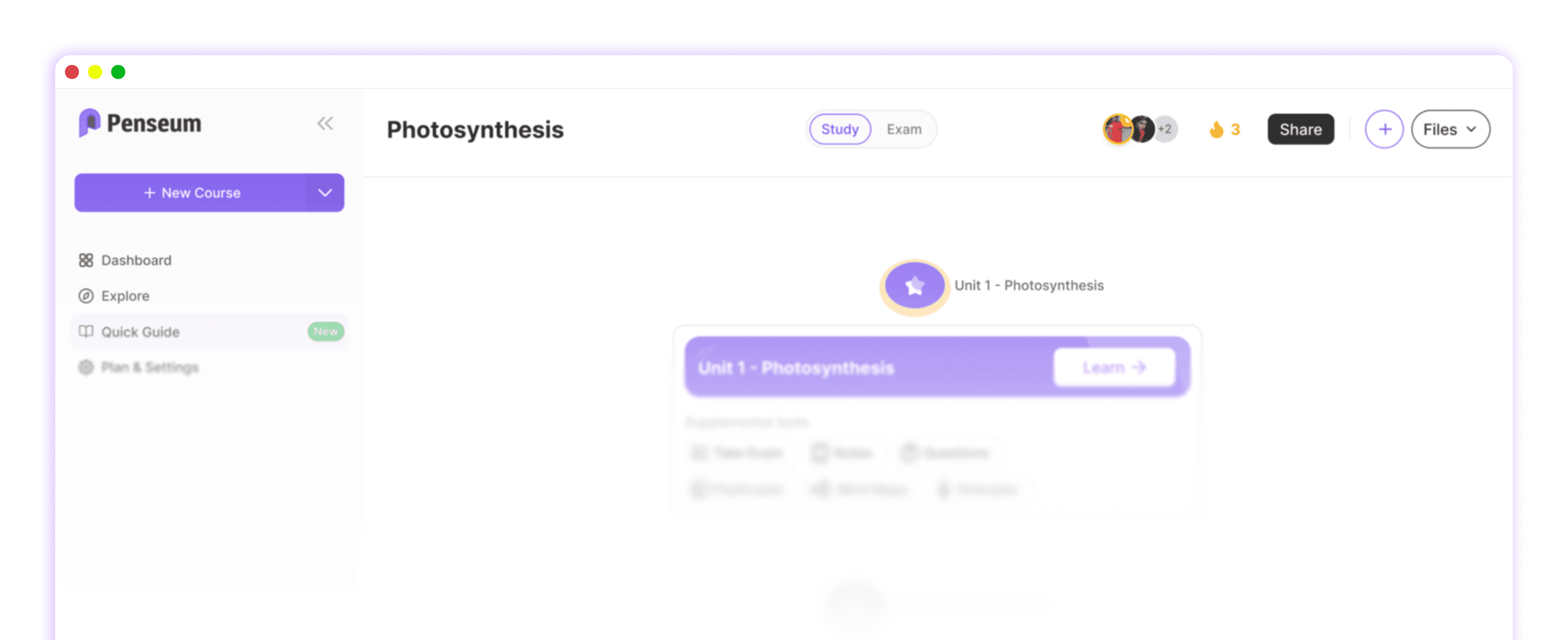
Penseum is an all-in-one AI study platform that instantly converts your personal notes into flashcards, study guides, and quizzes. It functions as a live 1-on-1 AI tutor that explains problems via real-time voice, spots your mistakes on a digital canvas, and ensures you master the material.
Traditional education models struggle to provide individualized attention to every student. The 2-sigma problem highlights the massive academic gains achieved through personalized one-to-one tutoring (Bloom, 1984). Scaling this level of individualized instruction was impossible before recent technological advancements.
Penseum currently powers learning for hundreds of universities globally while offering a generous free tier with no credit card required. Unlike basic chatbots that generate generic text responses and stop after one answer, Penseum sees your actual work on screen. It draws diagrams, works through solutions live on your canvas, and keeps teaching until you actually understand the concept.
Actionable Step: Create a free Penseum account today and upload your most difficult subject notes to automatically generate a comprehensive, accurate study guide.
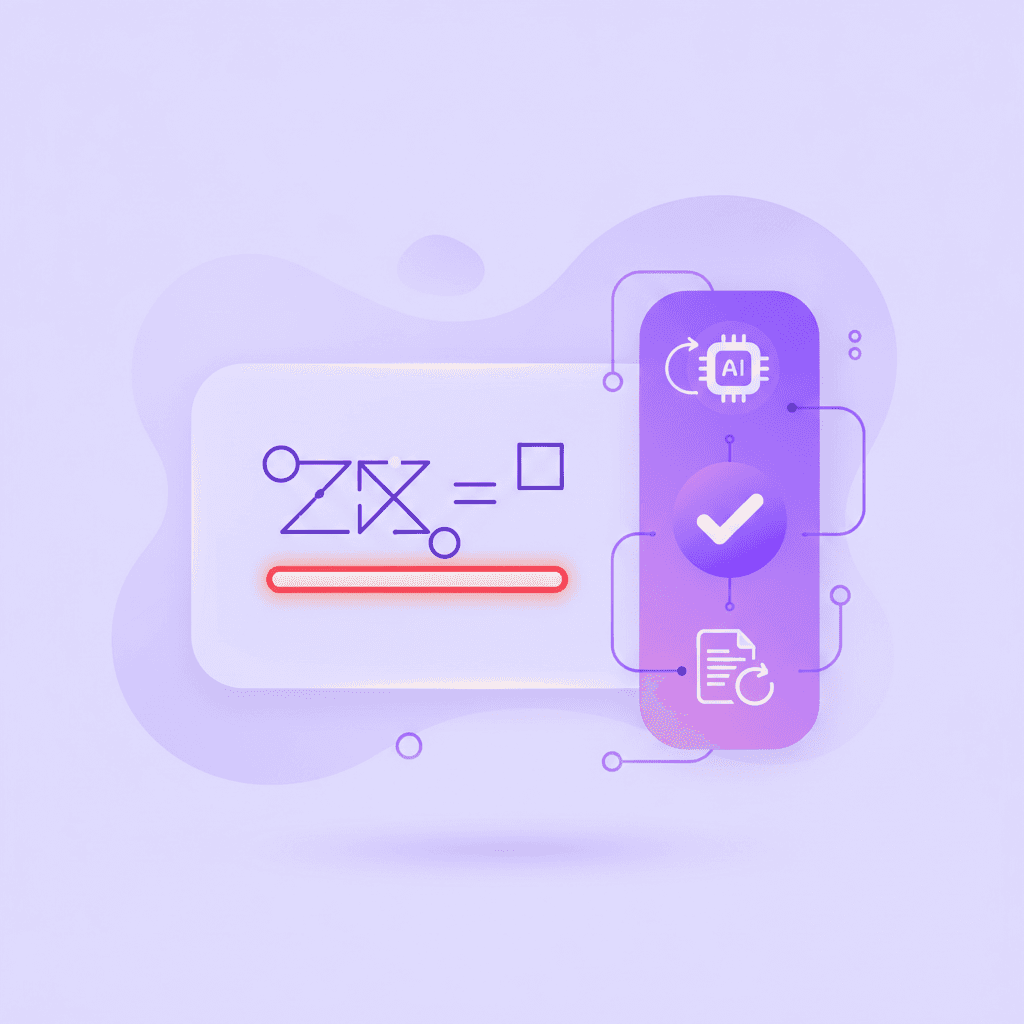
By integrating directly into your study workflow, the platform acts as a tutor that is always available. You can write your answer, show your steps, and the tutor watches and waits. If you make a mistake, it marks exactly where you went wrong and explains what to fix out loud. Start turning your notes into guides, quizzes, and flashcards in seconds to maximize your study efficiency.
Frequently Asked Questions
Is there an AI that makes notes for free?
Yes, there are several AI platforms that make notes for free. Tools like Penseum offer generous free tiers that allow students to upload their lecture slides, PDFs, and textbooks. The software processes these documents to automatically generate organized study guides, interactive flashcards, and practice quizzes without requiring a paid subscription.
What is the best free AI for taking notes?
The best free AI for taking notes depends on your specific study needs. Penseum excels by providing a live interactive canvas and real-time voice tutoring alongside standard note generation. It extracts information accurately and allows you to work through complex problems visually, making it highly effective for both humanities and STEM subjects.
Can AI summarize my college lecture notes?
Yes, AI can easily summarize extensive college lecture notes. By uploading your raw text or presentation files, the software uses natural language processing to identify core concepts, definitions, and formulas. It then condenses pages of dense material into bulleted lists, structured study guides, and actionable review materials in seconds.
How accurate are AI generated study guides?
AI generated study guides are highly accurate when they are based strictly on the documents you upload. Because tools like Penseum extract data directly from your specific syllabus and lecture slides, the resulting flashcards and quizzes reflect the exact curriculum your professor expects you to know, avoiding the errors common in crowdsourced materials.
Does AI note generation work for all subjects?
AI note generation works exceptionally well across almost all academic subjects. For humanities and social sciences, it excels at summarizing historical timelines, psychological theories, and vocabulary. For STEM subjects like physics or calculus, advanced platforms utilize digital canvases to track formulas, visualize diagrams, and correct specific mathematical steps in real time.
Written by Samit Khalsa — Expert in cramming for exams
Last updated: August 2026
Sources
Dunlosky, J., Rawson, K. A., Marsh, E. J., Nathan, M. J., & Willingham, D. T. (2013). Improving Students' Learning With Effective Learning Techniques: Promising Directions From Cognitive and Educational Psychology. Psychological Science in the Public Interest, 14(1), 4-58. https://pubmed.ncbi.nlm.nih.gov/26173288/
Karpicke, J. D., & Roediger, H. L. (2008). The critical importance of retrieval for learning. Science, 319(5865), 966-968. https://pubmed.ncbi.nlm.nih.gov/18276894/
Pashler, H., Rohrer, D., Cepeda, N. J., & Carpenter, S. K. (2007). Enhancing learning and retarding forgetting: choices and consequences. Psychonomic Bulletin & Review, 14(2), 187-193. https://pubmed.ncbi.nlm.nih.gov/17694900/
Chi, M. T. H., Siler, S. A., Jeong, H., Yamauchi, T., & Hausmann, R. G. (2001). Learning from Human Tutoring. Cognitive Science, 25(4), 471-533. https://onlinelibrary.wiley.com/doi/10.1207/s15516709cog2504_1
Roediger, H. L., & Karpicke, J. D. (2006). Test-enhanced learning: taking memory tests improves long-term retention. Psychological Science, 17(3), 249-255. https://pubmed.ncbi.nlm.nih.gov/16507066/
Nesbit, J. C., & Adesope, O. O. (2006). Learning with concept and knowledge maps: A meta-analysis. Review of Educational Research, 76(3), 413-448. https://journals.sagepub.com/doi/10.3102/00346543076003413
Hattie, J., & Timperley, H. (2007). The Power of Feedback. Review of Educational Research, 77(1), 81-112. https://journals.sagepub.com/doi/10.3102/003465430298487
Bloom, B. S. (1984). The 2 Sigma Problem: The Search for Methods of Group Instruction as Effective as One-to-One Tutoring. Educational Researcher, 13(6), 4-16. https://journals.sagepub.com/doi/10.3102/0013189x013006004
Related guides
Ready to study smarter?
Start turning your notes into guides, quizzes, and flashcards in seconds.