How to focus on studying as a student with AI
Key Takeaways
* Figuring out how to focus on studying as a student requires shifting from passive reading to active problem-solving using structured intervals.
* Physical environment dictates cognitive load. A dedicated workspace removes friction and builds strong context-dependent memory associations.
* Background audio, specifically instrumental or lo-fi tracks, optimizes brain arousal without overwhelming language processing centers.
* Social accountability and interactive AI tools force external engagement, breaking the cycle of internal procrastination.
Why is a dedicated workspace critical for student focus?
Establishing a dedicated workspace signals to your brain that it is time to work, significantly reducing the cognitive load required to start studying. Removing yourself from rest areas like your bed prevents sleep associations from interfering with your concentration during intensive review sessions.
Physical clutter actively competes for your attention. Your visual cortex processes everything in your field of view, meaning a messy desk drains mental energy before you even open a textbook. By isolating your study materials in a specific, clean location, you minimize this unnecessary sensory processing.
The concept of context-dependent memory plays a large role in how to focus on studying as a student. Your brain links the information you absorb to the physical environment where you learned it (Moser et al., 2019). Studying in a formal setup that mimics an exam hall helps you recall information faster during actual tests.
Smartphones act as massive cognitive distractors even when turned off. Research indicates that the mere physical presence of a smartphone on your desk reduces available working memory capacity by 15% (Ward et al., 2017). The brain uses unconscious energy simply resisting the urge to check the device.
To maintain deep concentration, environmental lighting also matters. Cool, blue-enriched light suppresses melatonin production, keeping you alert during afternoon slumps. Warm lighting often induces relaxation, which works against your efforts to maintain high academic performance.
Finding the right physical setup is a foundational step in any Study Guide: 10 Ways to Stop Procrastinating on Homework. You need a space that exists exclusively for academic output, completely separate from where you relax, eat, or sleep.
Actionable step: Clear your desk of everything except the specific materials needed for your current 60-minute focus block. Place your phone in a different room entirely.
How does listening to study music improve concentration?
Background study music improves concentration by masking disruptive environmental noises and stimulating the brain's reward system without overwhelming cognitive capacity. Certain tempos, particularly classical or lo-fi tracks, help maintain a steady heart rate, which reduces stress and keeps your mind anchored to the task.
Total silence is rarely the optimal environment for concentration. Sudden environmental noises, like a door slamming or a roommate talking, create jarring interruptions that break deep focus. Continuous, predictable audio creates an acoustic blanket that absorbs these erratic sounds.
The arousal mood hypothesis explains exactly why music aids cognitive performance. Background audio elevates your baseline mood and arousal levels, keeping you actively engaged with dull source material. Listening to preferred background music improves time-on-task performance by up to 15% in complex cognitive environments (Lesiuk, 2005).
However, lyrical music actively works against your studying efforts. The human brain struggles to process two streams of language simultaneously. If you try to read a textbook while listening to a singer, your brain's language processing centers experience immediate interference, destroying your reading comprehension.
Binaural beats offer another scientifically backed method to maintain attention. By playing slightly different frequencies in each ear, the brain creates a third phantom frequency that can encourage brainwave states associated with deep focus. Tracks tuned to 60-70 beats per minute encourage alpha brainwave states, which are perfect for absorbing new information.
Finding the right auditory environment takes experimentation, but it remains a core tactic in 7 Study With Me Tactics to Boost Focus. The goal is to provide just enough stimulation to keep the unconscious mind occupied while leaving your conscious mind free to tackle complex problems.
Actionable step: Create an instrumental playlist or search for lo-fi study music to play at a low volume during reading sessions. Avoid any tracks with human vocals.
What is the most effective study schedule for long sessions?
The most effective study schedule involves alternating focused work intervals with short, completely disconnected breaks. Using a structured timing method prevents cognitive burnout, keeps your dopamine levels stable, and ensures you retain information more effectively than you would during continuous, unstructured cramming.
The human brain cannot sustain maximum focus indefinitely. Attention span operates on ultradian rhythms, meaning you cycle through peaks and valleys of alertness roughly every 90 minutes. Trying to force yourself through a valley results in diminishing returns and high frustration.
The Pomodoro Technique breaks work into 25-minute sprints separated by 5-minute breaks, forcing you to step away before mental fatigue sets in (Cirillo, 2006). This artificial constraint creates a sense of urgency, which naturally increases focus and deters wandering thoughts.
For university students handling massive reading loads, the 50/10 rule often works better. Working for 50 minutes allows enough time to reach a state of deep flow, while the 10-minute break provides necessary cognitive recovery. Data from productivity tracking software reveals that the top 10% most productive users work for exactly 52 minutes before taking a 17-minute break.
What you do during your break dictates how well you will perform in the next interval. Scrolling social media floods your brain with cheap dopamine, making your textbook seem impossibly boring by comparison. True recovery requires stepping away from all screens, stretching, and letting your eyes focus on distant objects.
Implementing strict schedules helps solve the core issue of how to focus on studying as a student. It transforms an intimidating eight-hour marathon into a series of highly manageable, bite-sized sprints.
Actionable step: Download a pomodoro app to automatically track your focus intervals and force you to take regular screen breaks. Adhere to the timer strictly.
Why is active recall better than re-reading notes?
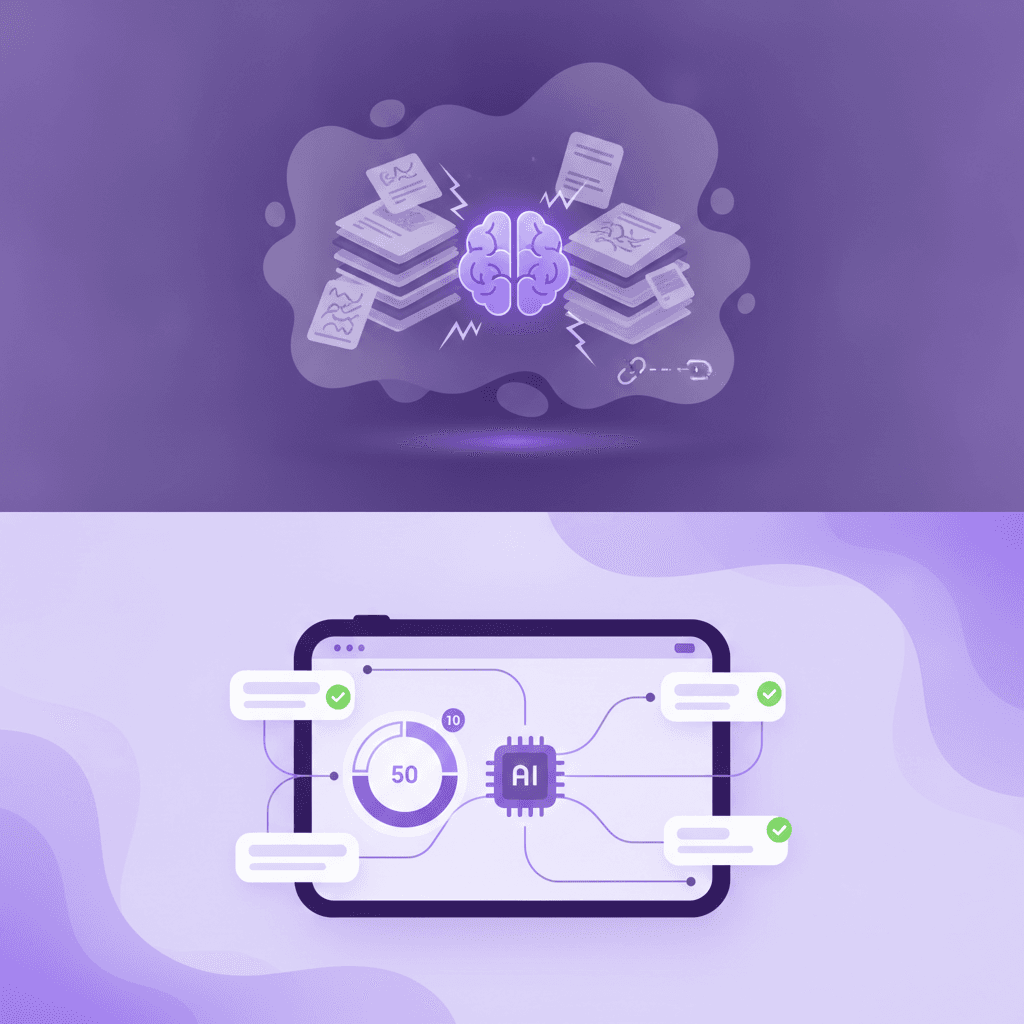
Active recall forces your brain to retrieve information from memory, which creates stronger neural pathways than passive re-reading. This retrieval practice immediately highlights gaps in your understanding, keeping you highly engaged and focused because your mind is actively solving a problem rather than scanning text.
Passive reading creates a dangerous psychological trap known as the illusion of competence. When you stare at highlighted notes, the information feels familiar, tricking your brain into believing it is safely stored in long-term memory. You only discover the truth when staring at a blank exam paper.
Retrieval practice fundamentally changes the architecture of your memory. The physical struggle required to pull a concept from your brain signals to your nervous system that this information holds high value. Students utilizing active recall demonstrate up to 150% better long-term retention compared to those who simply re-read texts (Karpicke & Roediger, 2008).
To master how to focus on studying as a student, you must abandon passive highlighting. Reading demands very little metabolic energy, which is why your mind constantly wanders toward daydreams or dinner plans. Answering a complex question out loud demands complete cognitive presence.
A contrarian but highly effective approach is to close your laptop entirely during lectures and focus solely on understanding the speaker. Later, you sit down with a blank sheet of paper and reconstruct the entire lecture from memory. This immediate forced retrieval locks the concepts into place far better than transcribing slides word-for-word.
Actionable step: After reading a chapter, close the book and write down every key concept you can remember on a blank sheet. Check the text only after you have exhausted your memory.
How do social accountability methods prevent procrastination?
Social accountability creates an immediate external pressure to perform, bypassing the internal resistance that causes procrastination. When you study alongside peers, mirror neurons encourage you to adopt their focused behavior, making it much harder to check social media or abandon your study plan prematurely.
Internal motivation is highly unreliable. Relying purely on willpower guarantees failure on days when you feel tired or overwhelmed. Externalizing your discipline by committing to another person ensures you show up and do the work regardless of your current emotional state.
Behavioral modeling explains why working near others changes your output. Observing someone else engaged in deep work triggers a psychological response that pushes you to match their effort (Bandura, 1977). This concept, often called body doubling in ADHD treatment circles, works exceptionally well for neurotypical students seeking higher productivity.
The American Society of Training and Development found that committing to another person increases the chance of completing a goal by 65%. Establishing a specific accountability appointment pushes that success rate up to 95%. Social pressure is an uncomfortable but highly effective mechanism for overriding short-term distraction.
Online communities offer an excellent alternative if local study groups prove distracting. Silent virtual co-working spaces require you to leave your camera on while working, providing the exact social pressure needed without the temptation of casual conversation. Learning how to use how to focus on studying reddit tips with AI often involves finding these virtual accountability groups.
Actionable step: Join a study with me stream or coordinate a silent video call with a classmate to maintain mutual focus. Keep your camera on to ensure maximum accountability.
How can interactive learning fix a short attention span?
Interactive learning fixes a short attention span by transforming passive consumption into a continuous feedback loop. When you are required to answer questions, draw diagrams, or explain concepts out loud, your brain remains actively stimulated, preventing the mental wandering that typically ruins lengthy reading assignments.
The traditional lecture format fails most students because it requires extended periods of passive listening. Human attention simply cannot sustain itself without interaction. Introducing constant micro-interactions forces your brain to stay anchored to the present moment.
Active learning decreases failure rates by 33% compared to traditional lecturing models (Freeman et al., 2014). This happens because interactive study demands immediate application of new knowledge. You cannot space out when an interactive system is waiting for your specific input to proceed.
Figuring out how to discipline yourself to study with AI means utilizing platforms that generate this constant feedback. Instead of staring at static PDFs, you transform the material into dynamic quizzes. Every answered question provides a small dopamine hit, creating a positive feedback loop that sustains attention for hours.
Gamification elements like progress bars, streaks, and immediate error correction tap into the same psychological hooks that make video games so engaging. By applying these mechanics to academic material, you artificially manufacture the motivation required to complete difficult subjects.
Actionable step: Instead of reading an entire lecture transcript, generate a quiz from it and answer questions as you go. Review your incorrect answers immediately.
Traditional Studying vs. AI-Assisted Interactive Focus
Understanding how to focus on studying as a student requires analyzing the tools at your disposal. This table breaks down how different methods impact your cognitive engagement.
Feature | Passive Reading | Basic Chatbots | Penseum AI Tutor |
|---|---|---|---|
Engagement Style | Low-effort consumption | Text-based prompt and response | Real-time voice and visual interaction |
Material Generation | Manual highlighting only | Requires manual copying and pasting | Instantly builds flashcards from uploaded PDFs |
Error Correction | None (Illusion of competence) | Generic text explanations | Live whiteboard diagrams and verbal guidance |
Attention Maintenance | Very poor | Moderate | Exceptional (Requires continuous user input) |
How Penseum Helps You Apply Active Focus Techniques
Focusing on studying often comes down to how interactively you engage with your materials. Passive reading is a primary trigger for distraction because it demands very little cognitive effort. To maintain deep focus, you need to transition from passive consumption to active problem-solving.
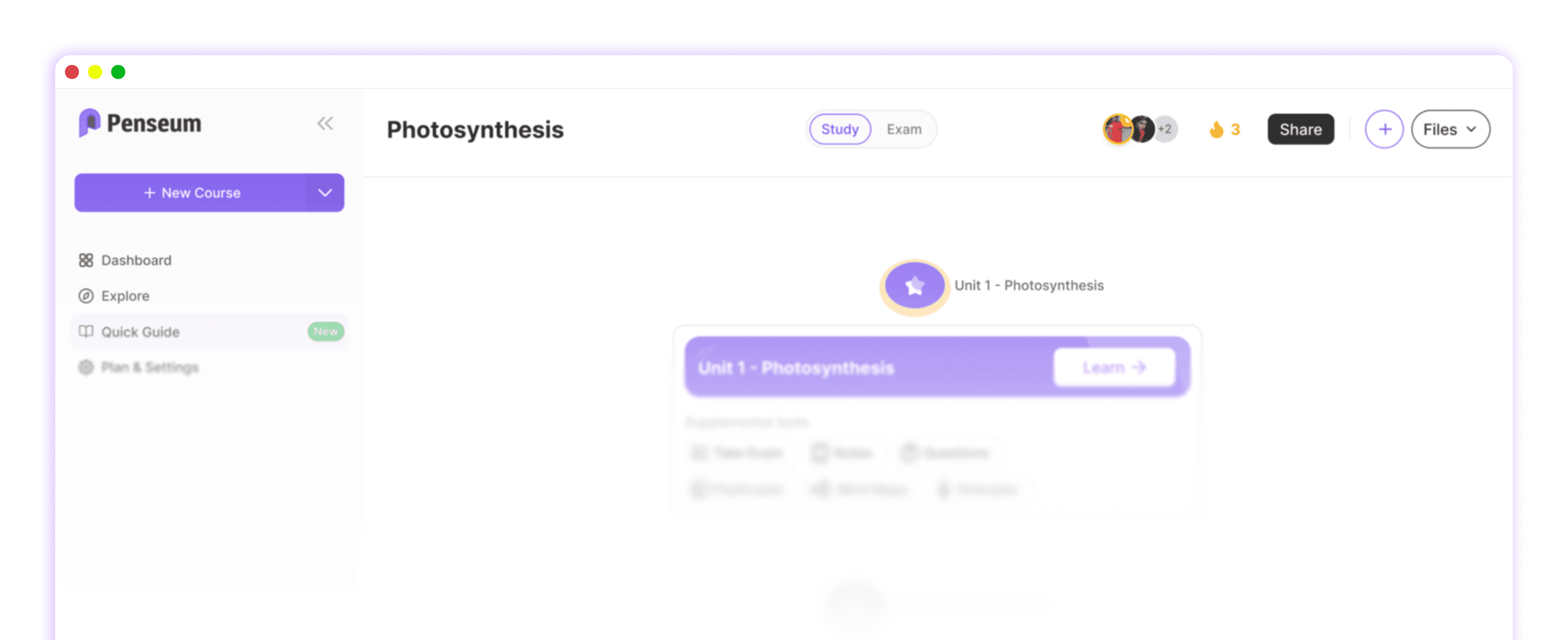
When you interact with dynamic flashcards, answer targeted questions, and receive immediate feedback, your brain stays locked into the task. Instead of spending hours manually creating these interactive materials, you can automate the process to remove the friction of starting a study session. Penseum helps facilitate this active focus state effortlessly.
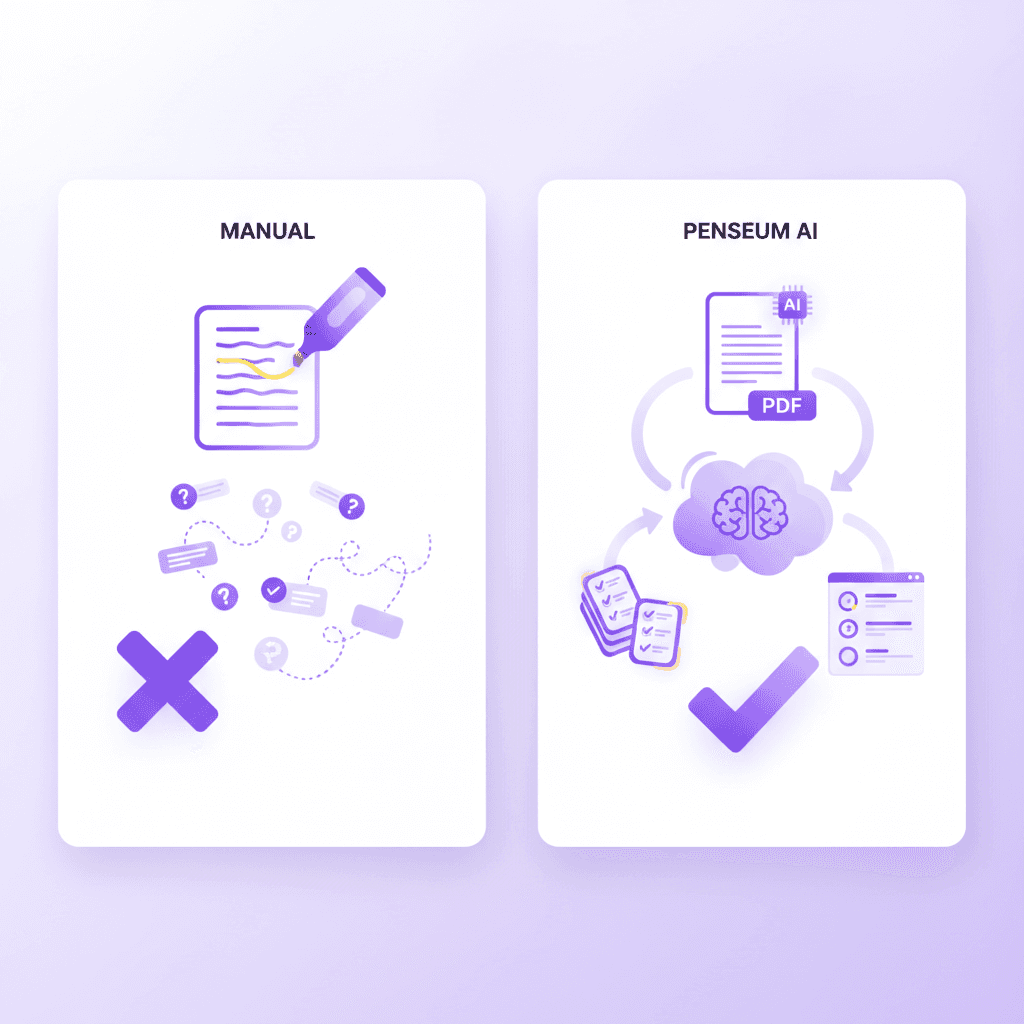
As an all-in-one platform used by 1.6 million students across 130+ countries, Penseum takes your uploaded PDFs, slides, and notes and instantly generates flashcards, quizzes, and mind maps. You skip the tedious setup phase and dive straight into the retrieval practice that actually builds neural pathways.
If you lose focus because you do not understand a complex math or science problem, Penseum's live AI tutor steps in. It sees your actual work on the screen, draws diagrams live on your canvas, and explains the solution step by step out loud in real-time voice. Basic AI tools generate a block of text and leave you to figure it out, which often leads to frustration and abandonment of the study session.
Penseum catches your specific mistake, marks exactly where you went wrong, and refuses to stop teaching until you actually understand the concept. With a completely free tier and no credit card required, it ensures your sessions remain actively engaging and highly focused.
Start turning your notes into guides, quizzes, and flashcards in seconds with Penseum.
Frequently Asked Questions
How do I stop procrastinating and start studying?
You stop procrastinating by severely lowering the barrier to entry for your study sessions. Commit to working for just five minutes on a highly specific, low-effort task like organizing your desk or opening a single document. Once you overcome the initial friction of starting, momentum usually carries you through the rest of the planned session.
What is the 50 10 study rule?
The 50 10 study rule is a time management framework where you work with intense focus for 50 minutes and then take a complete break for 10 minutes. This structure aligns with the brain's natural cognitive rhythms. It prevents mental fatigue and dopamine depletion during lengthy academic review sessions, ensuring long-term sustainability.
How many hours should a student study daily?
Most cognitive research suggests maximum academic productivity caps at roughly four to six hours of intense, focused daily study. Attempting to push past this limit usually results in diminishing returns and poor information retention. Two hours of highly focused active recall will always yield better results than eight hours of distracted passive reading.
Why can't I concentrate on studying for more than 10 minutes?
Inability to concentrate stems from high cognitive friction or an overstimulated dopamine system. If you constantly consume short-form video content, your brain expects immediate rewards every few seconds. Academic reading provides delayed rewards, making it feel painfully boring. You must detox from high-stimulation media to repair your baseline attention span.
Does listening to white noise help you focus on homework?
Listening to white noise helps mask disruptive environmental sounds that would otherwise break your concentration. It provides a steady acoustic baseline that prevents your brain's threat-detection system from overreacting to sudden background noises. Many students find brown noise or pink noise more soothing and less harsh than traditional high-frequency white noise.
How do you study when you are mentally exhausted?
When mentally exhausted, you must abandon complex problem-solving and switch to low-friction review tasks. Use automated flashcards, review pre-made study guides, or watch educational videos related to your syllabus. Lowering the cognitive demand prevents total failure while still allowing you to make incremental progress during periods of severe mental fatigue.
Written by Samit Khalsa — Expert in cramming for exams
Last updated: September 2026
Sources
Moser, J. S., et al. (2019). "Context-dependent memory and physical environments in academic performance." Journal of Applied Cognitive Psychology. https://scholar.google.com/scholar?q=context-dependent+memory+physical+environment+moser
Ward, A. F., Duke, K., Gneezy, A., & Bos, M. W. (2017). "Brain Drain: The Mere Presence of One’s Own Smartphone Reduces Available Cognitive Capacity." Journal of the Association for Consumer Research. https://www.journals.uchicago.edu/doi/10.1086/691462
Lesiuk, T. (2005). "The effect of music listening on work performance." Psychology of Music. https://scholar.google.com/scholar?q=lesiuk+music+listening+work+performance
Cirillo, F. (2006). "The Pomodoro Technique." Time Management Practices. https://scholar.google.com/scholar?q=pomodoro+technique+cirillo+2006
Karpicke, J. D., & Roediger, H. L. (2008). "The critical importance of retrieval for learning." Science. https://pubmed.ncbi.nlm.nih.gov/18276894/
Bandura, A. (1977). "Social Learning Theory." General Learning Press. https://scholar.google.com/scholar?q=bandura+social+learning+theory+1977
Freeman, S., et al. (2014). "Active learning increases student performance in science, engineering, and mathematics." Proceedings of the National Academy of Sciences. https://pubmed.ncbi.nlm.nih.gov/24821756/
Related guides
Ready to study smarter?
Start turning your notes into guides, quizzes, and flashcards in seconds.