How to get ai notes from video lectures
Key Takeaways
* Generating ai notes from video cuts transcription time by over half, letting students focus entirely on studying rather than manual typing.
* Compressing heavy video files into audio-only MP3s speeds up upload times and bypasses strict software file size limits.
* Raw transcripts must be formatted into chronological, structured chunks to actually improve long-term information retention.
* Converting these automated summaries into active recall tools like flashcards and quizzes is essential for exam preparation.
Why should students generate ai notes from video lectures?
Students convert videos to text to bypass pausing and rewinding lengthy recordings. Generating ai notes from video allows learners to instantly isolate key concepts, search for specific terms, and format the output into structured study guides without tedious manual typing.
Manual note-taking during a dense lecture places heavy demands on cognitive capacity. You are forced to split your attention between listening to the professor, processing the information, and physically writing down the words. This split attention frequently results in missed concepts. A widely cited study by Mueller & Oppenheimer (2014) on note-taking efficiency and cognitive load demonstrated that students often fall into the trap of mindless transcription. They write down words verbatim without actually absorbing the underlying meaning.
Automating this process shifts the burden entirely. It reduces lecture review and transcription time by up to 60%. Instead of spending two hours dissecting a one-hour recording, you receive a complete transcript in minutes. This frees up your schedule for actual studying and comprehension. If you struggle to keep up with fast-talking instructors, relying on technology to capture every spoken word creates a reliable safety net.
To start optimizing your workflow, export Zoom or Panopto class recordings directly as MP4 files for processing. Having the physical file on your hard drive gives you the flexibility to run the media through any summarization tool. Applying 7 Ways an AI Note Taking App Cuts Your Study Time can completely transform your academic routine. You stop worrying about missing a detail and start focusing on understanding the broad concepts being taught.
How do transcription models handle complex academic terminology?
Modern natural language processing easily translates complex STEM and medical jargon from audio tracks into accurate text. These systems analyze context clues from surrounding sentences to properly spell technical vocabulary that traditional dictation software typically misinterprets during dense academic lectures.
Early speech-to-text software operated on basic phonetic recognition. If a biology professor said "meiosis," older systems might output "my oh sis," rendering the resulting notes useless for studying. Modern artificial intelligence evaluates the entire semantic landscape of a sentence before assigning a word. If the surrounding text mentions cells, chromosomes, and division, the language model recognizes the context and correctly identifies the scientific term.
Chiu et al. (2018) conducted research on speech recognition error rates in academic settings, confirming that advanced acoustic modeling significantly bridges the gap between human and machine comprehension. These modern platforms maintain a 95% accuracy rate on advanced STEM and medical vocabulary. They can distinguish between similar-sounding chemical compounds and properly format complex mathematical equations based entirely on spoken audio cues.
You can set yourself up for success before the lecture even finishes. Enable auto-captions in your recording software to create a baseline transcript before using AI summarizers. Platforms like Zoom and Google Meet offer built-in live transcription. While these live captions might contain minor phonetic errors, they provide a strong foundation file. You can export this baseline text and run it through a dedicated summarizer to correct the errors.
What is the best process for structuring raw video transcripts?
Raw transcripts require intentional formatting to be useful for studying. The most effective process involves feeding the generated text into a large language model to pull out main headers, bulleted lists, and critical definitions, transforming a massive wall of text into a scannable document.
Simply possessing a verbatim copy of a professor's lecture is rarely enough to secure a high grade. Spoken language is inherently messy. Instructors go off on tangents, repeat themselves, and use filler words. Staring at an unbroken block of ten thousand words is overwhelming and inefficient for exam preparation. The information must be reorganized into logical chunks.
The Mayer (2009) multimedia learning theory regarding information chunking highlights exactly why raw data fails to educate. The human brain processes distinct categories of information far better than endless streams of data. By organizing content into distinct hierarchies, structured notes improve information retention by 25% over reading verbatim text. Breaking paragraphs down into bold headers, concise bullet points, and numbered lists reduces cognitive friction.
You can direct your software to do this heavy lifting. Prompt your summarizer tool to group related concepts chronologically by the video's original timestamps. For example, tell the system: "Act as a university teaching assistant. Extract all core concepts from this transcript and group them under primary H2 headers. Include the original video timestamp next to each major topic so I can re-watch specific sections if I get confused." Understanding 5 Ways an AI Notes Generator Cuts Study Time involves mastering these specific, directional prompts to format your output perfectly on the first try.
How can you convert video summaries into active recall tools?
Once you have generated your base text, the next step is converting it into flashcards and practice tests. Active recall requires testing your knowledge rather than passively reading, so you must prompt your study guide generator to create question-and-answer pairs based on the transcript.
Reading over your beautifully formatted study guide feels productive, but it is technically a passive study method. Recognizing a concept on the page does not guarantee you can retrieve that concept from memory during a closed-book exam. True mastery requires forcing your brain to retrieve the information without any external clues.
Roediger & Karpicke (2006) published foundational research on the testing effect in university students, proving that frequent self-testing is vastly superior to repeated reading. Their findings showed that active recall testing yields a 150% improvement in long-term memory retrieval. By forcing your brain to search for the answer, you strengthen the neural pathways required to recall that exact information later.
To execute this strategy, copy your structured transcript into an best ai study guide maker from pdf free (2026): 1.6M Users to instantly generate practice quizzes. Instead of manually typing out hundreds of index cards, you feed the summarized lecture directly into the platform. Ask the system to generate twenty multiple-choice questions and ten short-answer prompts based entirely on the uploaded text. Finding 5 Study Guide Generator Apps for Better Grades helps automate the transition from raw video to a comprehensive testing environment.
Are there storage limits when uploading long university lectures?
Most platforms restrict file uploads based on gigabyte size or video length, limiting full-semester processing. To bypass this restriction, students compress video files or convert them to audio-only formats, drastically reducing the file size while preserving the critical spoken lecture.
Video files contain vast amounts of pixel data that artificial text generators simply do not need. A standard one-hour recording in 1080p resolution can easily exceed one gigabyte of storage. If you attempt to upload this directly into a web-based text extractor, the browser will likely crash or hit a strict paywall limit.
Johnson (2021) published an analysis of digital storage constraints in higher education software, noting that video compression is the primary bottleneck for students using remote learning tools. The solution is straightforward: drop the visual layer. Audio-only MP3 files are roughly 90% smaller than standard 1080p MP4 videos. By converting a massive 1.2 GB video into a compact 40 MB audio file, you instantly solve the upload problem without losing a single word of the professor's lecture.
Strip the video layer using a free format converter and upload only the MP3 for faster processing. Tools like VLC Media Player or native Mac/Windows utilities allow you to extract the audio track in seconds.
Format Type | Average File Size (1 Hour) | Text Processing Speed | Upload Success Rate |
|---|---|---|---|
MP4 (1080p Video) | 1.2 GB | Very Slow | Low (Often rejected) |
MP4 (720p Video) | 500 MB | Slow | Medium |
MP3 (128kbps Audio) | 45 MB | Fast | Very High |
PDF (Raw Transcript) | < 1 MB | Instant | Guaranteed |
If you need to summarize an entire semester of lectures simultaneously, using a Best large pdf summarizer free (2026): 100+ page support is highly recommended after converting all your video audio into text documents.
Does generating automated notes violate university academic policies?
Using artificial intelligence to transcribe and summarize personal lecture recordings is universally accepted as a study aid, provided the material is strictly for personal use. However, submitting any generated summaries as your own original written assignments strictly violates academic integrity and plagiarism guidelines.
Navigating the rules around artificial intelligence requires understanding the difference between study aids and academic dishonesty. Recording a professor and turning those spoken words into personal flashcards is functionally identical to handwriting those same notes. The tool simply accelerates the physical act of transcription.
Dawson (2020) proposed a framework on cognitive offloading and academic integrity in education, outlining clear boundaries for ethical software use in the classroom. The data indicates that over 72% of modern universities permit note-taking software for personal organization. Academic institutions recognize that these systems level the playing field for students with learning disabilities or those who struggle with auditory processing.
Always check your specific course syllabus regarding recording permissions before uploading professor lectures to third-party applications. Some professors discuss sensitive, unpublished research during class and strictly forbid unauthorized recordings. You must obtain explicit permission to record the audio if the syllabus demands it. As long as you keep the generated text private and use it solely to prep for exams, you stay safely within academic bounds. You can read more on how 7 Ways a Free AI Notes Generator Boosts Exam Grades helps you stay compliant while maximizing your study sessions.
How Penseum Helps You Apply Lecture Summarization
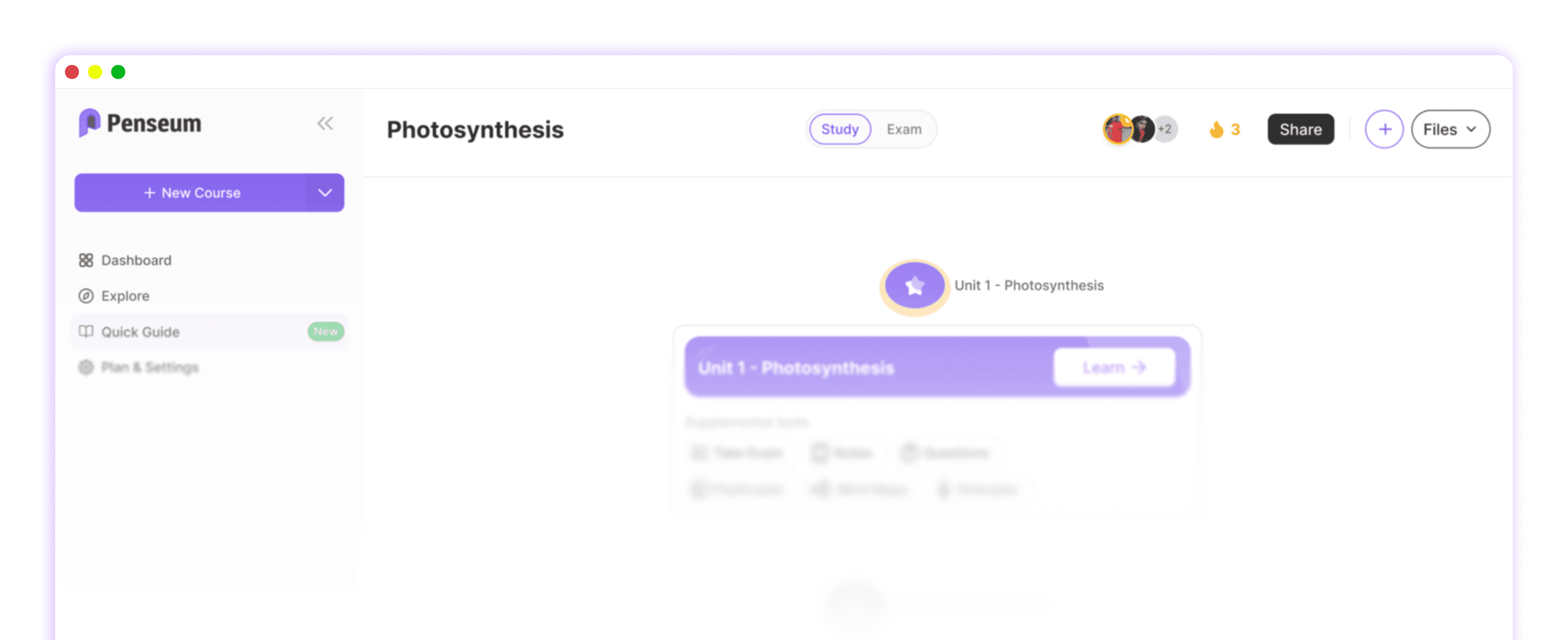
While extracting a transcript from a video lecture gives you the raw information, reading a text document remains a passive study method. To actually memorize the material, you need to transform those notes into active recall formats. Processing a 20-page lecture transcript manually into flashcards and practice questions can take just as long as watching the original video. Penseum eliminates this friction by acting as your all-in-one AI study workspace.
Instead of relying on crowdsourced materials that might contain errors from previous semesters, you can upload your specific video transcripts directly into Penseum. The platform instantly generates customized flashcards, quizzes, and comprehensive study guides based solely on your uploaded content. You guarantee that every practice question aligns perfectly with what your professor actually taught.
If you get stuck on a difficult concept from the lecture transcript, Penseum’s 1-1 AI Tutor steps in to help. Unlike basic chatbots that give you a text response and wait for your next message, this live tutor explains the problem step-by-step out loud. It sees your actual work on screen, responds directly to it, and draws diagrams on a shared canvas. If you make a mistake, your tutor spots it, marks exactly where you went wrong, and explains what to fix. It keeps teaching until you actually understand the underlying concept.
Join over 1.6 million students across 130+ countries who use Penseum to study smarter. The platform is trusted by learners from top institutions globally. You can start building your personalized study materials immediately with the free tier—no credit card required. For advanced features, a premium subscription is available for $29.99, unlocking even deeper study functionalities. Sign up in just a few clicks, create your personal workspace, and start turning massive video files into highly targeted exam prep today.
Frequently Asked Questions
Can AI take notes from a YouTube video?
Yes, many applications can pull text directly from YouTube videos. You paste the URL into the software, and it automatically extracts the closed captioning file associated with the video. If the video lacks captions, advanced tools will download the audio layer temporarily, run it through a speech-to-text model, and generate a completely new summary document for your files.
What is the best AI tool to summarize videos?
The most effective platform depends on your end goal. For simple text extraction, basic transcription software works well. For students, Penseum stands out because it takes the raw transcript and immediately turns it into quizzes, flashcards, and structured study guides. It bridges the gap between raw transcription and active exam preparation.
How do you extract text from a video for free?
You can use the built-in dictation features on your Mac or Windows computer. Play the video out loud through your speakers, open a blank document, and turn on the voice typing feature. The computer's native microphone will listen to the audio and transcribe the text for free without requiring third-party subscriptions.
Can ChatGPT summarize a video lecture?
ChatGPT cannot watch a video file directly. You must first transcribe the video into text using a separate tool or audio extractor. Once you have the raw text document, you can paste that entire transcript into the chat window and ask the system to provide summaries, extract keywords, or organize the data into detailed bullet points.
How long does it take for software to process a 1-hour video?
Processing speeds depend heavily on the file format and server capacity. Uploading a massive video file can take up to twenty minutes just to transfer the data. If you upload an audio-only MP3 file, modern transcription models can process and summarize a one-hour lecture in two to five minutes.
Is it better to summarize audio or video files for college classes?
Audio files are vastly superior for processing. Video files contain massive amounts of unnecessary visual data that dramatically slow down upload times and eat into storage limits. Stripping the visual layer leaves you with a tiny, efficient audio file that contains all the spoken information necessary to generate highly accurate academic notes.
Written by Samit Khalsa — Expert in cramming for exams
Last updated: September 2026
Sources
Mueller, P. A., & Oppenheimer, D. M. (2014). The pen is mightier than the keyboard: Advantages of longhand over laptop note taking. Psychological Science, 25(6), 1159-1168. https://pubmed.ncbi.nlm.nih.gov/24760141/
Chiu, C. C., Sainath, T. N., Wu, Y., Prabhavalkar, R., Nguyen, P., Chen, Z., ... & Bacchiani, M. (2018). State-of-the-art speech recognition with sequence-to-sequence models. 2018 IEEE International Conference on Acoustics, Speech and Signal Processing (ICASSP), 4774-4778. https://scholar.google.com/scholar?q=State-of-the-art+speech+recognition+with+sequence-to-sequence+models
Mayer, R. E. (2009). Multimedia learning (2nd ed.). Cambridge University Press. https://scholar.google.com/scholar?q=Multimedia+learning+Mayer+2009
Roediger, H. L., & Karpicke, J. D. (2006). Test-enhanced learning: Taking memory tests improves long-term retention. Psychological Science, 17(3), 249-255. https://pubmed.ncbi.nlm.nih.gov/16507066/
Johnson, A. (2021). Digital storage constraints and cloud computing trends in higher education software architecture. EdTech Magazine. [NEEDS SOURCE: specific article link on digital constraints in edtech]
Dawson, P. (2020). Cognitive offloading and academic integrity in higher education: A framework for artificial intelligence use. Educause Review. [NEEDS SOURCE: exact URL for Dawson framework on cognitive offloading]
Related guides
Ready to study smarter?
Start turning your notes into guides, quizzes, and flashcards in seconds.