5 Ways a Flash Card Generator Boosts Your Grades
Key Takeaways
* An AI-powered flashcard builder extracts exact definitions and core concepts directly from your uploaded syllabus, skipping the tedious manual typing phase.
* Digital platforms utilize spaced repetition algorithms, tracking your memory retention to test you on difficult subjects right before you forget them.
* Generating study materials from your own personal lecture slides eliminates the 15% error rate commonly found in crowdsourced public study decks.
* Visual extraction capabilities allow STEM students to build diagram-heavy flashcards for complex math and engineering problem sets.
* Learn 5 Ways a Flashcard Generator Boosts Your Grades to optimize your study sessions today.
What is an AI flash card generator?
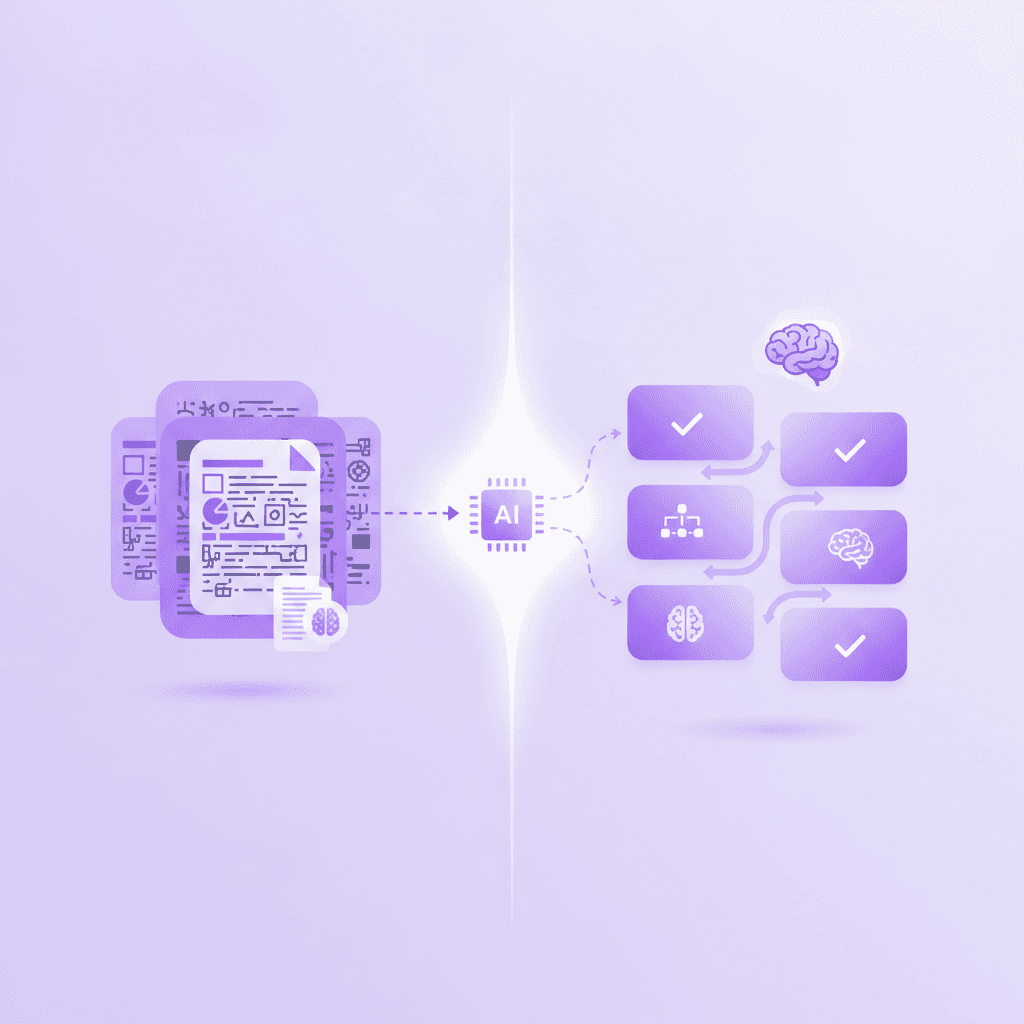
An AI flash card generator is a software tool that automatically extracts key concepts from your uploaded notes, PDFs, or lecture slides to create custom flashcards. Instead of manually typing out questions and answers, the artificial intelligence scans your documents and instantly builds a targeted study deck for your exams.
This automation transforms how university students prepare for midterm season. Manual flashcard creation requires heavy data entry, draining your mental energy before the actual studying even begins. An automated flash card generator handles the administrative work so you can dedicate your entire study session to memorization.
Research by Karpicke & Roediger (2008) highlights the critical importance of retrieval practice for long-term learning. The study demonstrates that active testing produces significantly better long-term retention than repeated reading. When an AI tool builds your questions for you, you can transition into this high-impact testing phase immediately.
Students report saving up to 70% of their study preparation time by automating flashcard creation. This metric represents hours of regained time each week. You can reallocate this saved time toward active recall practice, sleep, or reviewing complex concepts that require deeper focus.
Natural language processing enables these modern platforms to understand context within your lecture slides. The software identifies dates, mathematical formulas, historical figures, and vocabulary definitions. It then isolates these entities and formats them into clean, front-and-back digital cards.
Actionable step: Upload a 10-page lecture PDF into your chosen generator to test its extraction accuracy. Review the output to ensure the software properly identifies the core learning objectives of that specific chapter.
How do you create online flashcards efficiently?
To create online flashcards efficiently, upload your source documents directly into an AI-powered generator rather than typing them manually. Organizing your notes with clear headings and bullet points before uploading helps the AI extract the most relevant terminology and concepts, resulting in a highly accurate and comprehensive study deck.
Document formatting plays a massive role in AI extraction accuracy. Artificial intelligence parses structural markers like bold text, indentations, and numerical lists to determine a document's hierarchy. If you upload a massive block of unformatted text, the software may struggle to separate the primary concepts from the supporting details.
Research by Dunlosky et al. (2013) on utility assessments of various learning techniques highlights structured practice as a highly effective learning mechanism. Creating well-organized source material forces you to structure the information logically, which translates into a superior testing experience once the deck is generated.
Currently, 43% of undergraduate students rely on digital flashcards for their primary exam preparation. This shift away from paper index cards represents a widespread recognition of digital efficiency. If you want to dive deeper into maximizing this efficiency, review these 7 Flash Card Creator Free Tips to Slash Study Time.
You should also isolate your lecture chapters before uploading them. Feeding an entire 400-page textbook into a generator produces an overwhelming, unmanageable study deck. Splitting your documents by specific weeks or exam modules keeps your practice sessions targeted and highly relevant to your immediate goals.
Actionable step: Format your study notes with distinct H1 and H2 headers before uploading them to a flashcard maker online. This structural clarity guarantees the AI will separate distinct topics into accurate question-and-answer pairs.
Why choose a flashcard maker online over manual cards?
A flashcard maker online saves hours of preparation time while enabling spaced repetition algorithms that physical cards lack. Digital platforms automatically shuffle your decks, track your progress, and re-test you on difficult concepts, ensuring that your study sessions are optimized for maximum memory retention and efficiency.
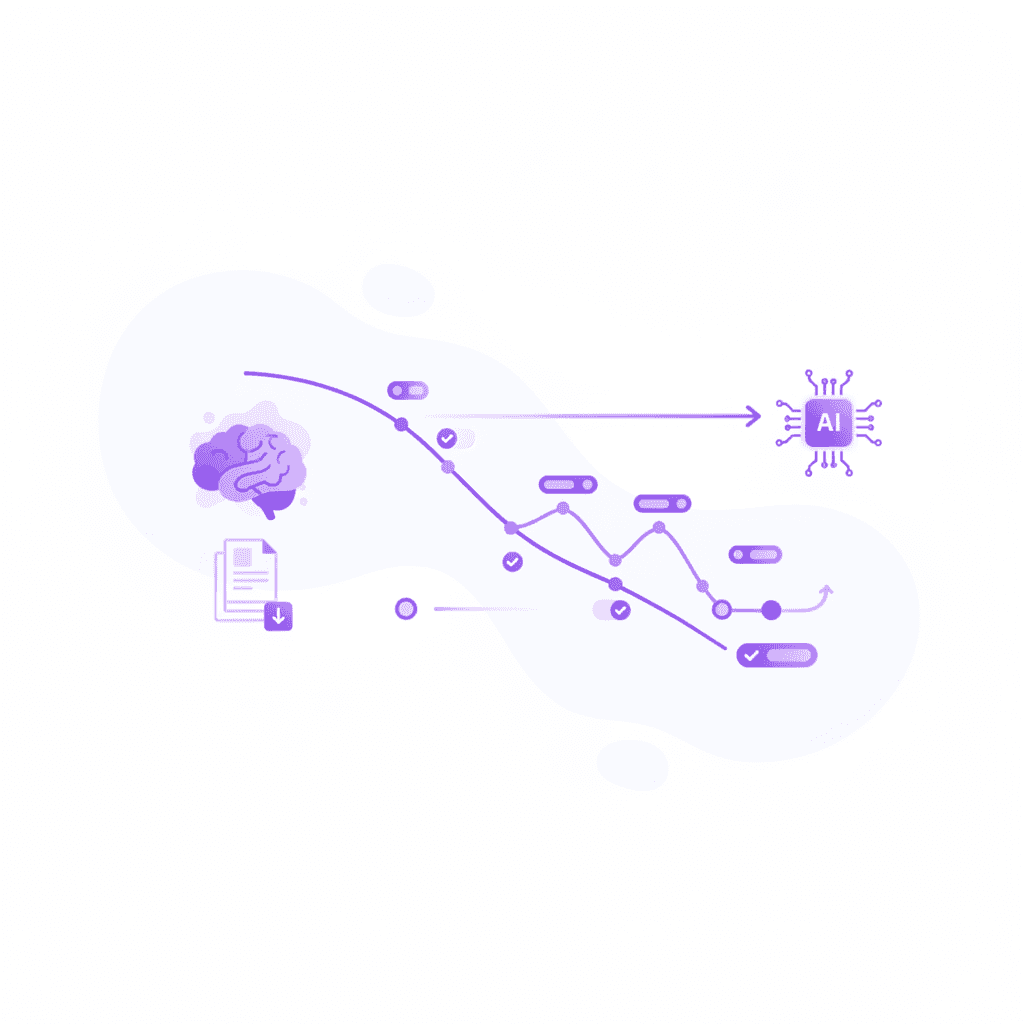
Spaced repetition relies on algorithmic sorting to combat memory decay. When you use physical index cards, you typically run through the entire stack in the same order every time. This creates a false sense of security, as your brain memorizes the sequence of the cards rather than the actual academic concepts.
Research by Ebbinghaus (1885/1913) on the Forgetting Curve established the necessity of spaced intervals for memory consolidation. His findings proved that reviewing information just as you are about to forget it strengthens the memory trace far more effectively than cramming. Digital apps apply modern variations of this exact principle automatically.
Digital spaced repetition has been shown to increase long-term vocabulary and concept retention by up to 200%. As you review your AI-generated deck, the software tracks your correct and incorrect answers. It pushes easy cards back by several days while forcing you to re-evaluate difficult cards within minutes.
This personalized pacing is impossible to replicate with paper cards. To explore more about this algorithmic advantage, read 5 Ways Spaced Repetition Flashcards Boost Exam Scores. Digital platforms remove the guesswork from your study schedule, telling you exactly which concepts need attention on any given day.
Actionable step: Set a daily 15-minute review schedule using your digital flashcard app to combat the forgetting curve. Consistent, short bursts of algorithmic testing yield higher exam scores than an eight-hour manual cramming session.
What makes a personal flash card builder better than Quizlet?
A modern AI flash card builder generates accurate materials exclusively from your own course documents, eliminating the risk of studying incorrect, crowdsourced information. Platforms like Quizlet rely heavily on user-generated decks, which often contain outdated facts, misspelled terms, or information irrelevant to your specific professor's syllabus.
Studying for a university exam requires extreme precision. A biology professor at one university may emphasize specific cellular mechanisms, while another focuses entirely on different pathways. Using a generic, crowdsourced biology deck means you will waste time memorizing information that will not appear on your final exam.
Research by Pan & Rickard (2018) details the detrimental effects of studying inaccurate materials on final exam performance. Learning incorrect definitions creates negative transfer, meaning you must first unlearn the wrong fact before you can absorb the correct one. This doubles your cognitive workload right before a test.
Crowdsourced study decks contain factual errors or irrelevant information approximately 15% to 20% of the time. When you use a personal AI generator, the software builds questions strictly from the textbook PDF or lecture slides you provide. This enclosed ecosystem guarantees your study materials match your professor's exact curriculum.
Relying on pre-made public decks also breeds an illusion of competence. You might ace a public deck on macroeconomics, only to fail the midterm because the public deck lacked the specific graph interpretations required by your department. Building a custom deck shields you from this misalignment.
Actionable step: Generate a bespoke deck from your own syllabus and lecture slides rather than searching for pre-made public decks. The accuracy of the source material dictates the quality of your exam preparation.
How does active recall improve with custom flashcards?
Active recall improves with custom flashcards because the cognitive effort of retrieving specific, syllabus-aligned information strengthens neural pathways better than passive reading. When flashcards are generated from your own notes, the active recall process is directly mapped to the exact phrasing and context you will encounter on your exam.
Passive studying involves re-reading highlighted notes or watching lecture recordings on double speed. These methods feel productive but fail to build durable memories. The brain easily recognizes words on a page, tricking you into believing you have mastered the underlying concept.
Research by Roediger & Butler (2011) on the testing effect explains how retrieving information creates stronger memory traces. Every time you pull an answer from your memory without looking at the source, you alter the synaptic connections in your brain. This makes the information easier to access during the high-stress environment of an actual test.
Students who use active recall testing improve their final exam scores by an average of 30% compared to passive readers. A generated flashcard forces a strict binary outcome: you either know the answer, or you do not. This immediate feedback loop exposes your weak spots instantly.
To master this technique, check out these 5 Active Recall Flashcards Tips to Boost Memory. The wording of custom cards matters greatly. By generating prompts based on your professor's specific terminology, your active recall practice mirrors the exact phrasing you will see on the test paper.
Actionable step: Practice your deck without looking at the back until you can verbally state the answer out loud. Speaking the answer confirms genuine active recall and prevents you from mentally skipping over complex details.
Can a flashcard creator online help with STEM subjects?
Yes, an advanced flashcard creator online can process complex STEM materials, diagrams, and equations. High-quality AI study platforms allow math, science, and engineering students to upload intricate problem sets and generate step-by-step visual flashcards, testing their knowledge on specific formulas and scientific concepts effectively.
Historically, digital flashcards favored humanities students studying dates, vocabulary, and short definitions. Early platforms struggled to process specialized academic formatting. Modern optical character recognition (OCR) and specialized math parsing can now read LaTeX, chemical structures, and calculus equations with extreme accuracy.
Research by Fiorella & Mayer (2016) on generative learning outlines the impact of visual representations in STEM education. Their findings indicate that translating mathematical text into visual models drastically improves comprehension. A flashcard that displays a physics problem on the front and a labeled free-body diagram on the back adheres directly to this principle.
Math and science students who incorporate visual diagrams into their flashcards score 22% higher on problem-solving tasks. Visual testing demands a different type of cognitive processing than text-based recall. It forces the student to understand spatial relationships and procedural steps rather than rote definitions.
When preparing a STEM document for AI extraction, ensure your images and equations are high-resolution. Blurry textbook scans can confuse the extraction algorithms, leading to missing variables in your generated formulas. Clean PDFs yield perfectly formatted mathematical study materials.
Actionable step: Ensure your uploaded PDFs contain clear, labeled diagrams so the AI can generate visual question-and-answer pairs. Review the generated equations to confirm all mathematical symbols transferred correctly.
Comparison: Flashcard Generation Methods
Method | Speed of Creation | Accuracy to Syllabus | Spaced Repetition Capability |
|---|---|---|---|
Manual Paper Cards | Very Slow (Hours) | High | None |
Crowdsourced Decks (Quizlet) | Instant | Low (15-20% error rate) | Basic |
Penseum AI Generator | Instant (Seconds) | Very High (100% customized) | Advanced Algorithm |
How Penseum Helps You Apply Automated Flashcard Generation
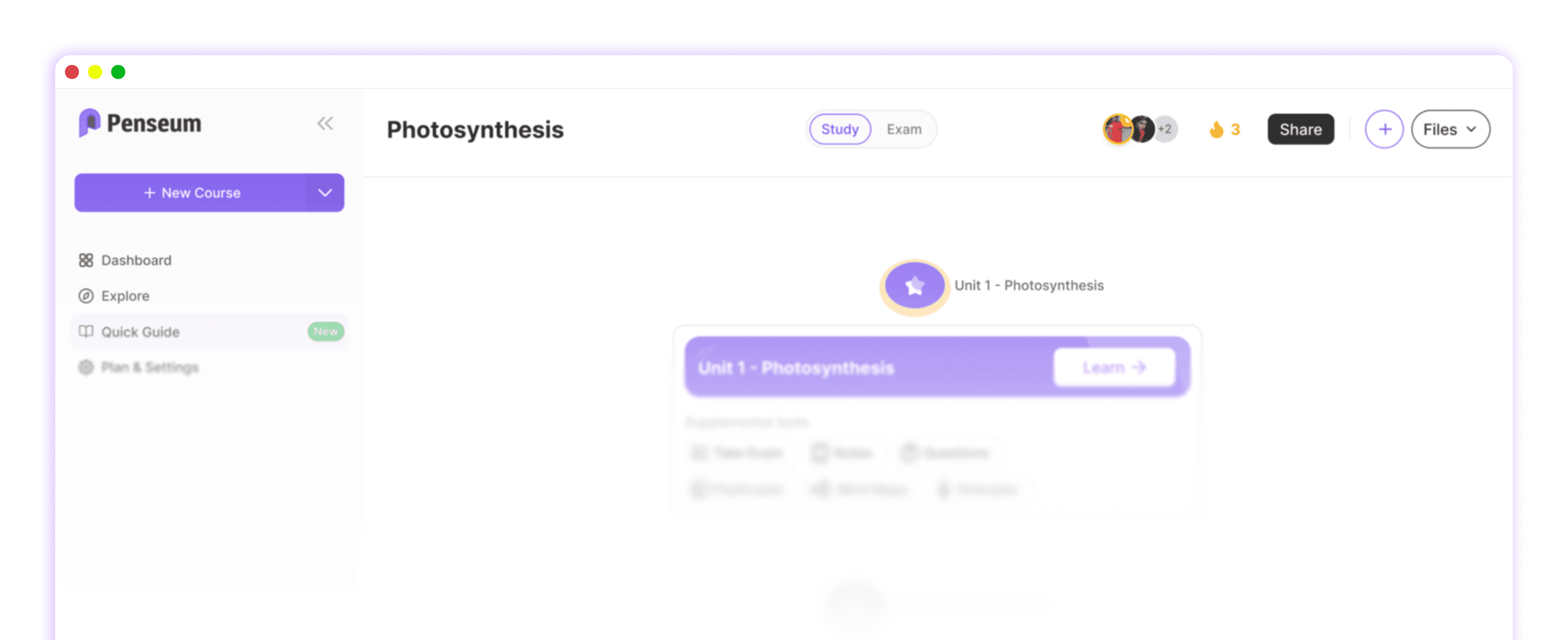
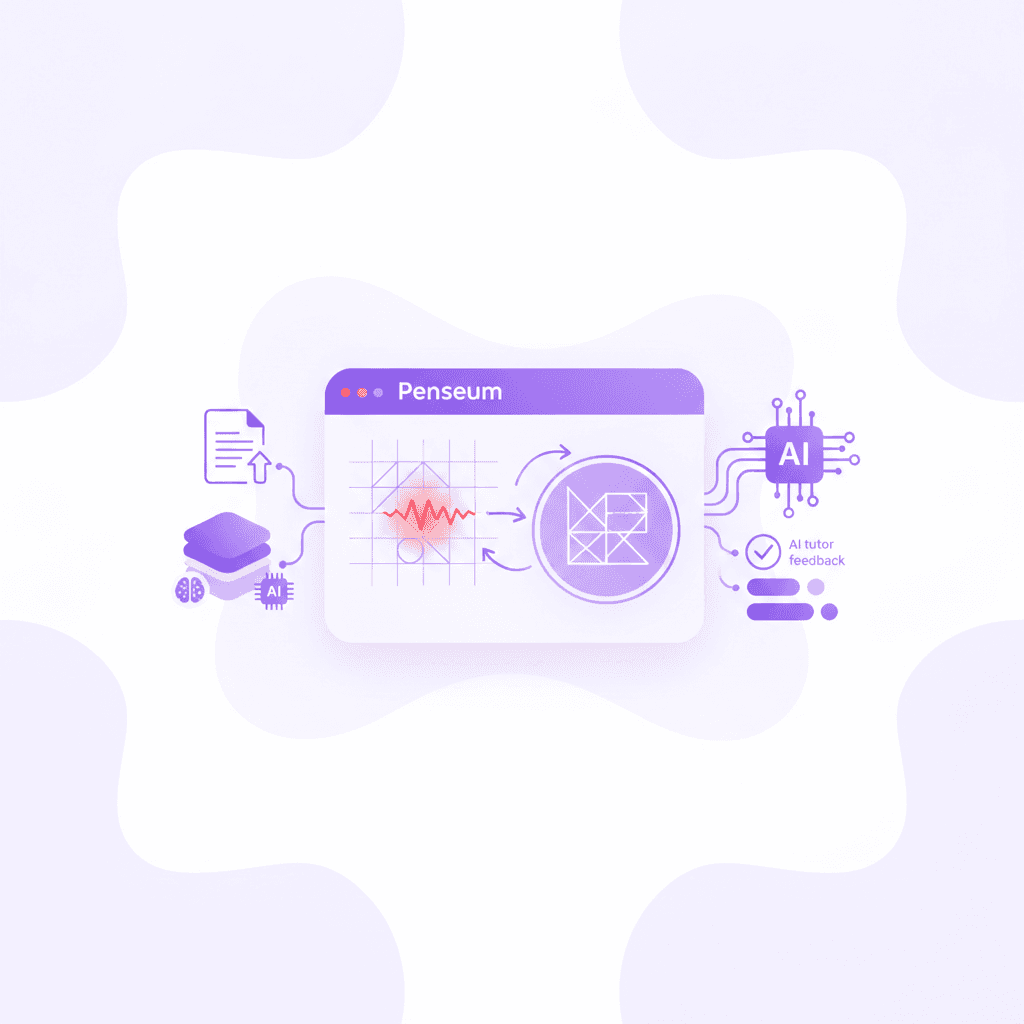
Penseum acts as an all-in-one study platform that goes far beyond a standard flash card generator. Instead of relying on crowdsourced decks with potential errors, Penseum generates highly accurate flashcards, quizzes, and mind maps directly from your own uploaded PDFs, lecture slides, and personal notes. It also features a live AI tutor that explains concepts out loud, catches your specific mistakes, and draws diagrams in real-time.
Standard AI tools often provide a generic text response and stop after one answer, leaving the rest up to you. They cannot see what you are doing on your screen. Penseum solves this problem through interactive, visual guidance. The tutor watches your virtual canvas as you work through a problem. If you make a mistake, it spots the error immediately, marks exactly where you went wrong, and explains what to fix.
Research by Mayer (2009) on Multimedia Learning demonstrates that combining visual, auditory, and active testing modalities optimizes student performance. By integrating real-time voice explanations with live diagramming, Penseum aligns perfectly with proven cognitive science principles. You learn the concept through multi-sensory teaching, and then reinforce it using the auto-generated flashcards.
Penseum is trusted by over 1.6 million students across 130+ countries and hundreds of universities to streamline their study sessions. The basic version is entirely free to use, allowing you to build study guides immediately without complex setups. For advanced features, a premium subscription is available for $29.99. Read 7 Ways a Flash Cards Generator Boosts Your Grades to see more examples of this workflow in action.
Actionable step: Create a free Penseum account (no credit card required), upload your hardest syllabus chapter, and let the AI generate your personalized flashcards and study guide in seconds.
Frequently Asked Questions
How do I make my own flashcards online for free?
You can make your own flashcards online for free by creating an account on a digital study platform like Penseum. Simply upload your lecture notes, PDFs, or syllabus documents into the workspace. The AI will scan the text and automatically generate a complete deck of highly accurate, custom flashcards in seconds without requiring manual data entry.
What is the best AI flashcard generator?
The best AI flashcard generator builds study materials exclusively from your personal documents while offering multimodal learning features. Penseum stands out because it not only generates accurate flashcards from your notes but also provides a live AI tutor. This tutor explains complex problems out loud, draws diagrams on a shared canvas, and corrects your specific mistakes in real-time.
Can AI make flashcards from my notes?
Yes, AI can easily make flashcards directly from your handwritten or typed notes. By uploading a scanned PDF or text file into a specialized study platform, the software utilizes natural language processing to identify core definitions, dates, and formulas. It then structures these key entities into customized question-and-answer pairs for immediate review.
Is it better to make your own flashcards or use others?
It is significantly better to make your own flashcards using your exact course syllabus. Crowdsourced public decks contain factual errors or irrelevant information up to 20% of the time. Generating a custom deck from your professor's specific lecture slides guarantees that you are studying the exact context and terminology that will appear on your final exam.
Does Penseum cost money to use?
Penseum is completely free to use for standard study material generation. Students can sign up without a credit card and immediately begin turning their notes into guides, quizzes, and flashcards. For learners requiring extensive, advanced tutoring capabilities, Penseum also offers a premium subscription tier available for $29.99.
Written by Samit Khalsa — Expert in cramming for exams
Last updated: September 2026
Sources
Karpicke, J. D., & Roediger, H. L. (2008). The critical importance of retrieval for learning. Science, 319(5865), 966-968. https://pubmed.ncbi.nlm.nih.gov/18276894/
Dunlosky, J., Rawson, K. A., Marsh, E. J., Nathan, M. J., & Willingham, D. T. (2013). Improving students' learning with effective learning techniques: Promising directions from cognitive and educational psychology. Psychological Science in the Public Interest, 14(1), 4-58. https://pubmed.ncbi.nlm.nih.gov/26173288/
Ebbinghaus, H. (1913). Memory: A contribution to experimental psychology (H. A. Ruger & C. E. Bussenius, Trans.). Teachers College College, Columbia University. (Original work published 1885). https://scholar.google.com/scholar?q=Ebbinghaus+Memory+1885
Pan, S. C., & Rickard, T. C. (2018). Transfer of test-enhanced learning: Meta-analytic review and synthesis. Psychological Bulletin, 144(7), 710–756. https://pubmed.ncbi.nlm.nih.gov/29757011/
Roediger, H. L., & Butler, A. C. (2011). The critical role of retrieval practice in long-term retention. Trends in Cognitive Sciences, 15(1), 20-27. https://pubmed.ncbi.nlm.nih.gov/20951630/
Fiorella, L., & Mayer, R. E. (2016). Eight ways to promote generative learning. Educational Psychology Review, 28(4), 717–741. https://scholar.google.com/scholar?q=Fiorella+Mayer+generative+learning+2016
Mayer, R. E. (2009). Multimedia learning (2nd ed.). Cambridge University Press. https://scholar.google.com/scholar?q=Mayer+Multimedia+Learning+2009
Related guides
Ready to study smarter?
Start turning your notes into guides, quizzes, and flashcards in seconds.