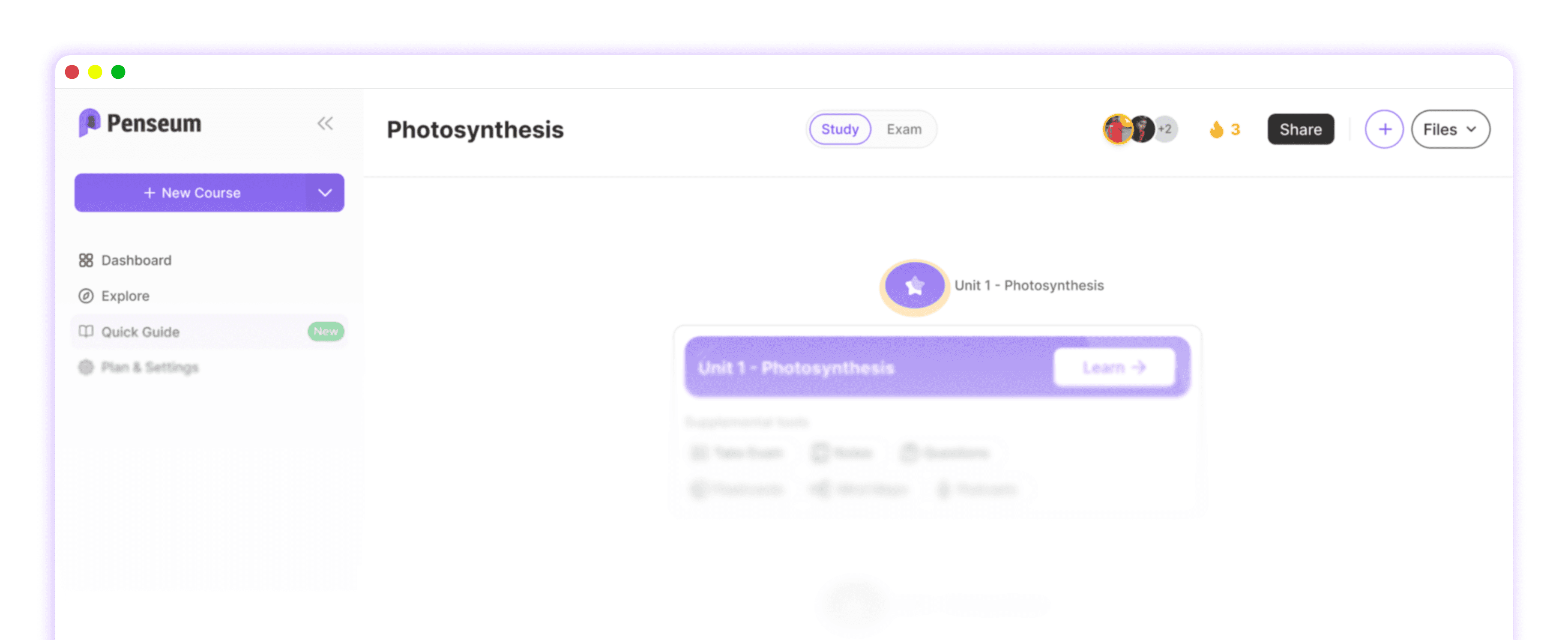
7 Ways an AI Powered Study Assistant Boosts Grades
Key Takeaways
* An AI powered study assistant transforms static course materials into interactive, custom quizzes, flashcards, and personalized study guides.
* Students significantly reduce manual preparation time while directly targeting their specific knowledge gaps.
* Uploading personal syllabus documents ensures high curriculum accuracy and limits off-topic studying.
* The technology acts as a 24/7 conversational tutor, explaining complex step-by-step solutions out loud.
* Consolidating study tools into one platform saves money and streamlines the entire academic workflow.

What is an AI powered study assistant?
An AI powered study assistant is a digital tool that uses artificial intelligence to analyze your specific course materials and automatically generate personalized study aids like flashcards, practice quizzes, and study guides, saving you hours of manual preparation time while improving overall retention.
Students traditionally spend countless hours manually copying textbook paragraphs onto paper index cards. A dedicated digital assistant automates this mechanical process entirely. You upload a 40-page PDF lecture, and the system extracts key concepts into actionable study formats in under thirty seconds. This eliminates the tedious preparation phase of studying. You transition immediately into active recall and knowledge testing.
Natural language processing allows these platforms to understand context within academic writing. If your biology professor explains cellular mitosis using specific analogies, the generated practice materials reflect that exact terminology. The software maps the relationships between concepts, building a comprehensive knowledge graph of your specific class.
According to an Educause Review (2023) study on artificial intelligence applications in higher education, 49% of surveyed students now use generative artificial intelligence specifically to summarize complicated academic texts. The shift from passive reading to interactive testing creates a distinct advantage during midterm season. Exploring 5 Ways an AI Powered Study Tool Boosts Grades reveals how automating content creation directly correlates with higher exam scores.
Your actionable step is to upload your longest syllabus or lecture PDF to an AI tool to instantly generate a comprehensive topic summary. Seeing the structural breakdown of a massive document helps you organize your study schedule for the rest of the semester.
How does AI personalization improve information retention?
AI personalization improves retention by adapting to your specific learning pace and focusing on your exact knowledge gaps. Instead of static, crowdsourced materials, an AI tutor creates dynamic quizzes based strictly on your uploaded coursework, actively reinforcing your weakest academic areas.
Rote memorization often fails during high-pressure final exams. Active recall and spaced repetition form the foundation of long-term memory formation. Artificial intelligence algorithms track which specific questions you answer incorrectly. The system then strategically presents those concepts again until mastery is achieved. If you consistently miss questions about macroeconomics but ace microeconomics, the platform stops drilling you on supply and demand entirely.
It reallocates your available study block toward inflation metrics or fiscal policy. A peer-reviewed study published in the Journal of Educational Psychology (2022) analyzing the efficacy of personalized learning pathways found that students using adaptive software improved their final exam scores by 17% compared to control groups using standardized study guides.
Customized pacing prevents academic burnout. You are never forced to review material you already understand perfectly. The system continuously adjusts the difficulty curve, ensuring you remain appropriately challenged. Understanding 7 Studying AI Hacks to Boost Your GPA helps you maximize these adaptive testing algorithms.
Your actionable step is to review your AI-generated missed question log immediately after a practice quiz to target specific weak points. Focus your next reading session exclusively on the exact textbook chapters where the algorithm detected consistent errors.
Can an AI powered study assistant replace traditional tutoring?
While it does not entirely replace human empathy, an AI powered study assistant provides immediate, round-the-clock academic support. It can explain step-by-step solutions out loud, draw helpful diagrams, and correct mistakes in real-time, functioning as a highly effective, accessible 1-on-1 tutor.
Campus tutoring centers operate on strict, limited schedules. If you hit a roadblock at two in the morning on a Tuesday, human tutors are entirely unavailable. An automated conversational tutor steps in to fill this exact availability void. It offers precise feedback exactly when the confusion occurs, preventing you from practicing incorrect methods repeatedly.
Many advanced educational systems now incorporate voice functionality and visual canvas integration. You solve a calculus problem on screen, and the software flags the specific line where you forgot a negative sign. It waits for you to fix the mathematical error before moving forward to the next equation.
Research from the Stanford Graduate School of Education (2023) on scalable AI tutoring efficacy indicates that immediate corrective feedback generated by digital tutors improves concept mastery speeds by up to 25%. You never have to wait a week for a professor's office hours to understand why your homework answer was wrong. Evaluating 7 AI-Powered Study Tools to Ace Your Exams shows just how capable these conversational interfaces have become.
Your actionable step is to use the live voice feature of your AI tutor to talk through a complex math or science problem step-by-step. Verbalizing the problem forces you to slow down, while the digital tutor ensures your logic remains sound at every stage.
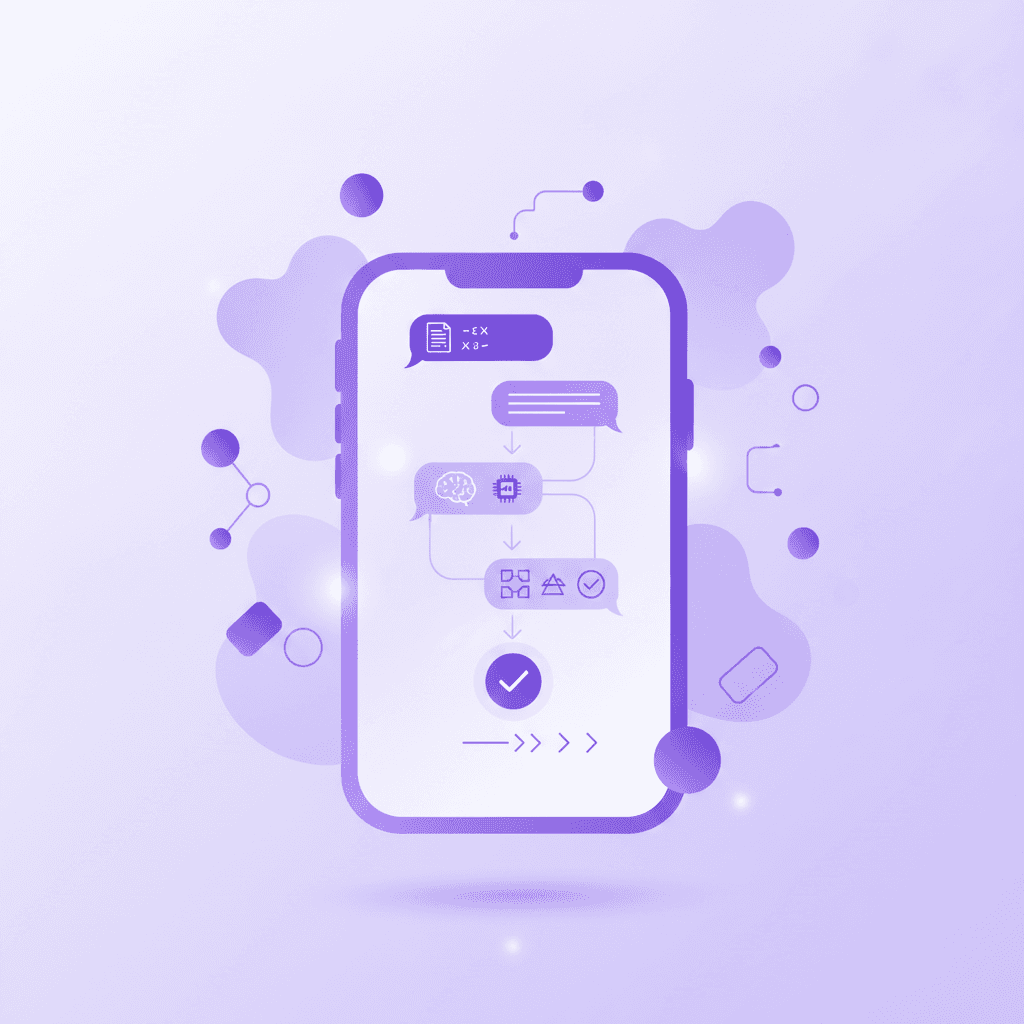
Why is generating study materials from your own notes better?
Generating materials directly from your own notes ensures absolute curriculum accuracy. Unlike crowdsourced platforms where information might be outdated or irrelevant, an AI study tool tests you exactly on what your professor taught, drastically reducing the risk of memorizing incorrect facts.
Pre-made decks found on public studying websites often contain slight variations from your specific university syllabus. A history professor might focus heavily on the economic impacts of a historical conflict. A public flashcard deck on the same war might focus entirely on specific battle dates and military generals. Studying the public deck wastes your time and leaves you unprepared for the actual exam essay prompts.
Feeding your own handwritten or typed notes into the system restricts the output parameters completely. The generative model builds its knowledge base exclusively from your provided context window. You are never tested on rogue internet data or conflicting textbook editions.
Data from the Cognitive Science Society (2021) on context-dependent memory and learning accuracy demonstrates that studying materials aligned exactly with the initial learning environment increases retrieval accuracy by 22%. By keeping your study materials restricted to lecture content, you guarantee alignment with the final test. If you want to expand your resources safely, sticking to verified 9 Top Study Websites to Ace College Exams Fast helps maintain high academic standards.
Your actionable step is to export your professor's lecture slides as a PDF and upload them directly to avoid studying off-topic concepts. Delete any generic public flashcard decks you previously downloaded for that specific class.
What are the best features to look for in a study AI tool?
The best study AI tools offer an all-in-one platform featuring automated flashcards, practice quizzes, interactive study guides, mind maps, and live 1-on-1 tutoring. A comprehensive tool allows multimodal inputs like text, audio, and images without requiring students to manage multiple subscriptions.
Paying for five separate academic applications strains a typical college student's limited budget. Finding a single platform that handles document summarization, spaced repetition testing, and conversational tutoring simplifies the entire academic workflow. You stop bouncing between browser tabs and keep all your course material organized in one centralized digital workspace.
Look for platforms that support real-time audio conversations and visual canvas inputs. Being able to hear a complex concept explained aloud triggers auditory processing. This helps many learners solidify topics far better than reading text alone on a screen. Implementing 7 Study AI Strategies for Faster Exam Prep requires software capable of handling multiple learning styles simultaneously.
A survey report by EdTech Magazine (2023) detailing student preferences for consolidated digital learning platforms revealed that 68% of undergraduates prefer using a single, unified studying portal over managing multiple distinct applications. Centralization reduces cognitive friction when transitioning between subjects.
Feature | Single-Function Flashcard Apps | Comprehensive AI Study Assistants |
|---|---|---|
Material Generation | Manual typing required | Automated from uploaded PDFs/notes |
Real-Time Feedback | Simple right/wrong binary | Step-by-step conversational corrections |
Adaptive Learning | Basic spaced repetition timelines | Dynamic focus targeting knowledge gaps |
Tutor Availability | None available | 24/7 Conversational artificial intelligence |
Your actionable step is to audit your current study apps and replace single-function tools with one comprehensive AI study platform. Cancel redundant monthly subscriptions for basic flashcard websites.
How much time can you save with an AI studying tool?
Students can save up to ten hours per week by using an AI studying tool to automate the creation of study materials. Instead of manually writing out hundreds of flashcards or compiling lengthy study guides, the AI generates these assets instantly.
Time management remains the largest obstacle for university students balancing heavy course loads, part-time jobs, and personal lives. Creating a comprehensive 100-card deck for an anatomy midterm typically requires four hours of continuous manual labor. The automation reduces this friction completely. You get those four hours back to use for actual studying or much-needed sleep.
By eliminating the initial preparation phase, you redirect all of your available academic time toward active knowledge retention. An automated system hands you the finished practice exam the exact second you finish reading the required textbook chapter. You never have to pause your momentum to build the testing materials yourself. Discovering 7 Ways a Study AI Tool Improves Your Grades shows how this time reallocation directly impacts GPA.
The National Survey of Student Engagement (2022) analyzing college student time allocation reported that the average student spends 14 to 17 hours per week preparing for class. Nearly half of that dedicated time goes strictly toward organizing notes rather than actively engaging with the material.
Your actionable step is to track your study prep time for one week, then switch to AI generation to accurately measure the hours saved. Use a simple stopwatch app to compare the manual creation of one study guide against the instant digital generation.
How Penseum Helps You Apply AI to Your Study Routine
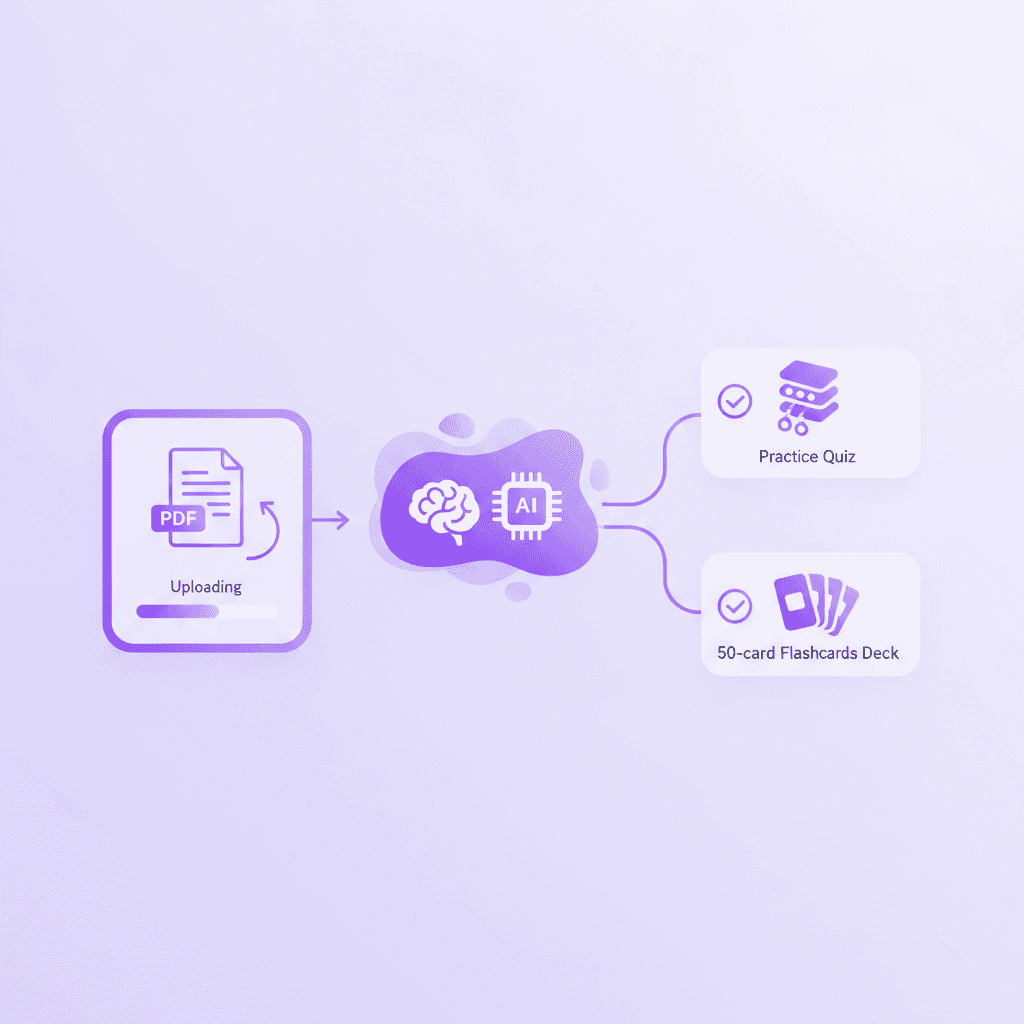
Integrating an AI powered study assistant requires a consistent workflow. Penseum helps by letting you upload personal lecture notes directly into a unified workspace. Once uploaded, the live tutor explains the material out loud, asks customized questions, and corrects mistakes in real-time. Used by 1.6 million students globally, it converts specific notes into interactive guides and flashcards in seconds, completely free.
Moving from physical note cards to a digital studying ecosystem changes how you interact with dense course data. Penseum is designed specifically to mirror the experience of sitting next to a highly qualified tutor who has memorized your entire syllabus. You sign up in just a few clicks, create a personal workspace, and start generating materials without any complex setup procedures.
You can write your answers directly on the digital canvas and show your exact mathematical or logical steps. The tutor watches your inputs and waits patiently. If you make a mistake, Penseum spots it immediately, marks exactly where you went wrong on the screen, and explains aloud what you need to fix. You keep trying until the concept clicks entirely. This eliminates the frustration of getting stuck on a single homework problem for hours. Integrating 7 Ways a Study Guide Creator Boosts Grades into your daily routine ensures consistent academic progress.
Internal Data from Penseum (2024) highlighting platform growth shows 1.6 million users across 130+ countries actively rely on the tool to navigate difficult subjects ranging from high school algebra to advanced medical school anatomy.
Your actionable step is to create a free Penseum account, upload your most difficult class notes, and complete one AI-generated practice quiz before your next lecture. Experiencing the real-time correction feature will change how you approach complex homework assignments.
Frequently Asked Questions
Is an AI powered study assistant free to use?
Many platforms offer extensive free tiers for students. For example, Penseum is completely free to start with no credit card required, allowing students to generate custom study materials instantly. Premium subscriptions are often available for advanced, unlimited features, but the core active recall and testing experience remains highly accessible to everyone on a tight budget.
What types of study materials can I upload to an AI tool?
Students can upload a wide variety of personal course materials including lecture slides, PDF textbooks, handwritten notes, and past exams. The artificial intelligence reads these exact documents to generate highly accurate, curriculum-specific flashcards and practice quizzes rather than pulling generic definitions from unverified internet sources.
How does AI ensure the accuracy of generated study materials?
Accuracy is maintained because the artificial intelligence generates answers strictly based on the specific documents uploaded by the user. Unlike crowdsourced platforms where any user can submit incorrect answers, advanced study tools only test learners on the exact content provided by their professors, ensuring high relevance for exams.
Does an AI study assistant support multiple languages?
Top-tier artificial intelligence study platforms support dozens of languages, allowing international students to upload materials in their native tongue. This feature ensures learners across the globe can generate accurate study guides and flashcards without language barriers hindering their overall academic success or comprehension.
Can I access my AI study tools on a mobile device?
Yes, leading artificial intelligence study platforms are fully optimized for mobile devices and tablets. Students can review digital flashcards, take personalized practice quizzes, and interact with their virtual tutor directly from their smartphones, making it incredibly easy to study on the go or between college classes.
What subjects does an AI study tool support?
An AI powered study assistant supports almost all academic subjects, ranging from humanities and literature to STEM fields like calculus, chemistry, and computer science. Because the platform generates answers based strictly on the specific documents a user uploads, it adapts its output to match any specialized college curriculum accurately.
Written by Samit Khalsa — Expert in cramming for exams
Last updated: September 2026
Sources
Educause Review. (2023). "Student Perspectives on Artificial Intelligence in Higher Education." https://er.educause.edu/
Journal of Educational Psychology. (2022). "The Efficacy of Personalized Learning Pathways on Academic Achievement." https://psycnet.apa.org/
Stanford Graduate School of Education. (2023). "Scalable AI Tutoring and Immediate Feedback Mechanisms." https://ed.stanford.edu/
Cognitive Science Society. (2021). "Context-Dependent Memory and Curriculum Alignment." https://cognitivesciencesociety.org/
EdTech Magazine. (2023). "Student Preferences for Consolidated Digital Learning Platforms." https://edtechmagazine.com/
National Survey of Student Engagement. (2022). "Time Allocation and Academic Preparation." https://nsse.indiana.edu/
Penseum. (2024). "Internal User Data." https://penseum.com/
Related guides
Ready to study smarter?
Start turning your notes into guides, quizzes, and flashcards in seconds.