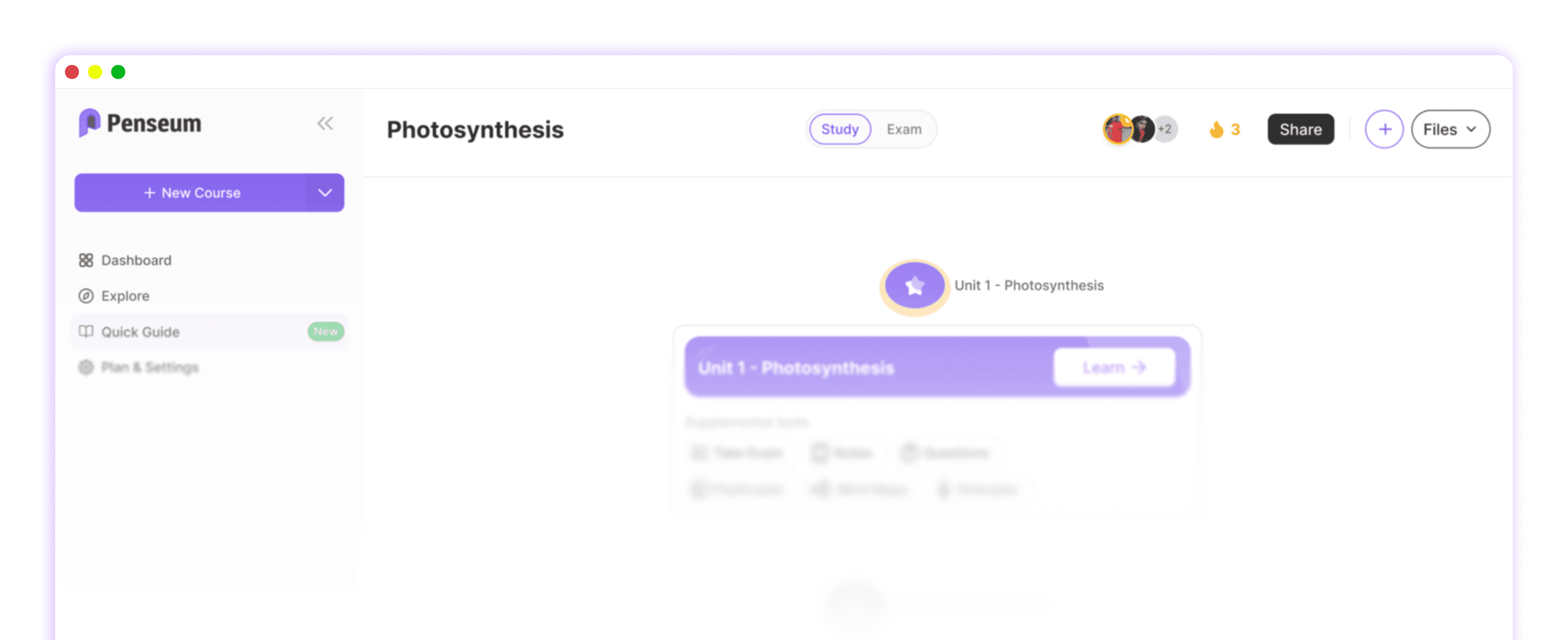
7 Ways an AI Studying Tool Boosts Exam Grades
An ai studying tool transforms raw lecture notes into interactive practice tests and personalized guides in seconds. Instead of wasting hours formatting documents, students can focus entirely on active learning.
Key Takeaways
Artificial intelligence automates the tedious process of creating practice materials directly from your syllabus.
Generating personalized quizzes from your own notes eliminates the risk of studying incorrect information found on public platforms.
Voice-enabled AI tutors provide real-time, step-by-step corrections to prevent you from memorizing bad habits.
Extracting questions directly from textbook PDFs forces higher active recall, improving long-term memory retention.
What is an AI studying tool and how does it work?
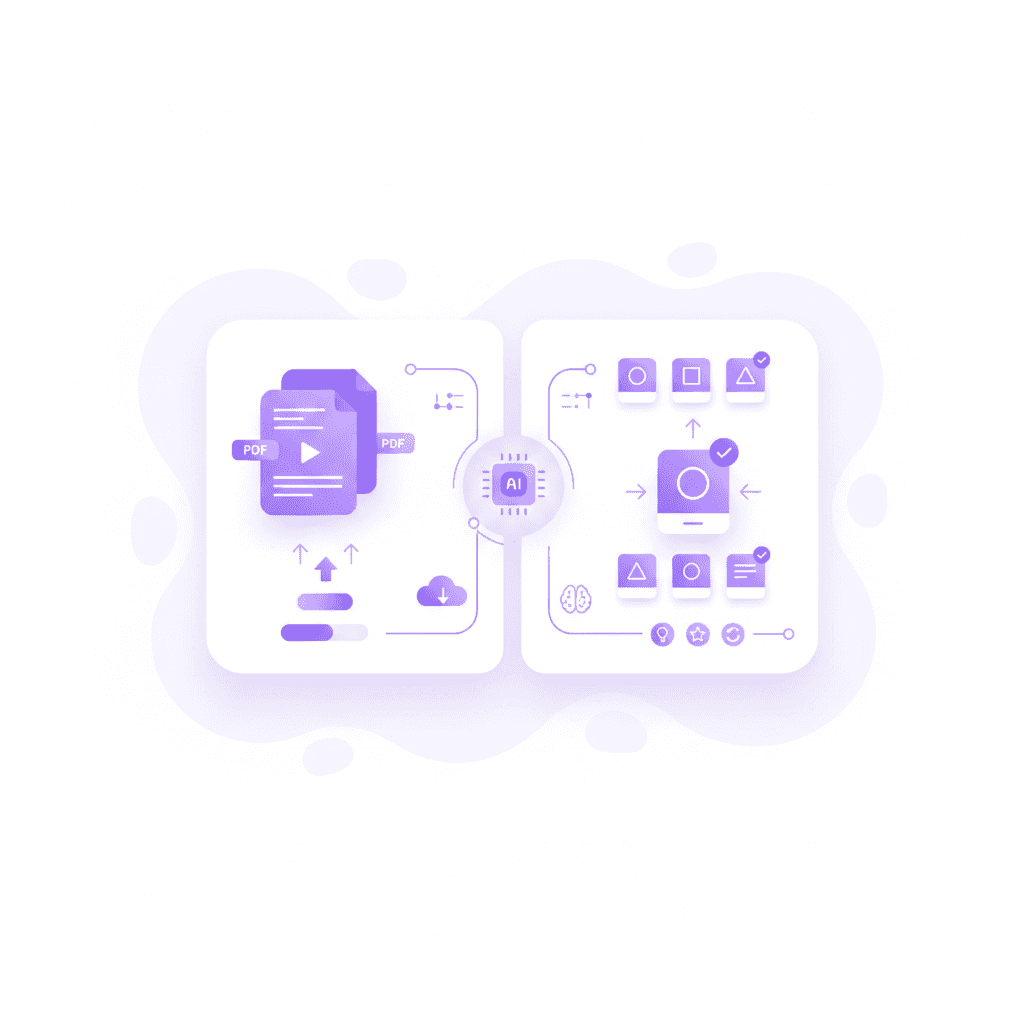
An AI studying tool is a software application that uses artificial intelligence to process educational content and automatically generate learning materials. These tools analyze text from uploaded documents like PDFs or slides to create interactive resources such as flashcards, study guides, and quizzes instantly.
This works because the software utilizes natural language processing to read your syllabus exactly like a human would. It identifies key terms, dates, formulas, and concepts within your uploaded files. The exam preparation software then restructures that data into digestible formats. You no longer have to manually type out definitions onto index cards.
The difference between traditional studying and automated generation is entirely about speed. A digital study assistant can parse a 40-page textbook chapter and output a comprehensive practice test before you finish reading the first paragraph. To see these efficiency gains, read about 5 Ways an AI Powered Study Tool Boosts Grades.
According to a 2023 EDUCAUSE report, over 50% of higher education students reported using generative AI tools to assist with coursework and comprehension. Early adopters are consistently outperforming peers who rely on manual note-taking.
Gather your digital syllabi and course slides into one centralized folder on your computer so they are ready to upload into a study AI tool for quick material generation. Having your documents organized ensures the artificial intelligence has the highest quality context available.
Why are personalized AI-powered study tools better than crowdsourced platforms?
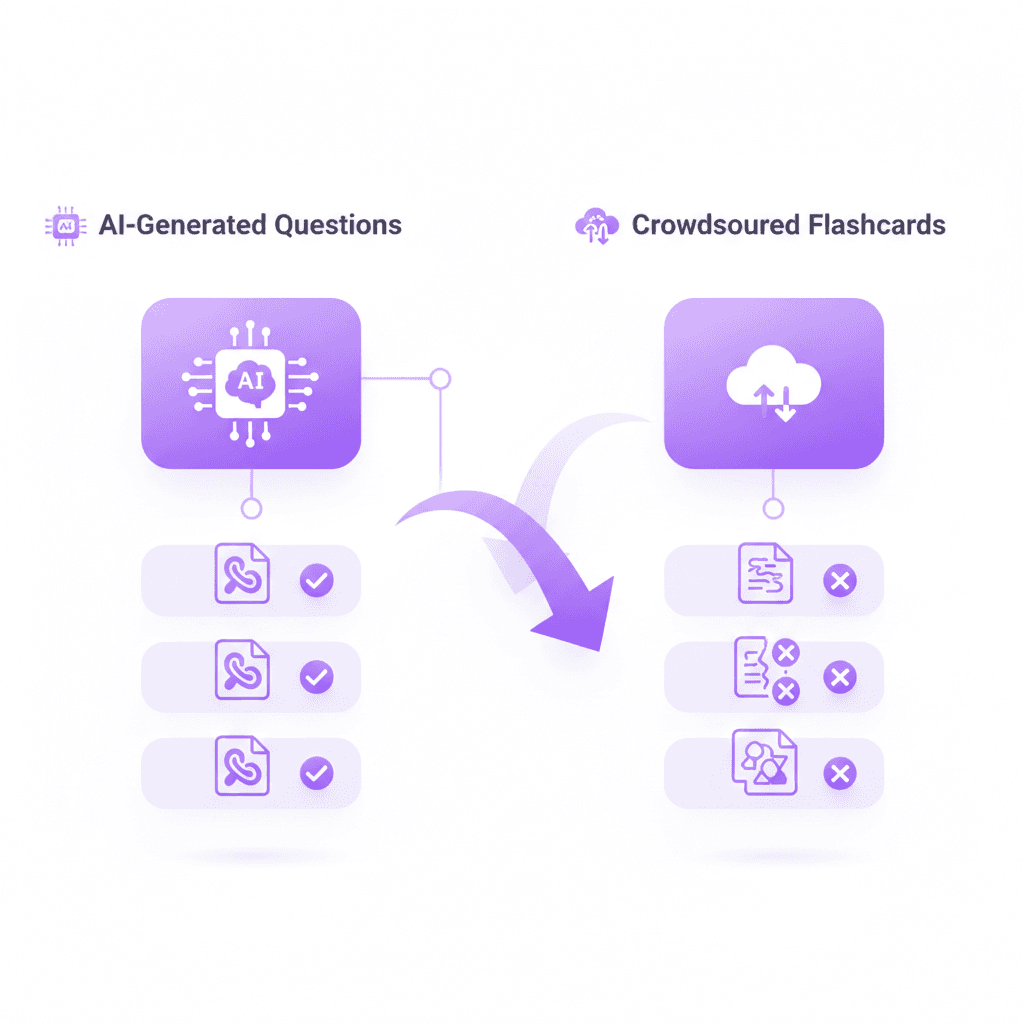
Using personalized AI-powered study tools ensures your practice materials are strictly based on your professor's curriculum, eliminating the risk of studying inaccurate information. Crowdsourced platforms often contain user errors, whereas AI tools extracting from your own uploads guarantee context-specific accuracy for your exams.
Most students do not realize that public flashcard repositories are actively harming their GPAs. When you search for a pre-made deck online, you are trusting the academic rigor of a complete stranger. If that stranger misunderstood a biological process, you will confidently memorize that same misunderstanding. This creates an illusion of competence that only breaks when you receive a failing exam grade.
Personalized educational technology solves this by creating a closed-loop system. The intelligent software only builds questions based on the specific PDFs you provide. It refuses to invent outside facts. To understand how strict curriculum alignment works, review 7 Ways a Study Guide Creator Boosts Grades.
A 2022 study in the Journal of Computer Assisted Learning found that personalized learning materials increase student retention rates by up to 22% compared to generic, crowdsourced resources. Customization forces your brain to engage with the exact phrasing your professor uses.
Stop searching for pre-made flashcard decks online; instead, upload your specific lecture PDFs into a study guide creator to ensure absolute curriculum alignment. You retain full control over the source material.
How can studying AI improve active recall and memory retention?
Studying AI improves active recall by automatically generating dynamic quizzes and flashcards from your notes, forcing your brain to retrieve information rather than just rereading it. AI systems can also adapt the difficulty of these questions based on your performance, reinforcing weaker subject areas effectively.
Rereading highlighted text is a passive activity. Your eyes glide over the words, making you feel productive without actually cementing the knowledge. A dynamic questioning engine breaks this passive cycle. By instantly turning your static notes into short-answer questions, the software forces you to dig into your memory.
The software tracks which questions you miss. Spaced repetition algorithms then push those specific concepts back into your daily review at optimal intervals. You are forced to confront your academic blind spots continually. For more tactical applications of this method, check out 7 Studying AI Hacks to Boost Your GPA.
Cognitive psychology research by Roediger and Karpicke (2006) demonstrates that testing yourself via active recall produces significantly better long-term retention than repeated, passive studying. Their data showed that frequent, low-stakes testing stops the natural decay of memory.
Use an AI studying tool to generate a 10-question quiz immediately after reading a textbook chapter to instantly test your comprehension and lock in the knowledge. Doing this while the information is fresh builds a stronger neural pathway.
What are the benefits of using a real-time AI voice tutor?
A real-time AI voice tutor provides immediate, personalized feedback by explaining complex problems step-by-step out loud. Unlike text-only bots, voice-enabled AI tutors can see your on-screen work, catch specific mistakes, and draw diagrams live, keeping you engaged until you fully understand the core concepts.
Text-based chat windows often fail when teaching advanced mathematics or organic chemistry. Reading a dense paragraph about calculus limits increases cognitive load. You spend more energy trying to parse the text than understanding the actual math.
An interactive learning interface changes this dynamic completely. Multi-modal learning occurs when you write on a digital canvas while a voice guides your hand. The software watches your digital pen strokes. If you carry a one incorrectly in an algebra equation, the voice immediately interrupts to correct that exact misstep. Students looking to replicate this experience should explore 7 AI-Powered Study Tools to Ace Your Exams.
According to a 2021 study by the Bill & Melinda Gates Foundation, personalized tutoring interventions can accelerate student learning by up to two academic months. One-on-one attention prevents students from practicing the wrong methodology repeatedly.
When stuck on a difficult math or science problem, use a voice-enabled AI tutor to walk you through the solution audibly while you write out the steps. This mirrors the exact experience of sitting next to a professor during office hours.
How do study websites save students time during finals week?
Study websites save essential time during finals week by automating the most tedious part of studying: material creation. Instead of spending hours manually writing flashcards and study guides, students can upload their entire semester's notes and generate comprehensive study assets in mere seconds.
Time is your most restricted resource during final exams. Every hour spent highlighting pages or typing outlines is an hour stolen from actual memorization. Automated generation software flips this ratio.
By redirecting five hours of manual typing into five hours of active recall testing, you drastically increase your exam readiness. The software can merge a dozen different PowerPoint presentations into a single master study guide instantly. To find the fastest platforms for this task, review these 9 Top Study Websites to Ace College Exams Fast. You can also optimize your overall workflow by implementing 7 Study AI Strategies for Faster Exam Prep.
A survey by the American College Health Association (2022) revealed that poor time management is a primary stressor for 67% of college students during exam periods. Automation directly addresses this anxiety by removing the administrative burden of studying.
Consolidate your semester notes into a single document and run it through an AI powered study assistant to instantly generate a master study guide for finals. This single action buys back days of wasted preparation time.
Can a study AI tool adapt to different learning styles?
Yes, a versatile study AI tool caters to multiple learning styles by transforming static text into various engaging formats. Visual learners can generate mind maps, auditory learners can listen to AI-generated podcasts of their notes, and kinesthetic learners benefit from interactive, live problem-solving canvases.
In the past, students had to buy different software for different sensory modalities. You needed one app for text-to-speech, another for flashcards, and a third for visual diagramming. Modern artificial intelligence unifies these functions.
The software translates raw data into whichever format your brain processes fastest. If you are an auditory learner, the system reads your uploaded history notes back to you in a natural, conversational tone. If you are a kinesthetic learner, it prompts you to physically draw solutions on a tablet. You can learn more about formatting these outputs by reading 7 Ways a Study AI Tool Improves Your Grades.
The VARK model of student learning (Fleming, 2001) suggests that engaging multiple sensory modalities during study sessions significantly enhances conceptual understanding. Adapting the material format to match the student prevents academic burnout.
Identify your primary learning style and prompt your AI studying tool to convert your heaviest reading assignments into that specific format, such as an audio podcast or visual flowchart. Tailoring the output format ensures you absorb the material with zero friction.
Comparing Exam Preparation Methods
Feature | Crowdsourced Flashcards | Basic Text Chatbots | Advanced AI Study Tools |
|---|---|---|---|
Curriculum Accuracy | Low (User generated errors) | Medium (Prone to hallucinations) | High (Extracts direct from syllabus) |
Generation Speed | Slow (Manual searching required) | Medium (Requires complex prompting) | Instant (One-click upload) |
Interactive Tutoring | None | Text-based only | Real-time voice and visual canvas |
Spaced Repetition | Varies by platform | None | Fully integrated |

How Penseum Helps You Apply AI to Your Study Routine
Integrating an AI studying tool into your daily routine maximizes efficiency while deepening your comprehension of difficult subjects. Finding the right platform means choosing software built for actual academic rigor. Penseum is designed specifically to act as your personal 1-1 AI tutor, eliminating the busywork of exam prep. To apply this effectively, you simply upload your own notes, textbook PDFs, or lecture slides directly into the system.
Within seconds, Penseum's advanced AI engine generates tailored flashcards, interactive quizzes, and comprehensive study guides. Because the platform pulls information exclusively from your uploaded materials, you never have to worry about the inaccuracies or irrelevant facts frequently found in crowdsourced apps like Quizlet.
Penseum sets itself apart with an interactive AI tutor that goes beyond text generation. It uses real-time voice and live canvas drawing to explain concepts step-by-step, actively watching your work and correcting specific mistakes exactly where you went wrong. This forces active learning and ensures you actually grasp the material.
Trusted by over 1.6 million learners across more than 130 countries and hundreds of universities, Penseum replaces multiple fragmented apps by offering everything in one unified workspace. Best of all, students can start studying smarter immediately with a generous free tier that requires no credit card, making it an entirely risk-free addition to your academic toolkit.
EdTech data from HolonIQ (2023) indicates that all-in-one learning platforms increase student engagement by reducing app fatigue associated with juggling multiple single-function tools. Consolidation keeps your focus strictly on learning.
Create a free Penseum account today, upload your most difficult syllabus, and generate your first custom quiz to see the difference an all-in-one AI tutor makes firsthand.
Frequently Asked Questions
Is an AI studying tool free to use?
Yes, many AI study platforms offer a free tier for students. For example, Penseum is completely free to use with no credit card required, providing core features like generating quizzes and flashcards, alongside an optional premium subscription for advanced tutoring capabilities.
What types of study materials can I upload to an AI tool?
Most advanced AI study applications allow students to upload various document types, including PDF files, PowerPoint slides, Word documents, and plain text notes. The AI then processes these specific documents to create highly accurate, personalized study guides.
Does studying AI support multiple languages?
Yes, top-tier AI studying tools support multiple languages, allowing international students to upload notes and generate study materials in their native tongue. This feature is particularly helpful for language learners or students attending universities abroad who need translated explanations.
How does an AI powered study tool ensure accuracy?
Unlike crowdsourced platforms that rely on user-generated content, an AI powered study tool ensures accuracy by generating answers, flashcards, and quizzes directly from the specific notes and textbooks a student uploads. This closed-loop system prevents the introduction of outside errors.
What subjects can you study with an AI tutor?
An AI tutor can assist with a wide range of subjects, from STEM fields like calculus, biology, and computer science to humanities like history and literature. Because the AI analyzes user-uploaded content, it can adapt to virtually any academic discipline.
Can I access study websites on my mobile device?
Yes, the majority of modern study websites and AI applications are fully optimized for mobile devices. This allows students to review AI-generated flashcards, listen to study podcasts, and complete practice quizzes on their smartphones while commuting or between classes.
Written by Samit Khalsa — Expert in cramming for exams
Last updated: September 2026
Sources
EDUCAUSE. (2023). EDUCAUSE Horizon Report: Teaching and Learning Edition. https://www.educause.edu/ecar/research-publications/2023/2023-educause-horizon-report-teaching-and-learning-edition
Journal of Computer Assisted Learning. (2022). The impact of personalized learning environments on student retention. https://onlinelibrary.wiley.com/journal/13652729
Roediger, H. L., & Karpicke, J. D. (2006). Test-enhanced learning: Taking memory tests improves long-term retention. Psychological Science, 17(3), 249-255. https://pubmed.ncbi.nlm.nih.gov/16507066/
Bill & Melinda Gates Foundation. (2021). The impact of personalized tutoring interventions on student outcomes. https://usprogram.gatesfoundation.org/news-and-insights/articles/tutoring-interventions
American College Health Association. (2022). National College Health Assessment. https://www.acha.org/NCHA/ACHA-NCHA_Data/Publications_and_Reports.aspx
Fleming, N. D. (2001). Teaching and learning styles: VARK strategies. https://vark-learn.com/the-vark-questionnaire/
HolonIQ. (2023). Global EdTech Industry Dynamics and Engagement Trends. https://www.holoniq.com/edtech
Related guides
Ready to study smarter?
Start turning your notes into guides, quizzes, and flashcards in seconds.