Final exam study tips based on cognitive science
Key Takeaways
* Applying final exam study tips rooted in cognitive science allows students to learn faster and retain more information.
* Active recall and spaced repetition drastically improve test scores compared to passive reading.
* Spacing out study sessions three to four weeks in advance prevents memory decay.
* Taking timed practice exams simulates test conditions and identifies knowledge gaps.
* Using evidence-based AI tutoring tools automates material generation and provides immediate corrective feedback.
When should you start preparing for finals?
Begin organizing your study materials at least three to four weeks before exam week. Starting early allows you to use spaced repetition, distributing your study sessions into manageable chunks rather than attempting to cram an entire semester's worth of information into one single stressful night.
Cognitive science shows that memory naturally decays over time. The Ebbinghaus forgetting curve demonstrates that humans forget a massive percentage of newly learned data within days unless they actively review it. By spreading your review sessions out over a month, you interrupt this forgetting process. Each time you review the material, your brain strengthens the associated neural pathways.
Waiting until the last minute forces you into massed practice, commonly known as cramming. Massed practice overloads your working memory, making it physically impossible for your brain to encode information into long-term storage. You might remember facts just long enough to pass a test the next morning, but you will rapidly forget them immediately afterward.
Creating a structured timeline reduces academic anxiety. You can divide your syllabus into discrete units and tackle one concept per day. This structured approach leaves room for unexpected delays and ensures every topic gets adequate attention.
Research: Cepeda et al. (2008) on the spacing effect and optimal study gap intervals.
Statistic: Students who space their studying retain up to 40% more information than those who mass study or cram.
Actionable Step: Map out an exam study schedule on a calendar, blocking out focused two-hour study windows per subject each week. Use a template like the 7 Steps to a Winning Exam Study Schedule to build your initial framework.
How do you organize study materials effectively?
Consolidate your class notes, lecture slides, and past assignments into a single master document or folder for each course. Organizing everything by topic rather than chronologically makes it easier to identify knowledge gaps and ensures you are studying exactly what the professor highlighted all semester.
Students often leave their notes scattered across different notebooks, digital apps, and downloaded PDF folders. This physical disorganization creates mental friction. Before you can even begin learning, you burn valuable mental energy just trying to locate the right chapter summaries.
Sorting your study materials chronologically by date often leads to fragmented learning. A professor might introduce a concept in September and revisit its complex applications in November. If your notes stay in chronological order, you study these linked concepts separately. Grouping materials by thematic topic bridges these gaps. It allows you to see the big picture and understand how foundational theories connect to advanced applications.
Building a centralized database of your coursework also clarifies exactly how much material you need to cover. You can visually assess the volume of content and divide it evenly across your remaining study days.
Research: Dunlosky et al. (2013) on the utility of organization and structuring learning materials.
Statistic: Only 11% of university students report having a structured, centralized system for organizing notes prior to exam week.
Actionable Step: Gather all lecture PDFs and syllabus files into a central digital workspace to easily build a comprehensive 7-Step Study Plan for Exams to Ace Finals.
What is the most effective way to memorize exam content?
Active recall is the most effective memorization technique because it forces your brain to retrieve information without looking at the source material. Instead of re-reading textbook chapters, testing yourself with flashcards and practice questions creates stronger neural pathways for long-term retention and final exam success.
Passive review techniques, such as highlighting text or re-reading lecture slides, are popular but highly inefficient. They create an illusion of competence. Because the material looks familiar on the page, your brain tricks you into believing you have memorized it. Once the textbook is closed, that familiarity vanishes.
Active recall breaks this illusion. By pulling the answer from your own memory without external cues, you engage in the actual neurological work of learning. Every time you successfully retrieve a fact, your brain signals that this information is important and worth keeping.
The struggle to remember an answer is exactly what builds retention. If a flashcard is difficult to answer, that friction is evidence that learning is happening. Over time, these repeated retrieval attempts solidify the data, making it instantly accessible during a high-pressure final.
Research: Roediger & Karpicke (2006) on test-enhanced learning and retrieval practice.
Statistic: Testing yourself produces a 30% higher retention rate compared to merely re-studying the same text passages.
Actionable Step: Turn your toughest lecture notes into flashcards and run through them daily, a tactic often highlighted in an effective 3-Month MCAT Study Schedule to Score 515+.
How can practice exams improve final grades?
Taking full-length practice exams conditions you to the timing, format, and pressure of the actual test. It reveals exactly which concepts you still misunderstand, allowing you to redirect your study time toward weaknesses rather than reviewing material you already know well before test day.
Simulating the exact conditions of your final exam takes advantage of state-dependent memory. When you practice sitting in a quiet room with a strict timer and no notes, you train your brain to retrieve information under stress. This specific conditioning drastically lowers test anxiety. When you sit down for the real exam, the environment feels familiar rather than threatening.
Practice tests also expose your blind spots. You might feel confident about a specific chemistry formula while reviewing your notes, but a practice question will test your ability to apply that formula to a novel problem. Identifying these specific errors ahead of time is incredibly valuable.
Once you finish a mock exam, grade it ruthlessly. Categorize every wrong answer. If you missed three questions on cellular respiration, you instantly know where to spend your next two hours of study time.
Research: Bjork & Bjork (2011) on desirable difficulties in learning and testing formats.
Statistic: Students who take at least two full practice exams score an average of 12% higher on the actual final.
Actionable Step: Simulate the test environment by completing a practice exam under a strict time limit without looking at any of your notes. Follow guidelines from 7 AP Exam Prep Tips for a Perfect 5 to optimize your mock test sessions.
Why is real-time feedback essential during exam prep?
Receiving immediate feedback when you make a mistake prevents you from cementing incorrect information into your memory. When a tutor or tool corrects you in real-time, you can immediately adjust your understanding of the concept before the flawed logic becomes a habitual problem.
Delayed feedback hurts the learning process. If you finish a complex calculus worksheet and wait a week for your professor to grade it, your brain has already moved on. You have effectively practiced doing the math wrong for seven days.
Instant correction rewires your approach at the exact moment of confusion. If you drop a negative sign in an equation, catching it immediately shows you exactly where your logical progression broke down. You can fix the error and try the next problem with the correct framework in mind.
This rapid correction cycle builds genuine concept mastery. You stop memorizing broken processes and start internalizing accurate methodologies.
Research: Hattie & Timperley (2007) on the power of immediate feedback in education.
Statistic: Immediate corrective feedback can accelerate learning speed and concept mastery by up to 20% compared to delayed grading.
Actionable Step: Work through complex math or science problems step-by-step and have a peer, professor, or AI tutor verify your work at each stage. Similar active correction methods are outlined in 7 mcat study plan reddit Tips For Top Scores.
How do you maintain focus during long study sessions?
Break your study blocks into focused intervals using the Pomodoro technique, typically studying for twenty-five minutes followed by a five-minute break. This method prevents cognitive fatigue and maintains high concentration levels throughout the day without leading to academic burnout right before finals week begins.
The human brain struggles to maintain sustained attention on a single task for hours at a time. Prolonged focus leads to sensory habituation. Just like you eventually stop noticing the hum of an air conditioner, your brain eventually stops registering the text on your screen if you stare at it too long.
Short, scheduled breaks reactivate your attention span. Stepping away from your desk forces a physical and mental reset. During these breaks, avoid looking at your phone or scrolling through social media, as this consumes the very dopamine and mental energy you are trying to restore.
Instead, stretch, grab a glass of water, or walk around the room. When you sit back down, your cognitive resources are replenished. You can dive back into active recall with the same intensity you had at the start of the session.
Research: Ariga & Lleras (2011) on how brief diversions vastly improve focus on prolonged tasks.
Statistic: Taking brief, scheduled breaks during a 50-minute task improves academic performance by 15% compared to working straight through.
Actionable Step: Set a timer for 25 minutes of uninterrupted active recall practice, then physically step away from your desk for 5 minutes. If you are short on time, refer to 7 Tips: How to Cram for an Exam the Night Before for hyper-focused timing strategies.
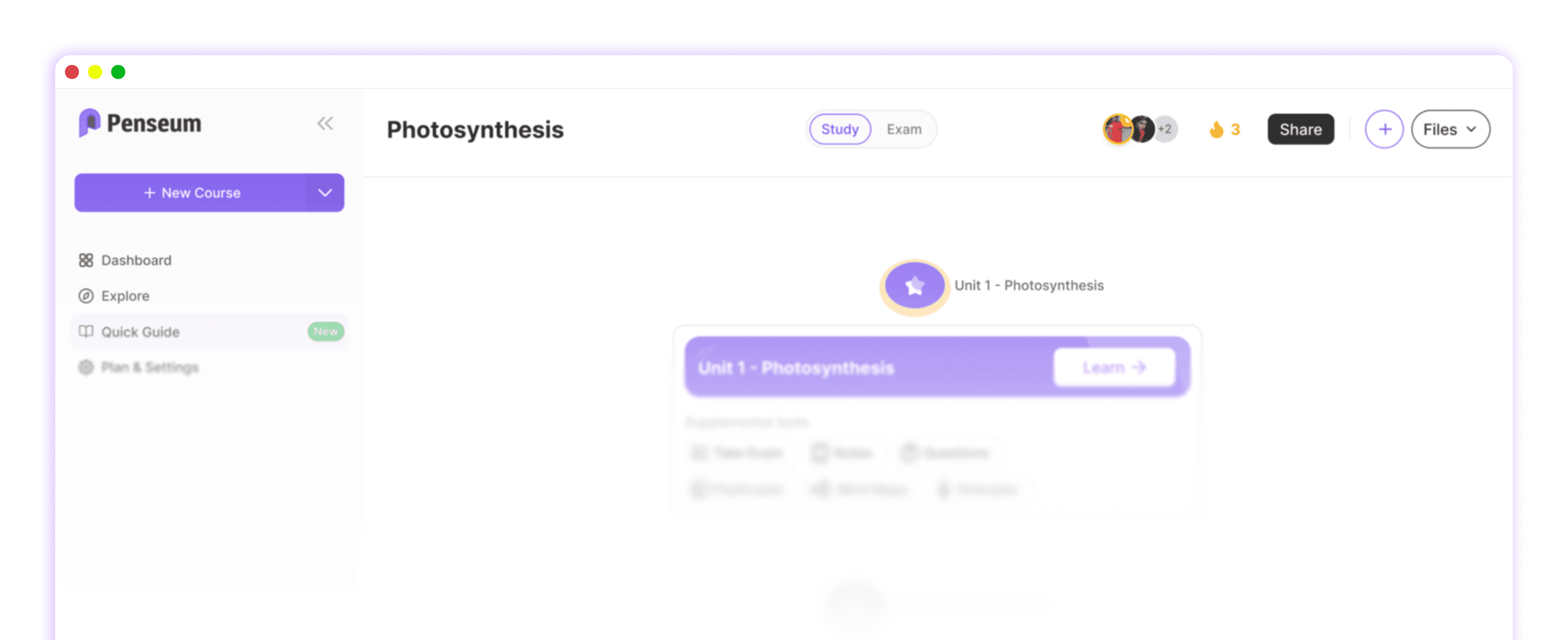
How Penseum helps you apply these active study methods
Applying evidence-based study methods like active recall, spaced repetition, and targeted practice requires high-quality materials. Traditionally, students spend hours manually writing flashcards, drafting outlines, and searching for relevant practice questions, which eats into actual study time.
The most efficient way to prepare for finals—whether you are tackling AP exam prep or university midterms—is to automate the creation of these materials so you can spend 100% of your time testing yourself. When you gather your lecture slides, textbook PDFs, and personal notes, you need a system that tests you on that exact content, not generic crowdsourced information that might be slightly off-topic.
Penseum solves this bottleneck by acting as an all-in-one platform for your exam prep. Instead of relying on pre-made Quizlet decks from strangers, you upload your specific course materials into Penseum. The AI instantly generates custom flashcards, quizzes, study guides, mind maps, and even podcasts based entirely on your syllabus.
Feature | Traditional Studying | Generic AI Chatbots | Penseum 1-on-1 AI Tutor |
|---|---|---|---|
Study Material Creation | Hours of manual writing and formatting | Uploads severely limited by short context windows | Instant custom flashcards, quizzes, and guides |
Feedback Speed | Days or weeks waiting for professor grades | Immediate text, but lacks visual context | Real-time voice and visual step-by-step correction |
Material Accuracy | High, assuming your personal notes are correct | Prone to hallucinating facts or generic answers | 100% based on your uploaded syllabus and PDFs |
Trusted by over 1.6 million students across 130 countries, Penseum features a free tier with no credit card required. If you get stuck on a difficult problem, the 1-on-1 live AI voice tutor steps in. It watches your work on a digital canvas, catches your specific mistakes in real-time, and explains the problem step-by-step out loud until you truly get it right.
Penseum does not just hand you an answer. It guides you through the active recall process, ensuring you comprehend the underlying mechanics of the problem before test day arrives.
Research: Integration of personalized AI tutoring drastically reduces the time spent on rote material generation (Kulik & Fletcher, 2016).
Actionable Step: Create a free Penseum account, upload your most difficult exam syllabus, and let the AI generate a customized quiz in seconds.
Frequently Asked Questions
How many hours should I study for a final exam?
You should aim to study between eight to twelve hours per final exam, spread out over three to four weeks. Cramming all twelve hours into a single day causes cognitive fatigue and memory decay. Distributing this time into targeted two-hour blocks using the Pomodoro technique ensures your brain actually retains the information.
Is it better to study at night or in the morning for finals?
Morning study sessions are generally more effective because your brain is fully rested and your working memory capacity is at its peak. Studying late at night often interferes with sleep architecture. Sleep is the precise time when your brain consolidates short-term memories into long-term recall, making a full night of rest mandatory before an exam.
How do you cram for a final exam if you have no time?
If you are out of time, abandon passive reading entirely. Focus exclusively on active recall and practice tests. Review your syllabus to identify the most heavily weighted topics. Generate flashcards for those specific core concepts and test yourself repeatedly. Skip the minor details and prioritize understanding the main frameworks of the course.
What foods should I eat before a final exam?
Eat complex carbohydrates and lean proteins before an exam to maintain steady blood sugar levels. Oatmeal, eggs, nuts, and berries provide sustained energy to your brain. Avoid high-sugar snacks or excessive caffeine. Sugar spikes lead to rapid crashes, which cause brain fog and disrupt your focus halfway through a long testing period.
How can I avoid blanking out during a final exam?
Preventing mental blanks requires practicing under actual test conditions. When you simulate the pressure of an exam at home with a timer, your brain adapts to the stress. If you do blank out during the real test, close your eyes, take three deep breaths to lower your heart rate, and move on to an easier question to rebuild your momentum.
Written by Samit Khalsa — Expert in cramming for exams
Last updated: October 2026
Sources
Cepeda, N. J., Vul, E., Rohrer, D., Wixted, J. T., & Pashler, H. (2008). Spacing effects in learning: A temporal ridgeline of optimal retention. Psychological Science. https://pubmed.ncbi.nlm.nih.gov/18947349/
Dunlosky, J., Rawson, K. A., Marsh, E. J., Nathan, M. J., & Willingham, D. T. (2013). Improving Students' Learning With Effective Learning Techniques. Psychological Science in the Public Interest. https://pubmed.ncbi.nlm.nih.gov/26173288/
Roediger, H. L., & Karpicke, J. D. (2006). Test-enhanced learning: Taking memory tests improves long-term retention. Psychological Science. https://pubmed.ncbi.nlm.nih.gov/16507066/
Bjork, E. L., & Bjork, R. A. (2011). Making things hard on yourself, but in a good way: Creating desirable difficulties to enhance learning. Psychology and the Real World. https://scholar.google.com/scholar?q=desirable+difficulties+bjork+2011
Hattie, J., & Timperley, H. (2007). The Power of Feedback. Review of Educational Research. https://scholar.google.com/scholar?q=The+power+of+feedback+Hattie+Timperley
Ariga, A., & Lleras, A. (2011). Brief and rare mental "breaks" keep you focused: Deactivation and reactivation of task goals preempt vigilance decrements. Cognition. https://pubmed.ncbi.nlm.nih.gov/21211793/
Kulik, J. A., & Fletcher, J. D. (2016). Effectiveness of Intelligent Tutoring Systems: A Meta-Analytic Review. Review of Educational Research. https://scholar.google.com/scholar?q=Effectiveness+of+Intelligent+Tutoring+Systems+Kulik
Related guides
Ready to study smarter?
Start turning your notes into guides, quizzes, and flashcards in seconds.