7 Tips: How Make Flashcards for Better Grades
Key Takeaways
* Formatting flashcards as specific questions forces mental retrieval, strengthening long-term memory pathways.
* Restricting each card to a single concept prevents cognitive overload and false confidence.
* Generating study materials from your personal lecture notes produces higher exam scores than borrowing crowdsourced decks.
* Pairing text with relevant images builds dual mental pathways for easier information recall.
* Using AI platforms to build flashcards cuts study preparation time from hours to seconds.
Tip 1: What is the most effective way to make flashcards?
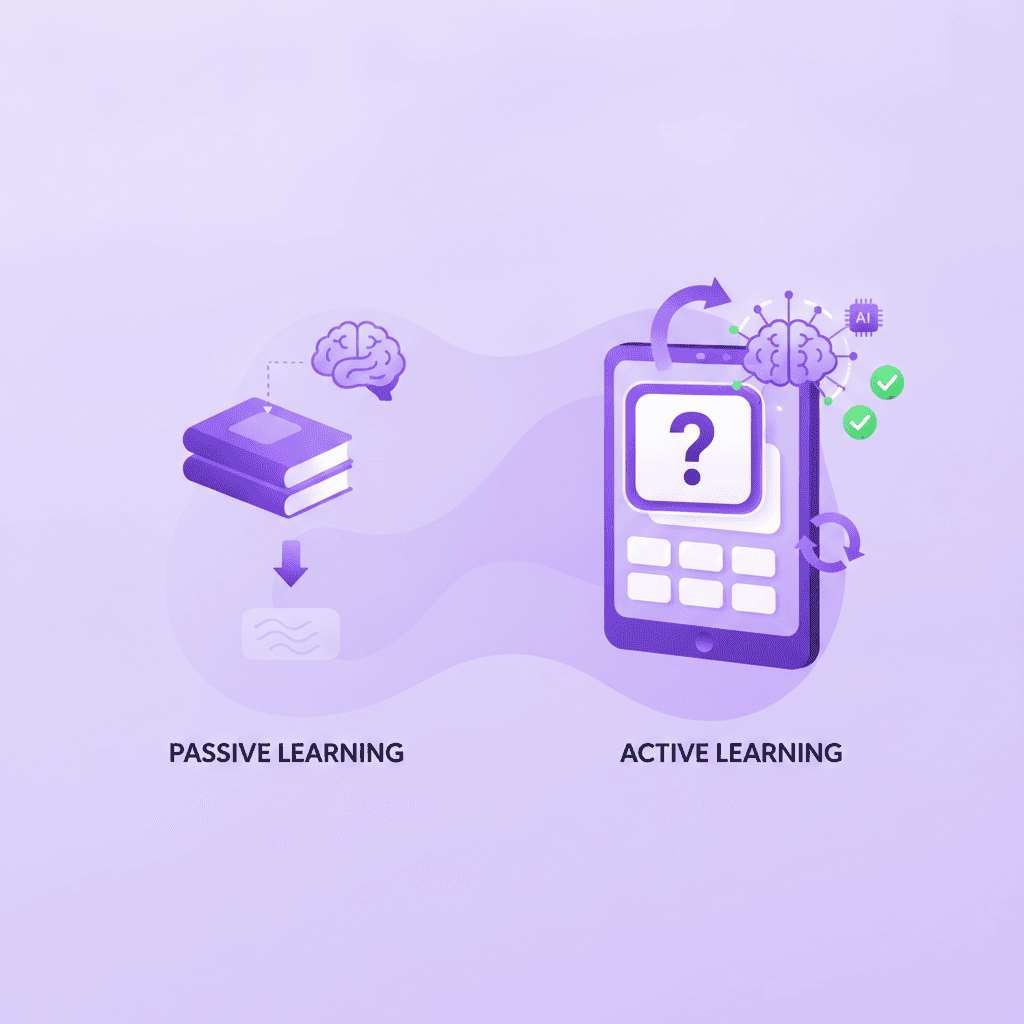
The most effective method for creating flashcards is designing them to trigger active recall. Rather than passively reading notes, format cards as direct questions that force your brain to retrieve information. This retrieval practice strengthens memory pathways significantly better than standard review.
Reading your textbook over and over creates a false sense of familiarity. You recognize the words on the page, but your brain never actually practices pulling that information out of storage. To fix this, you must transform your statements into questions. If your notes say "Mitochondria produce ATP," your flashcard should ask "Which cellular organelle is responsible for producing ATP?"
Research validates this exact approach to studying. Roediger & Karpicke (2006) discovered that active recall testing increases long-term memory retention by up to 50% compared to passive reading. Testing yourself builds new neural connections that make future retrieval faster and more reliable. This scientific foundation is exactly why adopting 5 Active Recall Flashcards Tips to Boost Memory transforms average grades into top-tier academic performance.
The mechanics of memory rely heavily on effort. The harder your brain works to pull up a fact, the stronger that memory becomes. Copying entire paragraphs onto an index card defeats this purpose entirely.
Actionable Step: Reframe the bullet points from your lecture slides into specific 'Why' or 'How' questions on the front of your cards to force mental retrieval.
Tip 2: How many concepts should go on one flashcard?
You should strictly follow the 'one concept per card' rule when designing study materials. Overloading a single flashcard with multiple facts causes cognitive overload and makes it impossible to measure true mastery. If you only remember half the card, you fail the entire concept.
Students often try to save time by listing all the causes of a historical event on a single card. When they flip the card and see they remembered three out of five points, they mark the card as "known." This partial recall creates an illusion of competence that destroys exam scores. Your brain registers the familiar points and ignores the forgotten ones.
Sweller (1988) Cognitive Load Theory indicates that human working memory can only process and hold 4 to 7 elements at any given time. Exceeding this limit guarantees that certain facts will slip through the cracks. To learn how to format these atomic units of information, reviewing 5 Flash Card Builder Tips for Faster Studying provides excellent structural templates.
Isolating facts into their own distinct cards ensures you can isolate your weak points. If a topic has five components, you need five separate flashcards.
Actionable Step: Break down complex topics into a series of smaller, interconnected cards rather than cramming an entire paragraph onto one side.
Tip 3: Why should you create your own flash cards instead of borrowing?
Creating your own flashcards forces you to cognitively process and synthesize the material, which is the vital first step of learning. Relying on generic, crowdsourced decks means you skip this deep processing, resulting in shallower understanding and significantly poorer exam performance.
When you download a premade deck made by a stranger, you lack the contextual framework that ties those facts together. The original creator went through the mental effort of deciding what was important, simplifying the wording, and structuring the question. You are just trying to memorize their final product without understanding the journey. The physical or mental act of deciding how make flashcards builds the initial memory trace.
Craik & Lockhart (1972) Levels of Processing framework demonstrates that deeper textual analysis and personal synthesis improves recall rates by roughly 30%. Translating complex lecture slides into your own simple words ensures you actually comprehend the topic. Using automated tools effectively requires personal input, which is why 5 Ways a Flash Card Generator Boosts Your Grades emphasizes uploading your specific syllabus documents.
Your professor will test you on how they presented the material in class. Generic online decks often include irrelevant information or miss the specific nuances your instructor expects you to know.
Actionable Step: Only study flashcards generated directly from your personal class notes, PDFs, or lecture slides to ensure context is retained.

Tip 4: How do images improve flashcard memorization?
Adding visual elements to your text-based flashcards dramatically improves your brain's ability to remember the content. This dual-coding approach builds two separate mental pathways, making it much easier to retrieve that specific piece of information during a high-pressure exam scenario.
Human brains are exceptionally well-wired for visual processing. If you only use text, you rely on a single verbal memory trace. Adding a picture creates a visual memory trace for the exact same concept. If the verbal pathway fails during a test, the visual pathway acts as a reliable backup system.
Clark & Paivio (1991) Dual Coding Theory reveals that combining pictures with relevant text increases memory recall rates by up to 65%. You do not need to be an artist to benefit from this effect. A rudimentary stick figure or a basic flowchart provides the exact same neurological benefit as a highly detailed illustration. Implementing visual cues is a core strategy found in 7 Tips: Flashcards for Memorization to Study Faster.
Visuals also help anchor abstract concepts into concrete reality. Connecting a complicated mathematical formula to a simple graph helps your brain categorize and store the data efficiently.
Actionable Step: Include a simple sketch, diagram, or chart on the back of your flashcard alongside the textual answer to double your retention pathways.
Tip 5: How often should you study your flashcards?
To maximize memory retention, you must space out your flashcard review sessions over increasing intervals of time. Reviewing a card right before your brain is about to forget it signals to your neurological pathways that the information is essential for long-term storage.
Cramming for eight hours the night before a final exam places information in your short-term memory. This data will vanish within a few days. Spaced repetition forces your brain to recall information just as the memory trace begins to fade. Every successful retrieval attempt thickens the myelin sheath around those specific neurons.
Ebbinghaus (1885) Forgetting Curve demonstrates that spaced review sessions can effectively halt memory decay, retaining up to 90% of learned material. Instead of studying a deck ten times in one day, studying it once a day for ten days yields vastly superior results. Understanding this mathematical approach to learning is covered extensively in 5 Ways Spaced Repetition Flashcards Boost Exam Scores.
Modern digital flashcard applications automate this scheduling process entirely. They track your success rate on individual cards and push difficult topics to the front of your daily review queue.
Actionable Step: Schedule your flashcard review sessions on days 1, 3, 7, and 14 after your initial learning phase to lock in the knowledge.
Tip 6: What are the most common mistakes when making flashcards?
The biggest mistake students make is confusing recognition with recall. Creating cards with obvious context clues, or flipping a card too early before vocalizing the answer, creates dangerous illusions of competence. You might think you know the material, but you will blank on the test.
When you look at a question and think to yourself, "I know this," you are experiencing recognition. Your brain recognizes the words, but it has not actually generated the answer. You must physically articulate the answer before revealing the back of the card. If you cannot say it out loud, you do not know it.
Karpicke et al. (2009) found that over 70% of students repeatedly fall victim to the illusion of competence by dropping flashcards from their deck too early. They get a card right once and assume it is permanently stored. Implementing strict testing protocols is highly recommended in 7 Rules for Making Flashcards That Improve Exam Grades.
Another massive error is copying textbook definitions verbatim. Memorizing a block of academic jargon without understanding the underlying meaning guarantees failure on applied exam questions.
Actionable Step: Say the answer to your flashcard entirely out loud before you allow yourself to flip it over and check the back.
Tip 7: How Penseum Helps You Apply Smart Flashcard Creation
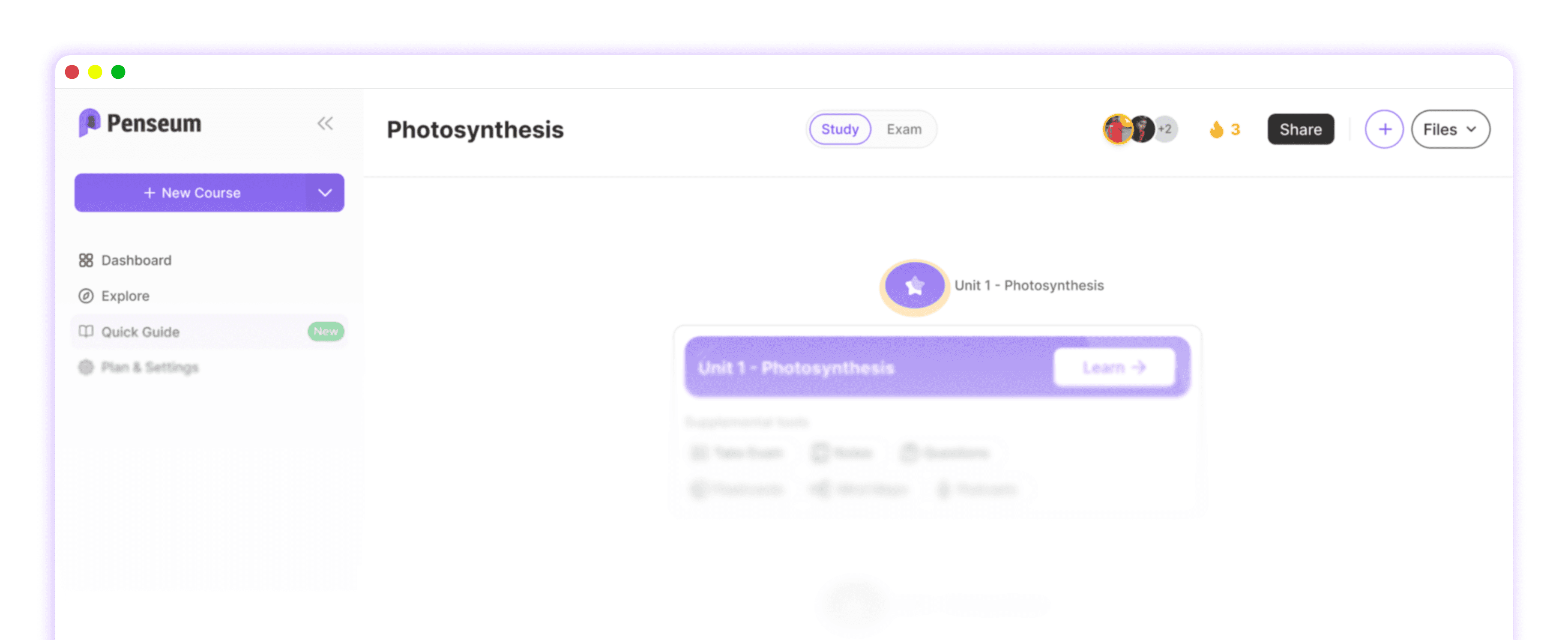
Instead of spending hours manually typing out cards, modern students use AI platforms to generate perfectly formatted flashcards directly from uploaded notes, PDFs, and slides. This ensures your study materials match your exact syllabus without the tedious prep work. By combining an automated flash card builder with an interactive AI tutor that explains mistakes live, you receive continuous, personalized educational support.
Creating an entire chapter's worth of active-recall flashcards by hand takes massive amounts of time away from actual studying. Penseum solves this by analyzing your specific documents and instantly extracting testable concepts into digital flashcards. Rather than relying on generic online decks, your study materials are tied exclusively to your professor's lectures.
Bloom (1984) 2 Sigma Problem shows that 1-on-1 tutoring improves student performance by roughly two standard deviations, or 98% better than standard classroom learning. Penseum acts as this dedicated tutor. It watches you work through problems, catches your specific mistakes, and explains the correction out loud using real-time voice and visual diagrams.
Feature | Manual Flashcards | Basic AI Text Bots | Penseum AI Tutor |
|---|---|---|---|
Material Source | Self-written | Generic training data | Your specific PDFs/notes |
Creation Time | 2-3 Hours | 5-10 Minutes | Under 30 Seconds |
Error Correction | None | Text responses only | Live voice & visual diagrams |
Testing Style | Static paper | Basic chat | Adaptive quizzes & cards |
Basic chat tools give you a text response and wait for your next message. Penseum sees your actual work on the screen, draws diagrams live on your canvas, and keeps teaching until you actually get the answer right. This continuous loop of testing and feedback ensures absolute mastery of the material. Incorporating tools like this perfectly aligns with 5 Ways a Flashcard Generator Boosts Your Grades.
Actionable Step: Upload your next lecture PDF into Penseum's free platform to instantly generate an active recall flashcard deck based exclusively on your own materials.

Frequently Asked Questions
How do I make flashcards online for free?
Yes, you can easily create online flashcards for free using digital AI platforms like Penseum. Instead of paying expensive subscriptions, simply upload your personal study materials. The AI will instantly generate customized flashcards, quizzes, and comprehensive study guides from your exact syllabus without requiring a credit card. Exploring 7 Flash Card Creator Free Tips to Slash Study Time provides more strategies for optimizing your digital workspace.
Is it better to type or handwrite flashcards?
While handwriting can slightly improve initial memory encoding, typing your flashcards is significantly faster and more practical for modern college students. Using a digital flashcard generator online allows you to incorporate spaced repetition algorithms, attach images effortlessly, and study anywhere on your mobile device. Students implementing 7 Ways a Flash Cards Generator Boosts Your Grades consistently report faster study sessions.
How long does it take to make good flashcards?
Manually creating a comprehensive deck for a single textbook chapter can take two to three hours of tedious work. Using an AI-powered flashcard creator online reduces this time to seconds. By uploading your existing notes, the AI extracts key testable concepts instantly, saving you hours of study prep.
What should you not do when making flashcards?
Avoid putting paragraphs of text on a single card, copying verbatim from textbooks, and relying on generic crowdsourced decks made by strangers. These mistakes create dangerous illusions of competence. Always use your own tailored notes and strictly limit yourself to one distinct fact or concept per card.
How do I create my own flashcards automatically?
To create your own flashcards automatically, upload your lecture slides, PDFs, or typed notes into an AI-powered study platform. The artificial intelligence reads your documents, extracts the most important testable information, and instantly formats it into a targeted question-and-answer deck, ensuring your study materials match your actual syllabus.
Written by Samit Khalsa — Expert in cramming for exams
Last updated: September 2026
Sources
Roediger, H. L., & Karpicke, J. D. (2006). Test-Enhanced Learning: Taking Memory Tests Improves Long-Term Retention. Psychological Science, 17(3), 249-255. Available at: https://pubmed.ncbi.nlm.nih.gov/16507066/
Sweller, J. (1988). Cognitive Load During Problem Solving: Effects on Learning. Cognitive Science, 12(2), 257-285. Available at: https://scholar.google.com/scholar?q=Sweller+Cognitive+Load+Theory+1988
Craik, F. I. M., & Lockhart, R. S. (1972). Levels of Processing: A Framework for Memory Research. Journal of Verbal Learning and Verbal Behavior, 11(6), 671-684. Available at: https://scholar.google.com/scholar?q=Craik+Lockhart+Levels+of+Processing+1972
Clark, J. M., & Paivio, A. (1991). Dual Coding Theory and Education. Educational Psychology Review, 3(3), 149-210. Available at: https://scholar.google.com/scholar?q=Clark+Paivio+Dual+Coding+Theory+1991
Ebbinghaus, H. (1885). Memory: A Contribution to Experimental Psychology. Annals of Neurosciences, 20(4), 155–156. Available at: https://pubmed.ncbi.nlm.nih.gov/25232230/
Karpicke, J. D., Butler, A. C., & Roediger, H. L. (2009). Metacognitive strategies in student learning: Do students practise retrieval when they study on their own? Memory, 17(4), 471-479. Available at: https://pubmed.ncbi.nlm.nih.gov/19358016/
Bloom, B. S. (1984). The 2 Sigma Problem: The Search for Methods of Group Instruction as Effective as One-to-One Tutoring. Educational Researcher, 13(6), 4-16. Available at: https://scholar.google.com/scholar?q=Bloom+2+Sigma+Problem+1984
Related guides
Ready to study smarter?
Start turning your notes into guides, quizzes, and flashcards in seconds.