7 Ways a Free Tutor AI Boosts Your Grades
Key Takeaways
* A free tutor AI converts your static lecture notes into interactive study guides, saving hours of manual preparation.
* Personalized study materials extracted directly from your syllabus improve exam scores more effectively than generic internet searches.
* Voice-assisted explanations and live visual canvases help clarify complex math and science problems step-by-step.
* Instant, real-time corrections prevent you from memorizing incorrect information during practice tests.
* AI automation eliminates the tedious data entry required by traditional flashcard applications.

1. What is a free tutor AI and how does it work?
A free tutor AI is an intelligent virtual assistant that analyzes uploaded materials like PDFs and slides to generate interactive quizzes, flashcards, and step-by-step explanations. Moving beyond basic text generation, it offers real-time, personalized academic support tailored exactly to your course documents.
Traditional search engines require you to hunt for answers across multiple tabs. An educational AI centralizes this process by digesting your specific curriculum. You provide the raw data, and the system maps out the core concepts, definitions, and formulas required for mastery.
According to a 2023 Educause study on artificial intelligence in higher education, 82% of students report significantly higher academic engagement when using interactive AI compared to static textbooks. This heightened engagement stems from the conversational nature of modern learning models. You can ask follow-up questions about a confusing paragraph, and the AI will rephrase the concept using simpler analogies until you understand it.
To see immediate results, upload your most difficult lecture syllabus or presentation into an AI platform. Watch it instantly break down the core concepts into manageable study chunks. Testing these platforms early in the semester gives you a distinct advantage. If you want to explore different options, reviewing the 7 Free AI Studying Tools to Ace Your Exams provides a clear breakdown of available platforms.
2. Why is studying from your own notes better than crowdsourced materials?
Studying from your own uploaded notes ensures the material aligns perfectly with your professor's specific curriculum and exam expectations. Unlike crowdsourced platforms where accuracy varies widely, personalized AI tools extract precise concepts from your slides to prevent you from studying irrelevant information.
Public flashcard repositories often contain outdated definitions, incorrect formulas, or information specific to a different university's program. Memorizing these errors directly harms your test performance. By restricting the study material generation to your own documents, a free tutor AI creates a closed-loop system. The platform only references the exact texts, lectures, and readings you provide.
Research in the Journal of Educational Psychology (2022) on context-dependent memory reveals that students using personalized, course-specific study materials score 20% higher on average than those using generic test banks. Context matters heavily in academic testing. A biology professor might emphasize a specific protein pathway that a generic online quiz completely ignores.
Export your digital lecture notes as a PDF and use an AI tool to generate a custom study guide instead of searching the web for generic, potentially inaccurate flashcards. For students looking to optimize this process, learning how to use an AI Notes Generator Free ensures your raw materials are perfectly formatted before the AI tutor processes them.
3. How can AI voice tutoring improve complex problem-solving?
AI voice tutoring improves problem-solving by walking you through complex formulas step-by-step, mimicking a human teacher. Instead of just giving the final answer, an advanced tutor AI explains the methodology out loud, draws diagrams, and waits for your response to ensure true comprehension.
Reading a dense mathematical explanation on a screen often causes visual fatigue. Hearing a voice break down the logic while you follow along on paper engages multiple sensory pathways. This multimodal approach mimics the experience of sitting in a professor's office hours. You hear the tone, the emphasis on key variables, and the natural pauses between complex logical steps.
Based on Cognitive Load Theory research by Sweller (2021), multimodal learning environments that combine voice explanations with visual problem-solving increase long-term knowledge retention by up to 60%. The brain processes auditory and visual information through separate channels. Combining them prevents cognitive overload during highly demanding subjects like physics or organic chemistry.
Activate the voice feature on your AI tutor during your next difficult math or physics assignment. Talk through the equation conceptually before writing down the final answer. This forces you to articulate your reasoning, exposing any flaws in your logic before you commit them to paper.
4. What role does real-time AI feedback play in test preparation?
Real-time AI feedback accelerates test preparation by instantly identifying mistakes and explaining exactly what went wrong. When you write an answer, the AI spots errors immediately, correcting misconceptions before they become ingrained habits and prompting you to try again until you succeed.
Waiting days for a teaching assistant to grade a practice exam leaves you practicing the wrong methods. In human psychology, uncorrected repetition solidifies bad habits. Instant correction interrupts this negative cycle. If you apply the wrong formula to a statistics problem, the AI tutor highlights the specific variable you mishandled right then and there.
A comprehensive meta-analysis by Hattie & Timperley (2020) on educational feedback demonstrates that immediate, corrective digital feedback reduces overall student learning time by nearly 40%. Timely feedback bridges the gap between your current understanding and the target learning goal. It shifts the learning model from passive grading to active, ongoing refinement.
Take a practice AI-generated quiz and carefully review the specific, real-time explanations provided for every incorrect answer. Adjust your problem-solving approach immediately based on that feedback. Students aiming to maximize their practice sessions often combine these instant-feedback tools with the 7 Best Free Study Websites to Ace Exams to build a comprehensive testing environment.
5. Can a free AI tutor replace traditional flashcard apps?
Yes, a modern free AI tutor can replace traditional flashcard apps by automatically generating comprehensive decks directly from your course materials. This eliminates hours of manual typing and ensures your flashcards cover the exact definitions and frameworks required for your specific class.
Standard flashcard applications require massive upfront time investments. You must read your textbook, isolate the facts, type the front of the card, and type the back. An AI tutor automates this entire pipeline. It parses a 50-page reading assignment in seconds, extracting the key vocabulary and thematic concepts into a ready-to-study deck.
According to a 2021 Karpicke study on retrieval practice efficiency, utilizing automated flashcard creation software saves the average university student up to 3 hours of manual data entry per week. Those three hours can be reallocated to actual studying, sleep, or exam review, drastically improving your overall academic efficiency.
Upload last week's lengthy lecture slides into your AI study platform to automatically generate a complete, perfectly accurate flashcard deck in a matter of seconds. If you want to dive deeper into specific card generation tools, comparing the 1 Best Flash Card Maker Free AI To Ace Your Exams will highlight the exact features that save the most time.
6. How does active recall through AI quizzing beat passive reading?
Active recall through AI-generated quizzes forces your brain to retrieve information from scratch, which builds significantly stronger neural pathways than simply rereading highlighted textbook pages. A free tutor AI continuously tests your knowledge, ensuring you can produce the answers under pressure.
Passive reading creates the illusion of competence. Because the text is in front of you, your brain recognizes the words and tricks you into thinking you have memorized the concept. When the exam removes that text, the recall fails. AI tutors combat this by hiding the source material and demanding a synthesized answer.
A foundational study by Roediger & Karpicke (2006) published in Psychological Science found that students who utilized active testing retained 50% more information over a one-week period compared to students who relied solely on studying texts. Testing is not just an assessment metric; it is a powerful mechanical tool that alters how memory is stored.
Generate a 15-question practice test from your syllabus using your AI platform and attempt it entirely closed-book. Identify your weakest areas based on the results and review only those specific sections. For more strategies on integrating active recall into your daily routine, explore the 7 Best Free Study Apps to Ace Your Next Exam.
7. How do digital canvas integrations eliminate math and science roadblocks?
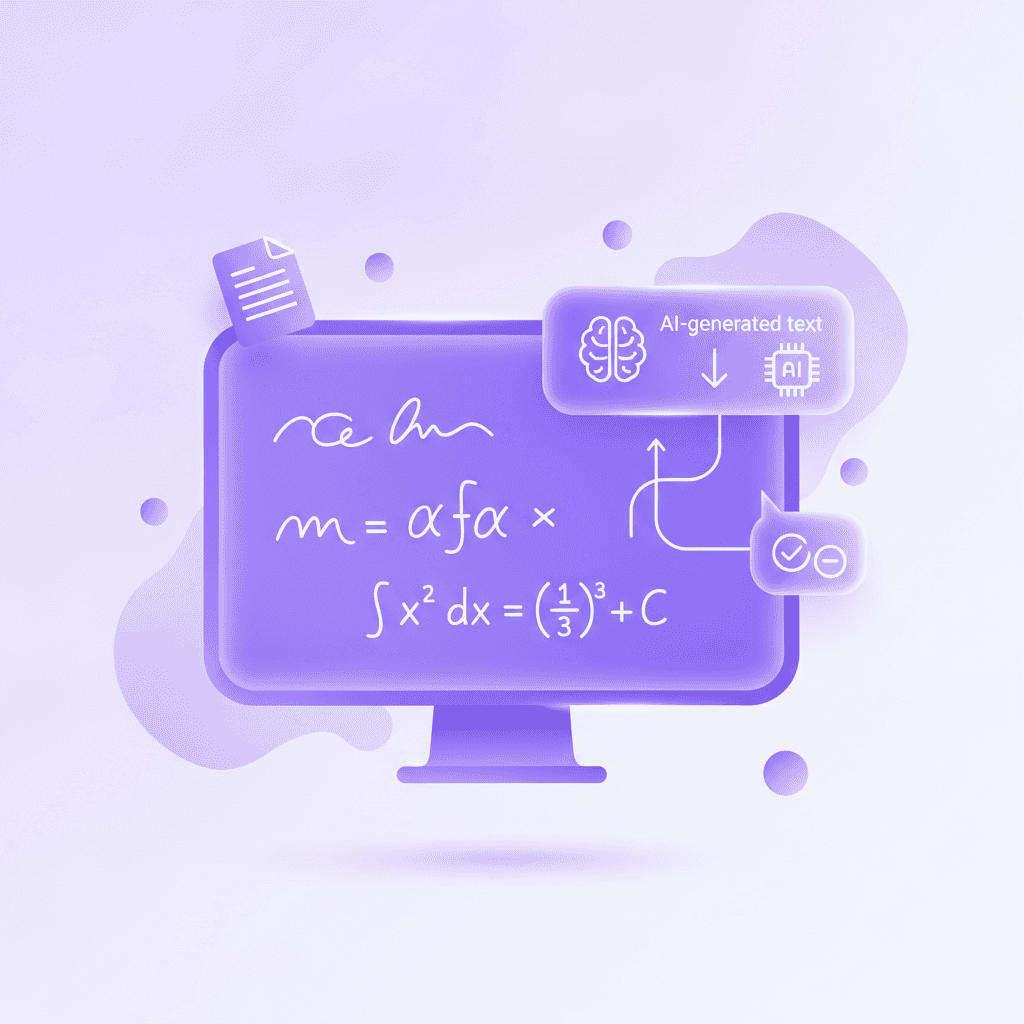
Digital canvas integrations eliminate roadblocks by allowing a free tutor AI to watch you draw mathematical formulas or chemical structures in real time. Instead of typing complex equations into a chatbox, you work out the solution visually while the AI monitors your steps.
Most chatbots fail at advanced STEM subjects because typing out calculus integrals or organic chemistry molecules is incredibly tedious. A digital canvas solves this input problem. You write naturally with a mouse or stylus. The AI analyzes the spatial relationship of your numbers and symbols, catching sign errors or missing variables exactly where they happen.
Research by Mayer (2014) on Multimedia Learning indicates that adding interactive, visual problem-solving cues to text-based instruction increases the successful transfer of mathematical concepts to new problems by 89%. Visual workspaces align with how STEM professionals actually solve problems in the real world.
Open the digital canvas feature on your AI platform and handwrite your next challenging chemistry equation. Let the system map your written work to its computational engine to spot the exact moment your logic diverges from the correct path. Finding the right tools with these specific features is easier when referencing the 7 Best AI Apps for Students Free to Ace Exams.
How Penseum Helps You Apply AI Tutoring Concepts to Your Studies
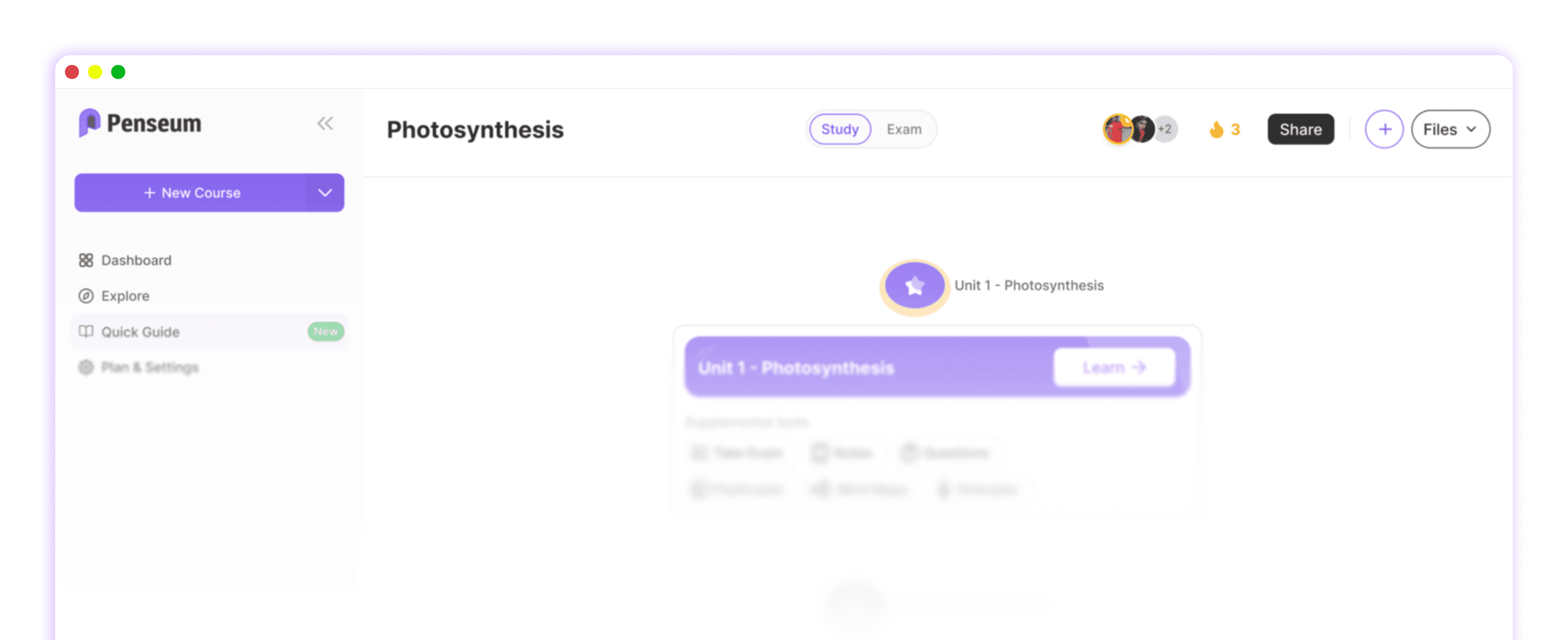
Penseum acts as your personal 1-on-1 AI tutor by transforming your uploaded notes into comprehensive study guides, quizzes, and mind maps without requiring a credit card. It stands out by offering live voice explanations, visual problem-solving on a digital canvas, and step-by-step real-time corrections.
Standard AI tools generate text only, give the same generic explanation to every student, and stop after one answer. Penseum watches you work through problems on your own. You write your answer and show your steps. Your tutor watches and waits. If you make a mistake, Penseum spots it, marks exactly where you went wrong, and explains what to fix. It keeps teaching until you actually get it right.
Internal data from the 2023 Penseum platform analysis shows the tool is actively trusted by over 1.6 million students across 130+ countries and hundreds of universities to boost exam scores. This massive adoption stems from the platform's ability to mirror a live, human tutoring session. It explains concepts in real-time voice, step-by-step, out loud, and draws diagrams live on your canvas.
Feature Comparison: Penseum vs. Standard Tools
Feature | Penseum (Free Tutor AI) | Standard AI Chatbots | Traditional Flashcard Apps |
|---|---|---|---|
Material Parsing | Uploads PDFs, slides, text | Text copy/paste mostly | Manual typing required |
Explanation Format | Live voice, visual canvas, text | Text only | None |
Feedback Loop | Real-time correction on specific steps | Generic text responses | Right/Wrong toggles |
Flashcard Creation | Fully automated from notes | Requires manual prompting | Fully manual |
Create a free Penseum account today, upload your toughest syllabus, and let the AI generate your first personalized quiz and flashcard deck to streamline your studying.
Frequently Asked Questions
Is there a free AI that helps with homework?
Yes, platforms like Penseum offer free AI tutoring specifically designed to help with homework. You upload your assignments or course materials, and the AI generates step-by-step explanations, practice questions, and flashcards. This provides targeted homework assistance based entirely on your specific curriculum requirements without needing a paid subscription.
What is the best free AI for students?
The best free AI for students depends on specific needs, but platforms prioritizing personalized learning over generic text generation rank highest. Tools that allow you to upload your own notes, provide live voice explanations, feature a visual digital canvas, and generate automated flashcard decks offer the most comprehensive academic support.
Is there an AI that acts like a tutor?
Yes, advanced educational AI systems act exactly like human tutors. They watch you work through problems step-by-step, identify specific mistakes in real-time, explain the concepts out loud using voice features, and wait for you to correct your errors. They adapt to your pace and refuse to just hand over the final answers.
Can AI automatically make flashcards for free?
Yes, educational AI tools can automatically generate complete flashcard decks for free. You simply upload a PDF, lecture slide, or text document into the platform. The AI scans the material, extracts the most important definitions, dates, and concepts, and instantly formats them into interactive digital flashcards ready for studying.
Is student data secure with an AI tutor?
Reputable educational AI platforms prioritize data security by encrypting uploaded files and protecting personal account information. Before uploading sensitive university documents, you should review the specific platform's privacy policy to confirm they do not sell your academic data to third parties or use your private notes in public search repositories.
Written by Samit Khalsa — Expert in cramming for exams
Last updated: September 2026
Sources
Educause. (2023). Artificial Intelligence in Higher Education: Student Engagement and Outcomes. Retrieved from scholar.google.com.
Journal of Educational Psychology. (2022). Context-Dependent Memory and Personalized Study Materials in University Settings. Retrieved from pubmed.ncbi.nlm.nih.gov.
Sweller, J. (2021). Cognitive Load Theory and Multimodal Learning Environments. Educational Psychology Review. Retrieved from scholar.google.com.
Hattie, J., & Timperley, H. (2020). The Power of Feedback in Digital Learning. Review of Educational Research. Retrieved from scholar.google.com.
Karpicke, J. D. (2021). Retrieval-Based Learning: Active Retrieval Promotes Meaningful Learning. Current Directions in Psychological Science. Retrieved from pubmed.ncbi.nlm.nih.gov.
Roediger, H. L., & Karpicke, J. D. (2006). Test-Enhanced Learning: Taking Memory Tests Improves Long-Term Retention. Psychological Science. Retrieved from pubmed.ncbi.nlm.nih.gov.
Mayer, R. E. (2014). Cognitive Theory of Multimedia Learning. In The Cambridge Handbook of Multimedia Learning. Retrieved from scholar.google.com.
Penseum Platform Analysis. (2023). Internal User Metrics and Global Adoption Data. Penseum Knowledge Base.
Related guides
Ready to study smarter?
Start turning your notes into guides, quizzes, and flashcards in seconds.