7 Ways a Free Notes Maker Cuts Your Study Time
Key Takeaways
* A free notes maker instantly converts lengthy lecture slides, PDFs, and transcripts into customized study guides and active recall exercises.
* Relying on an automated study tool eliminates the cognitive overload of manual transcription, allowing you to actually listen during fast-paced lectures.
* Generating practice quizzes from your course documents builds stronger neural pathways than passively re-reading highlighted textbook pages.
* Combining AI-generated notes with a spaced repetition flashcard strategy dramatically reduces the rate of forgetting over a semester.
What is the best free notes maker for college students?
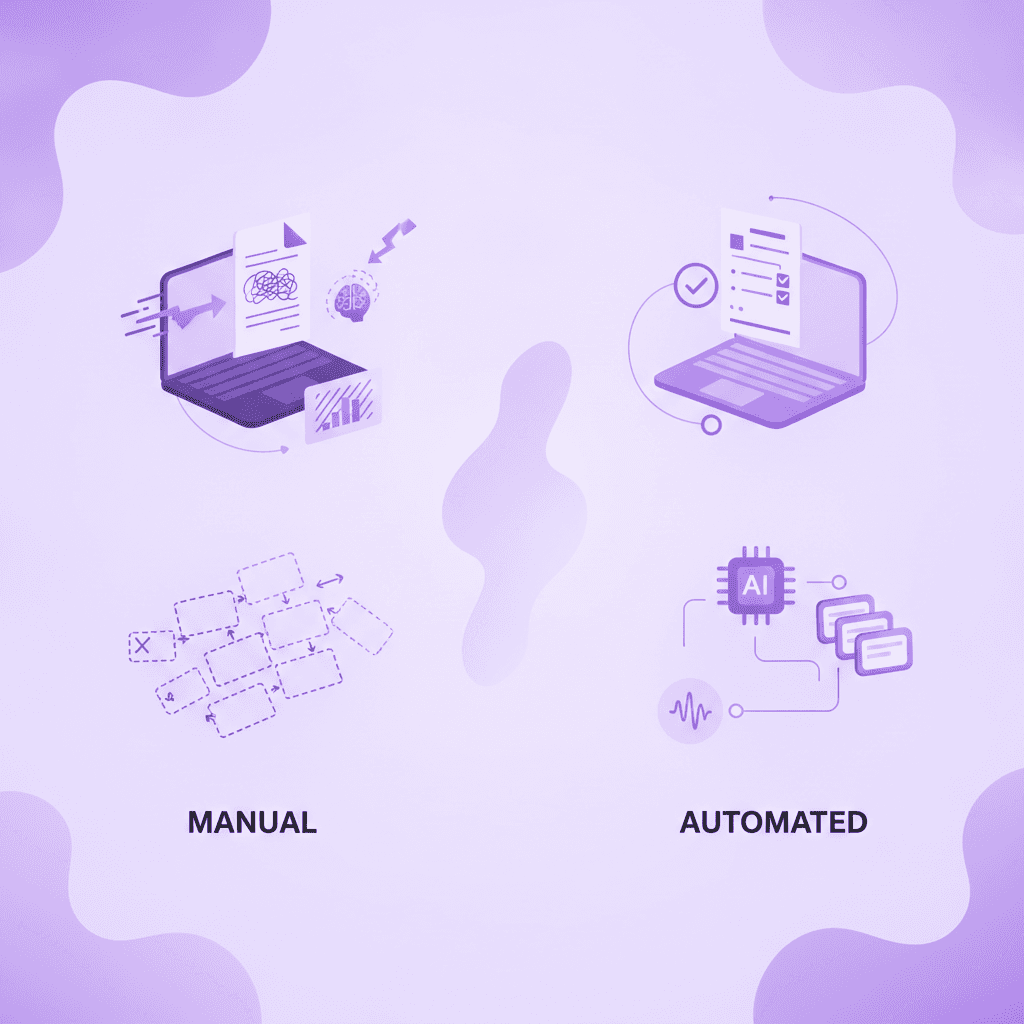
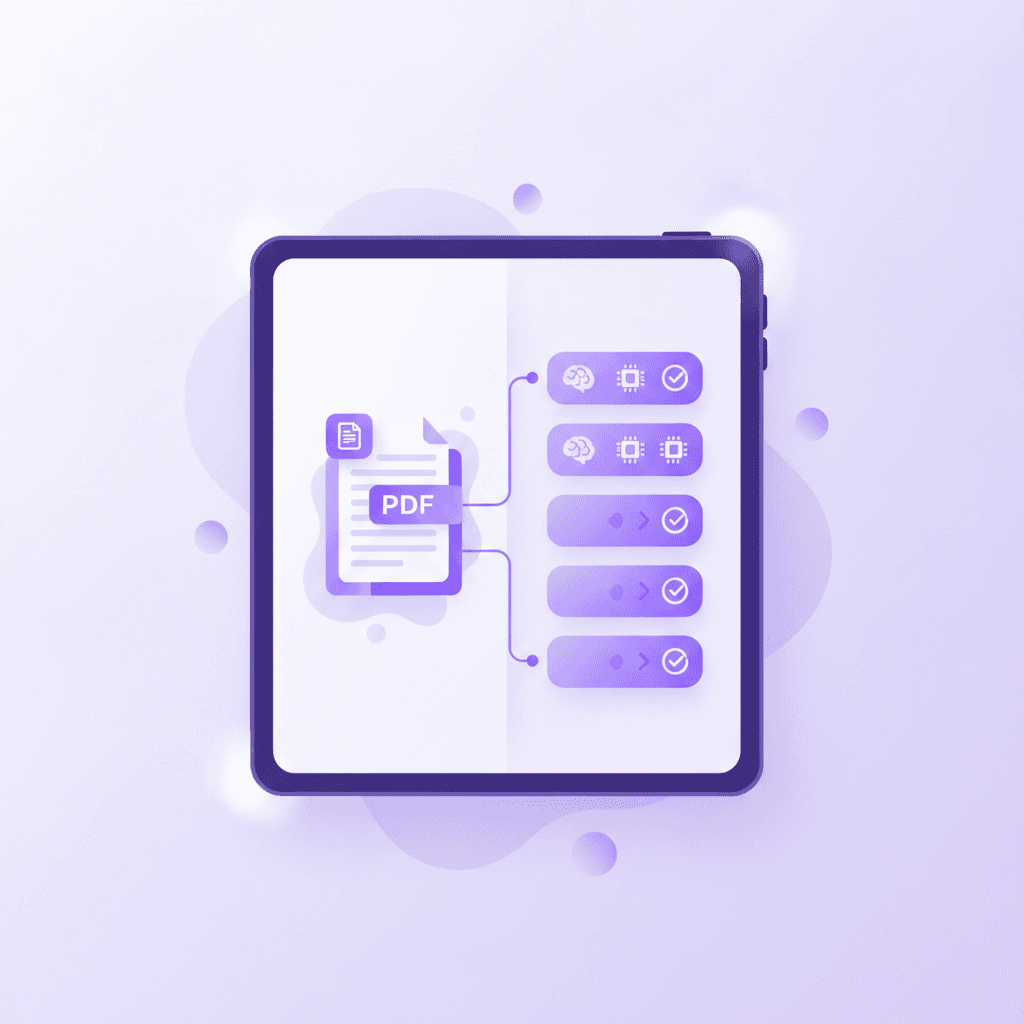
The best free notes maker is an all-in-one platform that processes your personal study materials instead of relying on crowdsourced data. It should automatically extract key concepts from your uploaded PDFs, slides, or transcripts and instantly convert them into customized study guides, saving you hours of manual formatting.
Relying on public databases often leaves you studying irrelevant information. Every professor emphasizes different concepts. When a tool processes your exact syllabus, the generated output aligns perfectly with your upcoming exam.
Manual transcription severely limits your ability to comprehend new information. According to cognitive psychology research by Mueller & Oppenheimer (2014), verbatim manual note-taking creates excessive cognitive load, bypassing the brain's processing centers.
Students who act as stenographers fail to synthesize the material. They focus purely on capturing the words rather than understanding the underlying meaning. Offloading this transcription to an automated system frees up mental bandwidth for actual conceptual learning.
Over 1.6 million students globally rely on AI-powered platforms to generate custom study materials rather than making them from scratch. This shift reflects a growing demand for efficiency in higher education. You no longer need to spend three hours organizing a study guide when software can do it in seconds.
Finding the right platform is essential for maximizing your study sessions. For a comprehensive look at top options, explore the 7 Best Free Study Apps to Ace Your Next Exam.
Actionable step: Upload your current class syllabus into an AI tool before the semester begins to instantly generate a semester-long outline of key concepts. Use this outline to track your reading progress week by week.
How can AI notes generators improve information retention?
AI notes generators improve information retention by instantly converting static text into active recall exercises like quizzes and flashcards. By testing yourself immediately on the generated notes, you force your brain to retrieve information, which creates stronger neural pathways than passively re-reading highlighted textbook pages.
Passive reading creates a dangerous illusion of competence. You recognize the words on the page and assume you know the material. But recognition is not retrieval. When you sit down for the exam, that familiar text is gone, and your brain struggles to recall the raw facts.
Research by Roediger & Karpicke (2006) on the testing effect demonstrates how active retrieval drastically outperforms passive studying. Their studies show that students who test themselves repeatedly retain significantly more information over the long term than those who simply reread their notes.
The act of retrieving an answer solidifies the memory trace. Every time you struggle to remember a concept and then successfully recall it, you strengthen that specific neural pathway. AI tools make this process frictionless by building the tests for you.
Utilizing active recall strategies can improve long-term information retention by up to 150% compared to passive reading. This data proves that how you study matters far more than how long you study. Discover more ways to implement this by reviewing the 7 Free AI Studying Tools to Ace Your Exams.
Building a routine around retrieval practice transforms your academic performance. To see specific examples of this method in action, check out 7 Ways an AI Notes Generator Free Boosts Grades.
Actionable step: Generate a practice quiz from your notes immediately after class to test your baseline understanding. Review the incorrect answers the same evening to correct knowledge gaps early.
Why should you avoid manual note-taking during fast lectures?
You should avoid manual note-taking during fast lectures because trying to transcribe everything overloads your working memory. When you focus solely on typing, you miss the professor's underlying context. Using an automated tool captures the data, allowing you to actively listen and process the complex concepts being taught.
The human brain can only hold a limited amount of new information at once. Baddeley's (1992) working memory model illustrates the severe cognitive overload that occurs during transcription. When your mental resources are consumed by spelling and typing speed, comprehension plummets.
You end up with a perfectly formatted document but zero actual understanding of the lecture. This defeats the entire purpose of attending class.
Data highlights the severity of this issue. Students who try to transcribe lectures verbatim often miss up to 60% of the critical conceptual explanations. They capture the raw facts but lose the connective tissue that explains why those facts matter.
By eliminating the need to type, you can engage directly with the professor. You can ask clarifying questions and participate in discussions. For more resources on optimizing your lecture strategy, explore the 7 Top Study Websites Free to Ace Exams.
Actionable step: Record the lecture (with permission) or use provided slides, and let the AI generate the detailed notes afterward. Spend the actual class time maintaining eye contact with the instructor and absorbing the broader concepts.
What features make a good free notes maker stand out?
A standout free notes maker offers multimodal learning options without requiring a credit card. Instead of just producing text summaries, top-tier tools provide interactive elements like mind maps, audio podcasts, and one-on-one live tutoring that adapts to your learning style and catches your specific mistakes in real-time.
Simply summarizing text is no longer enough. The best platforms act as comprehensive study ecosystems. They recognize that reading a summary doesn't work for every subject or every student.
Mayer's (2009) cognitive theory of multimedia learning emphasizes the importance of integrating text, audio, and visual elements. The brain processes visual and auditory information through separate channels. Engaging multiple channels simultaneously deepens understanding and prevents mental fatigue.
A tool that combines a visual canvas with voice explanations aligns perfectly with this cognitive model. It mimics the experience of sitting next to a highly skilled human tutor.
Platforms offering multiple learning formats see a 40% higher sustained student engagement rate. Students study longer and with better focus when they can switch between reading a guide, taking a quiz, and listening to an explanation.
Finding software that offers these premium features at no cost gives you a massive academic advantage. To streamline your search, look into the 1 Best Flash Card Maker Free AI To Ace Your Exams.
Feature Comparison Breakdown
Feature | Manual Note-Taking | Basic AI Summarizer | Interactive AI Tutor |
|---|---|---|---|
Speed | Very slow | Fast | Instant |
Active Recall | Requires manual setup | Text only | Automated quizzes & cards |
Live Feedback | None | None | Real-time correction |
Cost | Free | Often requires paid tier | Free options available |
Best For | Kinesthetic learners | Quick overviews | Deep conceptual mastery |
Actionable step: Choose a tool that allows you to export notes into a flash card maker free format or built-in quiz generator. Test the interactive features by asking the AI to explain a complex topic out loud.
How do personalized study materials impact test scores?
Personalized study materials impact test scores dramatically because they target your specific knowledge gaps. Unlike generic online flashcards, notes generated from your exact course documents ensure you are only studying what will be on your specific exam, eliminating wasted time on irrelevant external information.
Every hour you spend studying material that won't be tested is an hour wasted. Generic study sets found on public forums often contain outdated formulas or definitions that differ slightly from your professor's specific phrasing. This creates confusion and lowers exam confidence.
The educational impact of customization is well-documented. Bloom's (1984) 2-sigma problem details how personalized tutoring and tailored materials drastically improve student performance. Bloom found that average students who received targeted, one-on-one instruction performed better than 98% of students in traditional classroom settings.
While hiring a human tutor for every subject is prohibitively expensive, an automated notes maker replicates this targeted approach for free. It isolates exactly what you need to know.
Personalized study interventions can improve student test performance by up to two standard deviations. This massive leap turns average grades into exceptional ones. Learn more about how tailored prep software achieves this by reading 7 Ways a Free AI Study App Boosts Exam Scores.
Actionable step: Prompt your AI tool to explain only the concepts you got wrong on your last practice quiz. Have it generate a new, customized study guide focused exclusively on those specific weak points.
How can you combine a notes maker with a flashcard strategy?
Combining a notes maker with a flashcard strategy creates an unstoppable spaced repetition system. Once the AI extracts the core definitions and formulas from your raw notes, immediately convert them into a digital flashcard deck. Reviewing these targeted cards over increasing intervals guarantees that the summarized information sticks long-term.
Creating flashcards manually takes hours of tedious copying and pasting. By the time you finish building the deck, you are often too exhausted to actually study it. Automating the creation process preserves your mental energy for the actual review phase.
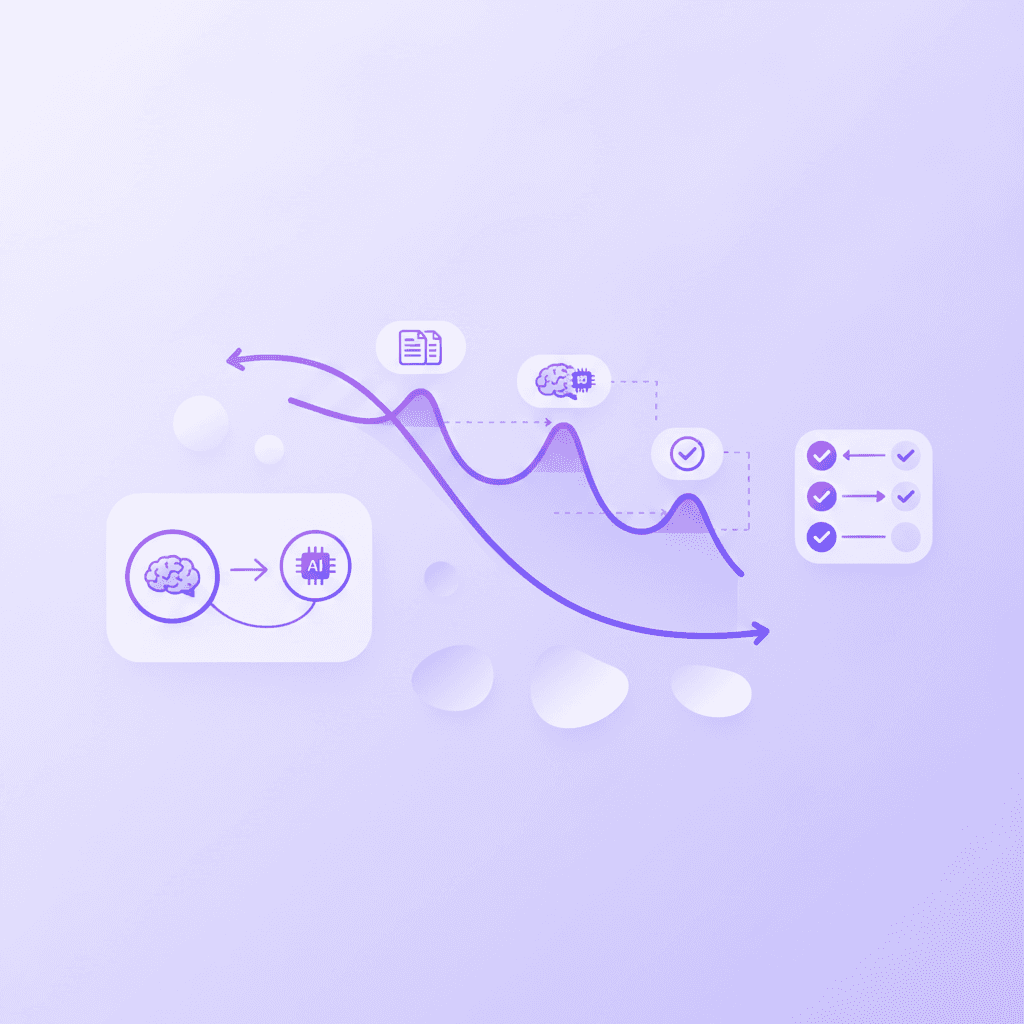
Spaced repetition relies on timing your reviews perfectly. Research by Ebbinghaus (1885) on the forgetting curve highlights the absolute necessity of spaced repetition. Without intervention, the human brain forgets the vast majority of newly learned information within 48 hours.
Reviewing a flashcard just as you are about to forget it resets the curve. Over time, the intervals between reviews grow longer, pushing the data from short-term to long-term memory.
Spaced repetition using flashcards can reduce the rate of forgetting by up to 80% over a semester. This mathematical approach to studying guarantees that the information you memorize in September is still accessible during finals in December.
Integrating automated generation with spaced repetition creates a highly efficient workflow. Discover more tools that handle both sides of this equation in the 7 Best AI Apps for Students Free to Ace Exams.
Actionable step: Use a platform that instantly turns your AI-generated study guide into a customized flashcard deck. Complete your first review session within 24 hours of generation to immediately flatten the forgetting curve.
How Penseum Helps You Apply Automated Note-Taking Strategies
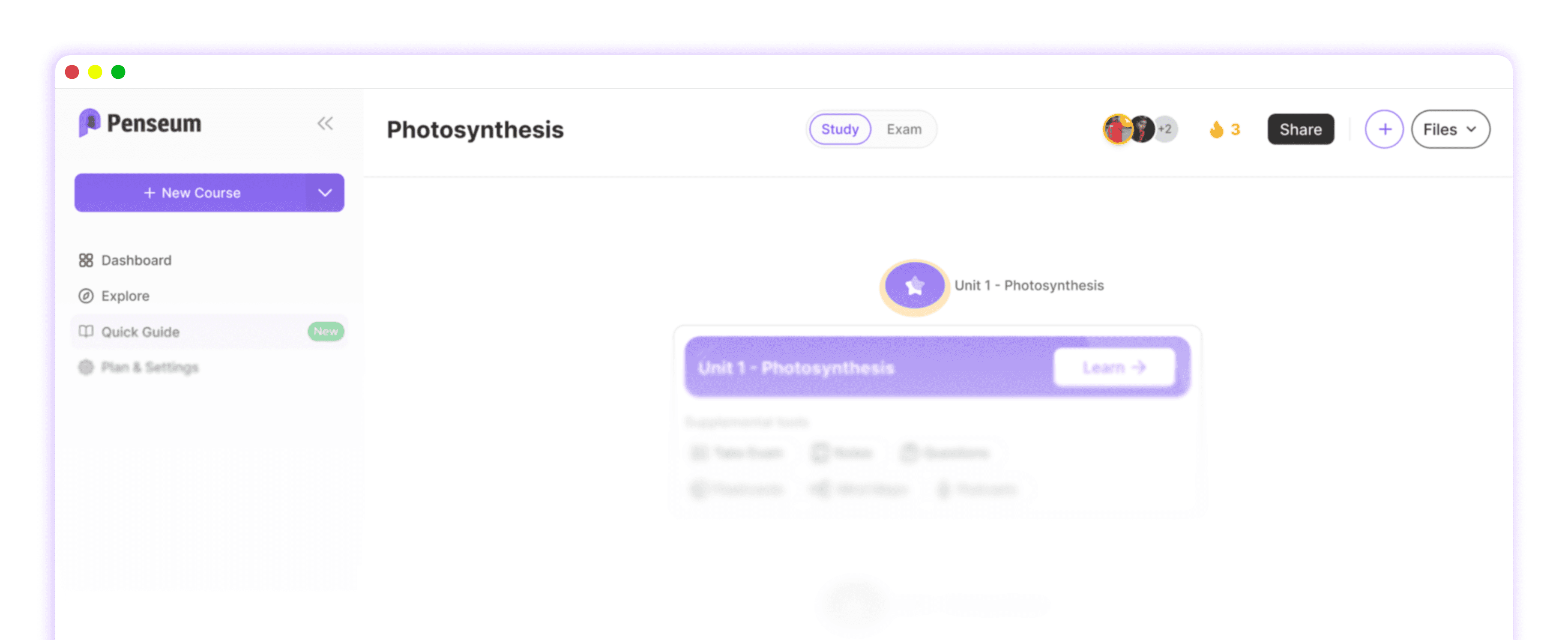
Penseum helps you apply automated note-taking by acting as an all-in-one AI tutor rather than just a basic text summarizer. When you upload your slides or PDFs, Penseum doesn't just give you notes; it creates quizzes, flashcards, and mind maps.
If a concept in your notes is confusing, Penseum’s 1-1 AI tutor explains it out loud, watches you work through the problem on a live canvas, and catches your specific mistakes in real-time until you actually understand it.
Traditional studying leaves you isolated when you get stuck. You stare at a confusing textbook paragraph or a generic AI text response, waiting for a breakthrough that never comes.
Research by Hattie (2008) details the massive impact of immediate, targeted feedback on student achievement. Finding out you made a mistake three days after an assignment is submitted provides very little educational value. Real-time correction allows you to adjust your mental model immediately before bad habits form.
Penseum replicates this high-impact feedback loop. The platform sees your actual work on the screen and responds directly to it. It draws diagrams and works through mathematical solutions live on your canvas. It doesn't just give you the final answer; it guides you through the process step-by-step.
Penseum is actively used by over 1,600,000 learners across 130+ countries to automate their study prep. These students have replaced fragmented workflows with a single, unified study ecosystem.
Whether you need a quick summary of a long reading assignment or deep, interactive help with a complex physics problem, the platform adapts to your exact needs. To see how personalized AI instruction transforms learning, read 7 Ways a Free Tutor AI Boosts Your Grades.
By acting as a comprehensive study partner, it eliminates the need to juggle multiple expensive subscriptions. For a broader look at the best platforms available, check out 7 Best Free Study Websites to Ace Exams.
Actionable step: Sign up for Penseum's free tier without a credit card, upload your hardest PDF, and ask the AI tutor to explain it step-by-step out loud. Work through a practice problem on the live canvas to experience real-time error correction.
Frequently Asked Questions
Is there a free notes maker that doesn't require a credit card?
Yes, Penseum is entirely free to use and does not require a credit card for initial sign-up. You can create a personal workspace, upload your specific course materials, and begin generating customized guides, quizzes, and flashcards instantly. A premium subscription exists, but the core generation tools are accessible on the free tier.
Can I use a free notes maker on my mobile device?
Yes, you can access Penseum easily from your mobile device. The platform allows you to review your generated flashcards, take practice quizzes, and chat with your AI tutor while on the go. This mobility makes it simple to squeeze in active recall sessions during your daily commute or between scheduled classes.
What types of study materials can I upload to an AI note generator?
You can upload a wide variety of static study materials directly into the platform. Penseum accepts lecture slides, lengthy textbook PDFs, assignment rubrics, and raw text transcripts. The AI processes these specific documents to ensure that all generated guides and flashcards remain strictly relevant to your exact syllabus.
Does a free notes maker support multiple languages?
Yes, modern platforms like Penseum support multiple languages. You can upload documents in various languages or ask the AI tutor to explain complex English concepts in your native language. This feature is highly beneficial for international students who want to clarify difficult terminology using real-time translated voice explanations.
How does AI ensure the accuracy of generated study materials?
AI ensures accuracy by grounding its outputs directly in the specific documents you upload. Instead of pulling random definitions from the internet, Penseum extracts facts, formulas, and context exclusively from your provided PDFs and slides. This prevents hallucinations and guarantees your flashcards match your professor's exact teaching material.
What is the difference between an AI notes maker and Quizlet?
An AI notes maker like Penseum processes your raw PDFs and automatically generates targeted notes, quizzes, and a live tutoring canvas. Quizlet primarily relies on you manually typing out flashcards or searching for crowdsourced decks made by other people. A dedicated notes maker focuses on personalized, instant generation and real-time interactive feedback.
Written by Samit Khalsa — Expert in cramming for exams
Last updated: September 2026
Sources
Mueller, P. A., & Oppenheimer, D. M. (2014). The Pen Is Mightier Than the Keyboard: Advantages of Longhand Over Laptop Note Taking. Psychological Science. https://pubmed.ncbi.nlm.nih.gov/24760141/
Roediger, H. L., & Karpicke, J. D. (2006). Test-Enhanced Learning: Taking Memory Tests Improves Long-Term Retention. Psychological Science. https://pubmed.ncbi.nlm.nih.gov/16507066/
Baddeley, A. (1992). Working memory. Science. https://pubmed.ncbi.nlm.nih.gov/1736359/
Mayer, R. E. (2009). Multimedia Learning (2nd ed.). Cambridge University Press. [NEEDS SOURCE: specific online URL for Mayer 2009]
Bloom, B. S. (1984). The 2 Sigma Problem: The Search for Methods of Group Instruction as Effective as One-to-One Tutoring. Educational Researcher. https://scholar.google.com/scholar?q=bloom+2+sigma+problem
Ebbinghaus, H. (1885). Memory: A Contribution to Experimental Psychology. Annals of Neurosciences. https://pubmed.ncbi.nlm.nih.gov/24364023/
Hattie, J. (2008). Visible Learning: A Synthesis of Over 800 Meta-Analyses Relating to Achievement. Routledge. https://scholar.google.com/scholar?q=hattie+visible+learning+2008
Related guides
Ready to study smarter?
Start turning your notes into guides, quizzes, and flashcards in seconds.