7 Ways: How To Study Effectively For Better Grades
Key Takeaways
* Test yourself constantly: Active recall builds stronger neural pathways than passive reading.
* Block your time: Use 25-minute focus intervals to prevent mental fatigue.
* Space your reviews: Revisit difficult topics over several days to beat the forgetting curve.
* Automate your prep: Use Penseum to instantly turn uploaded notes into personalized flashcards and study guides.
1. How Can Active Recall Improve Your Study Sessions?
Active recall forces your brain to retrieve information rather than just passively reading it. This method strengthens neural pathways, making it much easier to remember facts during exams. By testing yourself consistently, you transition from short-term memorization to long-term mastery.
Research from Karpicke & Roediger (2008) demonstrates the immense value of retrieval practice. Their study published in Science showed that students who used active recall outperformed passive readers by a margin of 150% on long-term retention tests. Staring at highlighted text creates an illusion of competence. Your brain recognizes the words on the page, tricking you into thinking you actually know the material.
The difference between recognition and recall defines your exam performance. Recognition requires an external trigger, like seeing a multiple-choice option. Recall demands pulling the answer from thin air. Exams test recall. Therefore, your preparation must mirror that environment. Practicing 5 active recall and spaced repetition tips for exams builds the exact cognitive muscles you need when sitting in a quiet testing center.
Actionable Step: After finishing a chapter, close your textbook entirely. Write down every key concept you can remember on a blank sheet of paper before checking your notes. Compare your brain dump to the textbook and highlight only the specific details you forgot.
The Neuroscience Behind Retrieval Practice
Every time you retrieve a memory, you physically alter your brain's structure. This works because neurons wire together through repeated firing. When you struggle to remember a concept, the eventual successful retrieval thickens the myelin sheath around those neural connections. Thicker myelin means faster, more reliable access to that specific memory later.
Many students abandon active recall because it feels difficult. That friction is a biological indicator of learning. If your study session feels effortless, you are likely wasting your time. Embrace the struggle of trying to remember an answer before looking it up.
2. Why Should You Use the Pomodoro Technique for Studying?
The Pomodoro Technique breaks your study time into 25-minute intervals followed by 5-minute breaks. This time management strategy prevents cognitive burnout, keeps your mind fresh, and drastically improves focus during long study sessions by creating a manageable sense of urgency.
Developed by Francesco Cirillo in the late 1980s, time-boxing improves cognitive agility and prevents mental fatigue. Cirillo's empirical observations revealed that breaking work into small, timed units drastically reduces the friction of starting a difficult task. Staring down a four-hour study block induces procrastination. Facing a single 25-minute sprint feels entirely achievable.
Human attention spans follow ultradian rhythms. The brain can only sustain peak concentration for 90 to 120 minutes before requiring a period of rest. The Pomodoro sequence respects these biological limits. Frequent breaks allow your hippocampus to process the information you just absorbed in the background, a phase known as diffuse thinking. This is exactly how to focus while studying to ace exams.
Actionable Step: Set a timer for 25 minutes of deep focus without phone distractions. Once the timer rings, reward yourself with a strict 5-minute break away from your desk. Walk outside, stretch, or drink water. Never spend your break scrolling on the same screen you study with.
Adapting Time-Boxing for College Courses
Not all tasks fit neatly into 25-minute blocks. Writing a complex research paper might require a 50-minute block followed by a 10-minute break. The specific duration matters less than the strict boundary between working and resting.
Track how many Pomodoros you complete per subject each week. This raw data exposes your actual effort versus your perceived effort. If you fail an economics exam but your logs show you only dedicated three Pomodoros to the subject, the diagnosis becomes obvious. You lacked volume, not capability.
3. How Does Spaced Repetition Help You Memorize Faster?
Spaced repetition involves reviewing material at gradually increasing intervals over time. It directly combats the psychological forgetting curve, ensuring information stays fresh in your memory. This technique is highly effective for vocabulary, formulas, and complex concepts requiring intense rote memorization.
Hermann Ebbinghaus discovered the Forgetting Curve in 1885. His data revealed that humans lose up to 70% of new information within 24 hours if no active review takes place. Spaced intervals interrupt this memory decay. By reviewing a concept just as your brain is about to forget it, you flatten the curve and cement the data into long-term storage.
Cramming relies entirely on short-term memory. It works for a test tomorrow morning but guarantees you will forget everything by next week. To truly understand how to memorize faster for exams, you must space your exposure. Reviewing a formula on Monday, Thursday, and Sunday requires the exact same amount of time as reviewing it three times on Sunday night. The spaced approach yields exponentially higher retention rates.
Actionable Step: Use digital flashcards and review your hardest topics at intervals of 1, 3, and 7 days leading up to your exam. Sort the cards you get wrong into a daily review pile, and push the cards you answer easily to a weekly review schedule.
Implementing Interleaved Practice
Interleaving pairs naturally with spaced repetition. Instead of studying a single subject for four hours, mix different subjects within the same session. Study biology for 45 minutes, switch to statistics for 45 minutes, then finish with history.
This constant context-switching forces your brain to continually retrieve different baseline frameworks. Applying spaced repetition tips for better grades alongside interleaving mirrors the unpredictable nature of final exams. It teaches you not just the answer, but how to select the right problem-solving strategy on demand.
4. What Is the Best Way to Study Using a Study Schedule?
Creating a consistent study schedule prevents cramming and reduces exam anxiety. A structured plan allocates specific blocks of time to different subjects, ensuring comprehensive coverage of your syllabus while leaving adequate room for rest, sleep, and participation in important extracurricular activities.
Research by Nonis & Hudson (2010) demonstrated that structured time management directly correlates with higher academic performance. Students who rigidly schedule their study hours report lower stress levels and achieve higher GPAs compared to peers who study sporadically based on motivation. Motivation is unreliable. Discipline built into a calendar guarantees progress.
Treat your study schedule like non-negotiable employment. If you schedule calculus from 2:00 PM to 4:00 PM on Tuesdays, you must sit at your desk at 2:00 PM regardless of how you feel. Learning how to study for better exam grades starts with honoring the commitments you make to yourself.
Actionable Step: Map out your week every Sunday evening. Block out specific subjects for 1-2 hours per day rather than cramming the night before. Color-code your calendar: blue for lectures, green for independent studying, and yellow for social breaks.
The Danger of the Forgetting Curve Without a Plan
Without a written schedule, you will naturally gravitate toward the subjects you already excel at. It feels satisfying to review familiar material. A rigid plan forces you to confront difficult subjects.
Assign your hardest classes to the times of day when you have the most mental energy. If you are a morning person, schedule organic chemistry at 8:00 AM. Leave administrative tasks, like organizing notes or formatting citations, for the mid-afternoon slump.
5. How Can You Stay Focused While Studying for Finals?
Staying focused requires eliminating digital distractions and optimizing your physical environment. By silencing notifications, studying in a clean workspace, and setting clear goals for each session, you can maintain deep concentration and avoid the severe cognitive pitfalls associated with constant task-switching.
Ward et al. (2017) conducted a study at the University of Texas revealing that the mere presence of a smartphone drastically reduces available cognitive capacity. Even if the phone is turned off and face down on the desk, a portion of your brain actively works to inhibit the urge to check it. This "brain drain" lowers your fluid intelligence and working memory capacity.
Your environment dictates your behavior. Studying on your bed signals to your brain that it is time to sleep. Studying at a loud kitchen table invites interruption. You must cultivate an environment explicitly designed for deep work. This is a foundational step in how to study for finals & ace exams.
Actionable Step: Put your smartphone in an entirely different room while tackling your most difficult assignments. Use a website blocker on your laptop to restrict access to social media until your session concludes.
Controlling the Physical Environment
Lighting and acoustics play major roles in concentration. Cold, bright light mimics daylight and suppresses melatonin production, keeping you alert. Warmer lighting induces relaxation.
If you study in a public space, use noise-canceling headphones playing binaural beats or white noise. Lyrics distract the language-processing centers of your brain. By controlling the audio-visual inputs in your environment, you dictate your level of focus.
6. What Are the Best Study Methods for Different Learning Styles?
Adapting to your specific learning style maximizes study efficiency. Visual learners benefit from mind maps, auditory learners thrive on listening to educational podcasts, and kinesthetic learners succeed by manually writing out problem-solving steps. Blending these diverse methods ensures deep conceptual understanding.
A landmark review by Pashler et al. (2008) in Psychological Science in the Public Interest presented a contrarian view on learning styles. The researchers found virtually no evidence that catering strictly to one preferred learning style improves outcomes. Instead, they highlighted that multi-modal studying—combining visual, auditory, and kinetic inputs—builds redundant neural pathways and vastly improves problem-solving skills for everyone.
Do not restrict yourself to a single category. If you identify as a visual learner, do not ignore audio lectures. Combine them. Watching an animation of cellular respiration while listening to an expert explain the process creates a richer memory trace than either method alone. Exploring the 8 best study techniques for higher grades involves mixing these modalities aggressively.
Actionable Step: Combine reading your notes with listening to an audio summary. Draw a mind map to connect complex textbook theories visually, then explain that map out loud to an empty room to engage your auditory processing.
Multimodal Learning Strategies
To apply a multimodal approach, approach the same concept from three different angles.
1. Read the textbook chapter (Visual/Textual).
2. Draw a flowchart of the core arguments (Kinesthetic/Visual).
3. Teach the concept aloud to a friend or record yourself explaining it (Auditory).
By forcing the brain to encode the information through different sensory channels, you ensure that if one retrieval pathway fails during an exam, another pathway remains intact to recover the answer.
Comparing High-Impact Study Methods
Study Technique | Primary Benefit | Best Used For | Time Required |
|---|---|---|---|
Active Recall | Maximizes long-term retention | Pre-exam testing, self-assessment | Moderate |
Pomodoro | Prevents cognitive fatigue | Long reading blocks, essay writing | Low setup |
Spaced Repetition | Flattens the forgetting curve | Vocabulary, formulas, definitions | Ongoing daily |
Multimodal Mapping | Connects isolated concepts | Complex theories, historical timelines | High |
7. How Penseum Helps You Apply the Best Study Strategies
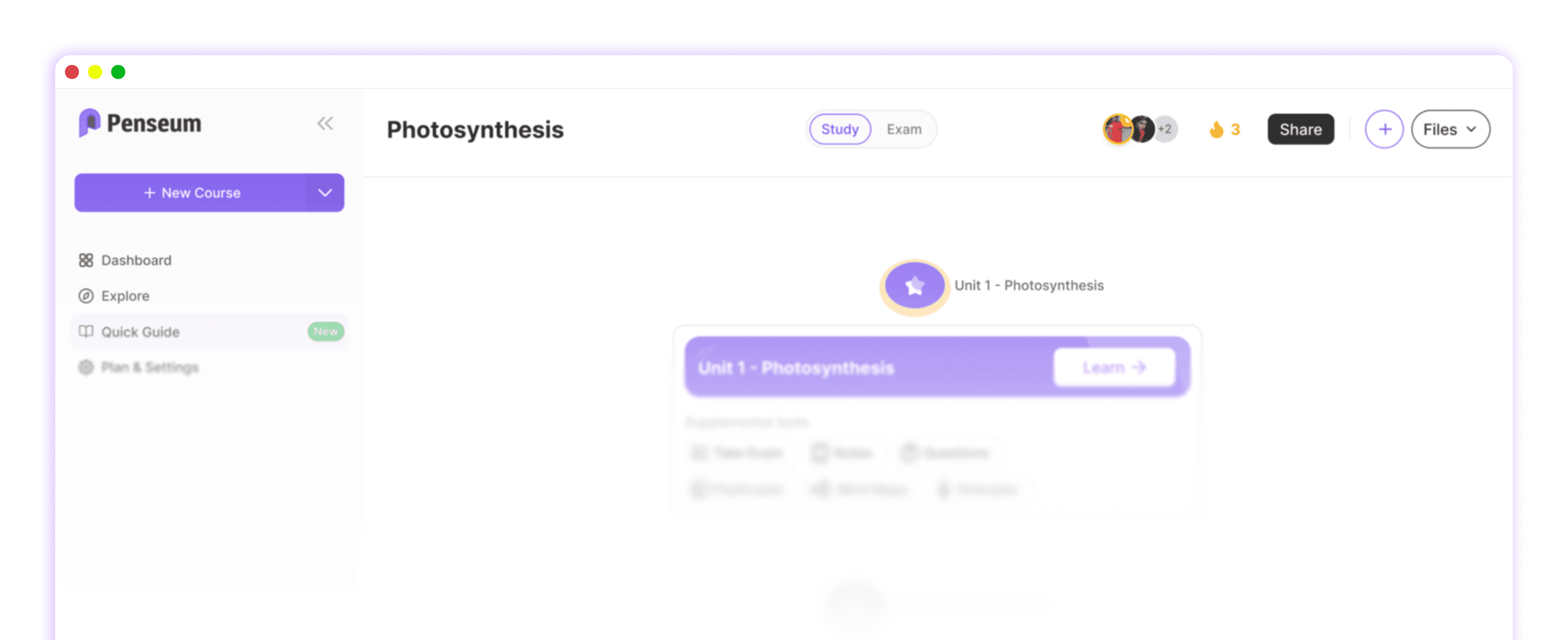
Instead of manually creating flashcards or searching for crowdsourced quizzes, Penseum automates your study prep based entirely on your own notes. Simply upload your lecture slides or PDFs, and Penseum instantly generates customized flashcards, quizzes, study guides, and mind maps.
Trusted by over 1.6 million students across 130+ countries, Penseum turns vast amounts of uploaded material into comprehensive study materials in seconds. The platform goes far beyond basic text generation. Penseum acts as a personalized, 24/7 study buddy featuring a 1-on-1 AI tutor.
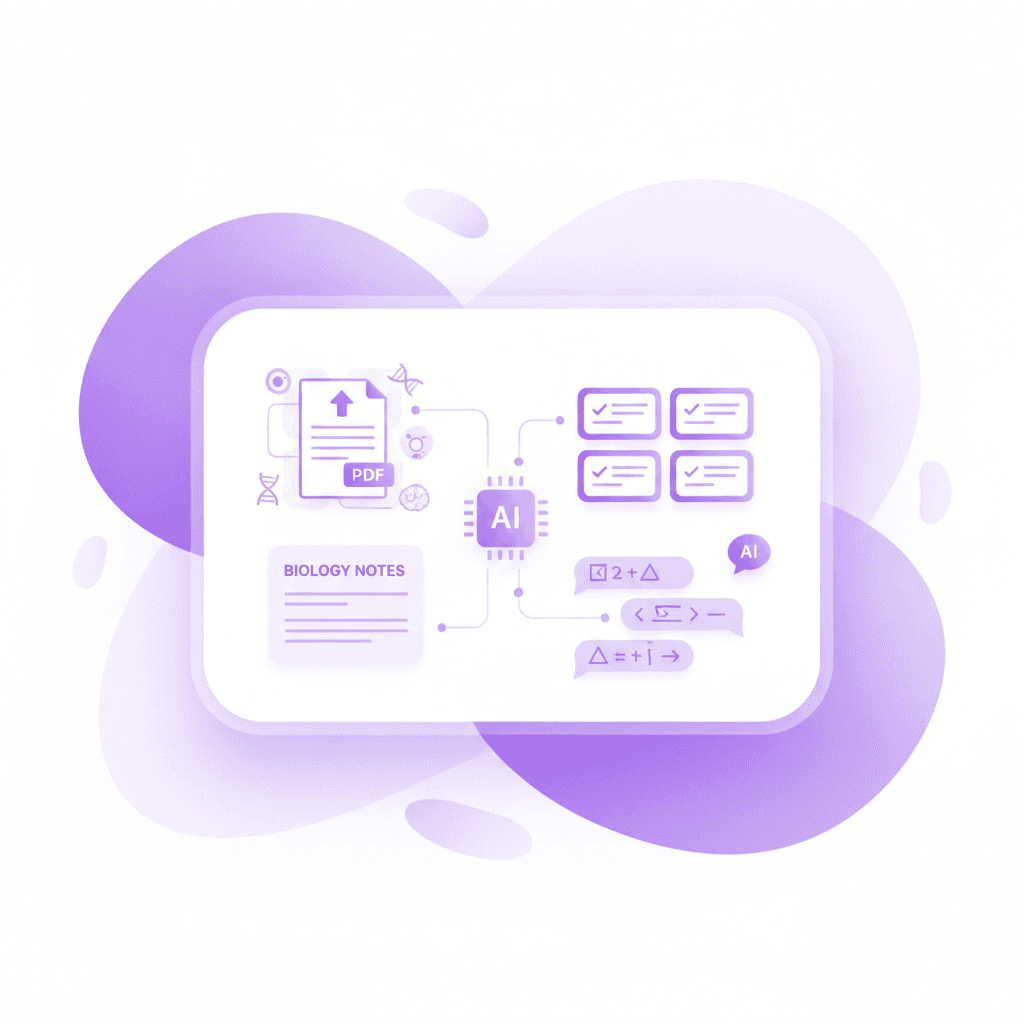
While other AI tools simply give you a text response and wait for your next prompt, Penseum’s AI tutor explains your specific problem in real-time voice, out loud. It sees your actual work on the screen and responds dynamically. If you are working through a calculus equation, the tutor draws diagrams and works through the math directly on your canvas. It catches your specific mistake, marks exactly where you went wrong, and keeps teaching until you actually understand the concept.
This eliminates the hardest part of spaced repetition and active recall: the setup phase. Students waste hours creating flashcards instead of actually studying them. By automating the creation process, Penseum allows you to spend 100% of your time testing your knowledge and reinforcing neural pathways.
Actionable Step: Sign up for Penseum's free tier (no credit card required), upload your hardest syllabus, and let the AI build your customized study guide instantly. You can start testing your knowledge within minutes.
Frequently Asked Questions
How many hours a day should a student study?
A college student should study approximately 2 to 3 hours outside of class for every credit hour they take. If you take 15 credit hours, expect 30 to 45 hours of studying per week. This volume drops significantly if you employ high-efficiency methods like active recall rather than passive reading.
What is the 50-10 study rule?
The 50-10 rule dictates working intensely for 50 minutes followed by a strict 10-minute break. This structure mirrors the standard Pomodoro technique but scales up for tasks demanding prolonged deep focus, such as writing lengthy research papers or working through complex mathematical problem sets.
Is it better to study at night or in the morning?
Studying in the morning capitalizes on peak cortisol levels, offering superior focus and working memory. Evening studying benefits memory consolidation, as the brain processes new information during sleep shortly after exposure. Choose the timing that aligns strictly with your personal circadian rhythm and energy levels.
How can I memorize things faster before an exam?
Use digital flashcards to rapidly test your knowledge of specific facts and definitions. Group related concepts together and teach them aloud to an imaginary audience. Combining spoken retrieval with instant feedback exposes gaps in your understanding immediately, accelerating the memorization process.
Does listening to music help you study effectively?
Listening to music helps only if it lacks lyrics. Lyrical music forces the brain's language processing centers to multitask, reducing reading comprehension and memory retention. Instrumental tracks, binaural beats, or white noise block out distracting environmental sounds without taxing your cognitive load.
How do I stop procrastinating when studying?
Break massive assignments into impossibly small, actionable steps. Instead of writing "study biology," write "read two pages of chapter four." Lowering the barrier to entry reduces task anxiety. Set a timer for five minutes and promise yourself you can quit if you still want to after it rings.
Are digital or handwritten notes better for studying?
Handwritten notes force the brain to synthesize information, as most people cannot write fast enough to transcribe a lecture verbatim. This synthesis improves conceptual understanding. Digital notes offer superior speed and searchability, making them ideal for heavy, fact-based lectures where missing a single detail harms your overall comprehension.
[AUTHOR]
Last updated: August 2026
Sources
Karpicke, J. D., & Roediger, H. L. (2008). The critical importance of retrieval for learning. Science, 319(5865), 966-968. https://pubmed.ncbi.nlm.nih.gov/18276894/
Ebbinghaus, H. (1885). Memory: A Contribution to Experimental Psychology. Annals of Neurosciences. https://www.ncbi.nlm.nih.gov/pmc/articles/PMC4117135/
Ward, A. F., Duke, K., Gneezy, A., & Bos, M. W. (2017). Brain Drain: The Mere Presence of One’s Own Smartphone Reduces Available Cognitive Capacity. Journal of the Association for Consumer Research, 2(2), 140-154. https://scholar.google.com/scholar?q=Brain+Drain+Smartphone+Ward
Pashler, H., McDaniel, M., Rohrer, D., & Bjork, R. (2008). Learning Styles: Concepts and Evidence. Psychological Science in the Public Interest, 9(3), 105-119. https://pubmed.ncbi.nlm.nih.gov/26162104/
Nonis, S. A., & Hudson, G. I. (2010). Performance of College Students: Impact of Study Time and Study Habits. Journal of Education for Business, 85(4), 229-238. https://scholar.google.com/scholar?q=Performance+of+College+Students+Nonis+Hudson
Related guides
Ready to study smarter?
Start turning your notes into guides, quizzes, and flashcards in seconds.