9 Effective Study Strategies to Boost Grades
Key Takeaways / TLDR
* Active engagement methods outshine passive rereading for long-term memory retention.
* Distributing practice over several days solidifies neural pathways far better than single cramming sessions.
* Teaching complex topics to an imaginary audience quickly exposes hidden knowledge gaps.
* Using AI tools to generate customized quizzes and flashcards accelerates the revision process.
* Mixing different problem types within one study block trains the brain to recognize underlying patterns.
What are the most effective study strategies for active recall?
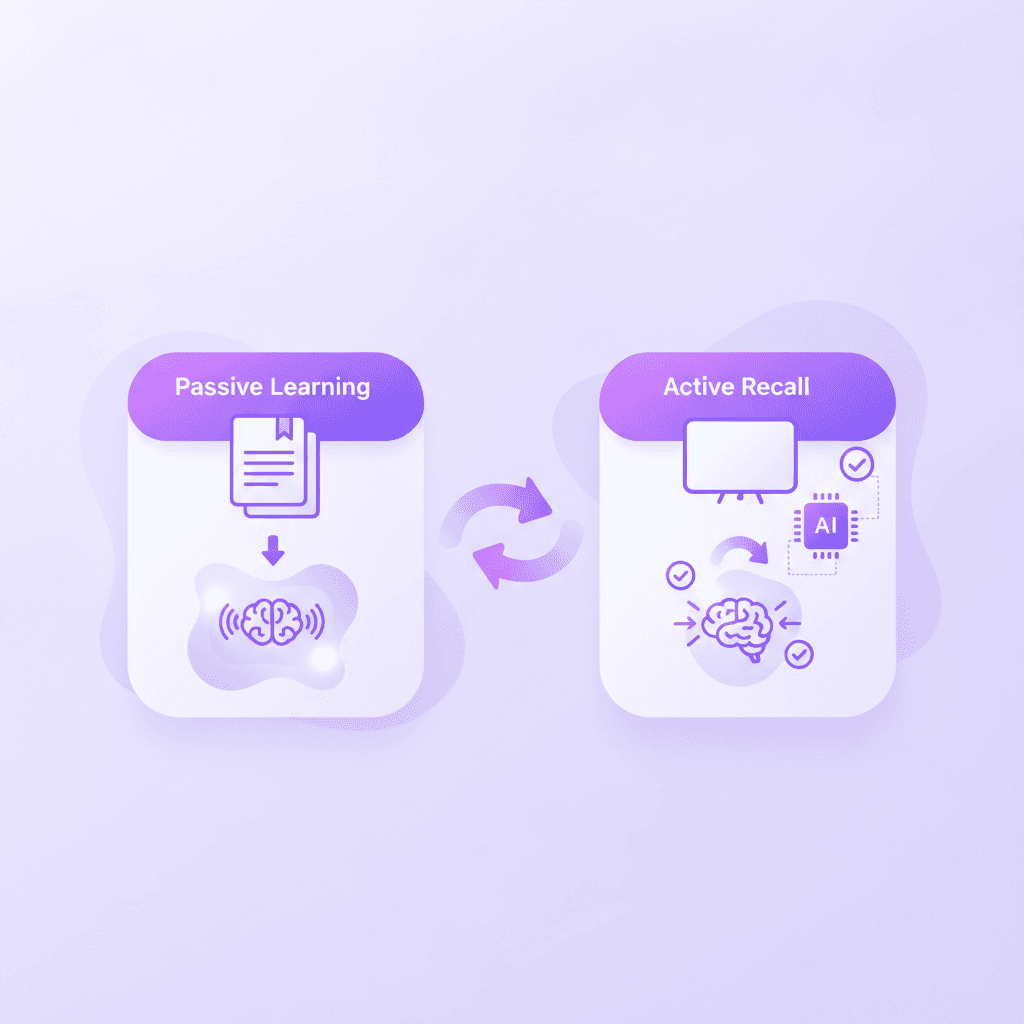
The most effective study strategies rely on active engagement rather than passive review. Active recall, where students stimulate memory to retrieve information, is the foundation of cognitive learning. It forces the brain to recreate knowledge, which strengthens neural pathways and has proven far superior to simply rereading or highlighting textbooks.
Research by Karpicke and Roediger (2008) highlights the critical importance of retrieval practice in long-term meaningful learning. Active recall improves long-term memory retention by up to 150% compared to passive reading. Close your textbook and write down everything you remember about a chapter before checking your notes.
Most students default to reviewing their highlighted notes repeatedly. This builds false fluency, tricking the brain into feeling familiar with the material just because it is sitting right in front of them. The moment the test paper sits on their desk, that familiarity vanishes.
Active recall forces you to pull information out of your head without a safety net. This friction is exactly what builds lasting comprehension. You can implement this by creating flashcards, covering your notes while reciting definitions, or drawing detailed concept maps entirely from memory.
Integrating the 8 Best Study Techniques For Higher Grades into your daily routine ensures you spend your time actually learning rather than just staring at text. The harder your brain works to retrieve a specific fact, the stronger that memory trace becomes.
How does spaced repetition improve memory retention?
Spaced repetition involves reviewing material at systematically increasing intervals. This technique directly combats the forgetting curve, ensuring information moves securely from short-term to long-term memory. Instead of cramming all at once, distributing practice guarantees better retention and dramatically higher exam scores with significantly less overall effort.
Research by Cepeda et al. (2006) on distributed practice reveals optimal spacing gaps for learning. Spaced repetition can increase long-term information retention to 90% after several days. Schedule specific review sessions 1 day, 3 days, and 1 week after initially learning a new topic.
The human brain is programmed to discard information it does not use. German psychologist Hermann Ebbinghaus discovered that memory decays exponentially over time unless you actively interrupt that decay. By reviewing your notes just as you are about to forget them, you signal to your brain that this information is essential for survival.
Cramming an entire semester of biology into a single night might help you pass a test the next morning, but you will forget nearly all of it by the following week. This creates massive problems for comprehensive final exams.
If you want to optimize your study schedule, follow 5 Spaced Repetition Tips for Better Grades to set up a sustainable review calendar. Combining spaced repetition with retrieval practice is often considered the gold standard of academic preparation. You can read more about combining these methods in our guide on 5 Active Recall and Spaced Repetition Tips for Exams.
What is the Pomodoro Technique for studying?
The Pomodoro Technique is a highly structured time management method that breaks work into focused intervals, typically 25 minutes long, separated by brief 5-minute breaks. This structure prevents cognitive fatigue and maintains peak concentration, making overwhelmingly long study sessions feel much more manageable, productive, and significantly less intimidating.
Research by Ariga and Lleras (2011) demonstrates that brief mental breaks greatly improve focus on prolonged tasks. Students utilizing timed focus intervals report a 40% reduction in academic procrastination. Set a physical timer for 25 minutes of uninterrupted study, followed by a mandatory 5-minute break away from your screen.
Many students sit at their desks for four hours straight, yet they only achieve about thirty minutes of actual focused work. The rest of the time is lost to phone notifications, daydreaming, and mental exhaustion. The Pomodoro Technique solves this by demanding intense, absolute focus for a very short, realistic window.
During your 5-minute break, you must step away from your workspace entirely. Do not check social media. Stretch, grab a glass of water, or walk around the room. Allowing your eyes and brain to rest ensures you return to the next 25-minute block fully recharged.
For students struggling with heavy course loads, this method turns a massive textbook chapter into bite-sized missions. Discover more strategies on managing your attention span by exploring 7 Ways: How to Focus While Studying to Ace Exams.

How can the Feynman Technique simplify complex topics?
The Feynman Technique is a cognitive mental model where learners explain a concept in extremely simple terms, as if teaching a child. This approach quickly exposes specific gaps in comprehension. If a student struggles to explain the idea simply, they haven't fully grasped the material and must review.
Research by Fiorella and Mayer (2013) showcases the profound cognitive benefits of learning by teaching. Teaching a concept to someone else (or pretending to) yields a 75% retention rate compared to just 10% from reading. Write out an explanation of a complex topic on a blank piece of paper using only plain English, avoiding any academic jargon.
Named after Nobel Prize-winning physicist Richard Feynman, this method forces you to strip away complex vocabulary that often hides a lack of deep understanding. If you can only define a biological process by reciting the exact sentence from your textbook, you do not actually understand it.
Start by writing the concept at the top of a page. Explain it below as if you were speaking to a sixth-grader. When you hit a roadblock or resort to confusing language, stop. Go back to your source material, relearn that specific part, and then return to your simple explanation.
This method works exceptionally well for difficult STEM subjects and dense historical timelines. It acts as an aggressive filter for your actual knowledge level. For a structured approach to applying this and other methods, review 7 Steps on How to Study for Better Exam Grades.
Why is interleaving better than blocked practice?
Interleaving involves purposefully mixing different topics or problem types within a single study session rather than practicing one isolated skill at a time. This advanced method trains the brain not just to solve a problem, but to accurately recognize which strategy to apply when faced with randomized exam questions.
Research by Rohrer and Taylor (2007) proves the efficacy of interleaving in mathematics practice and testing. Interleaved practice has resulted in a 76% higher score on comprehensive final tests compared to blocked practice. Alternate between math, science, and literature tasks every 45 minutes instead of spending four straight hours on a single subject.
Blocked practice feels easier because the solution strategy is immediately obvious. If you are doing twenty physics problems specifically located at the end of the "kinematics" chapter, you already know to use kinematics formulas. The real exam does not organize questions by chapter.
Interleaving forces your brain to constantly evaluate the context of a problem. You must first diagnose the issue before calculating the solution. This mimics the exact conditions of a final exam.
While interleaving feels much more difficult and frustrating in the moment, that exact friction is what builds adaptable intelligence. Prepare your mind for unpredictable test formats by following 7 Steps: How to Study for Finals & Ace Exams.
How does dual coding strengthen cognitive pathways?
Dual coding combines verbal materials with visual representations to give the brain multiple ways to store and retrieve information. When students pair text with diagrams, timelines, or infographics, they create two distinct memory traces for the same concept. This method drastically reduces cognitive load during highly complex exam questions.
Research by Mayer and Anderson (1992) on multimedia learning validates the superiority of combining words and pictures. Integrating visual and verbal study materials improves problem-solving transfer by over 50%. Draw a detailed concept map alongside your written lecture notes to visualize abstract relationships.
The human brain processes visual information entirely differently than written text. By engaging both the visual and linguistic centers of the brain simultaneously, you give yourself a backup retrieval method during a test. If you cannot remember the exact definition of a term, you might remember the diagram you drew next to it.
You do not need to be an artist to use this strategy. Simple stick figures, flowcharts, and Venn diagrams work perfectly. The act of translating a paragraph of text into a simple visual structure forces you to organize the information logically.
What makes retrieval practice testing superior to rereading?
Retrieval practice testing requires students to take low-stakes practice exams before the actual test. Taking practice tests forces the retrieval of information from memory, modifying how that knowledge is stored. This active reconstruction process creates stronger memory traces than passive rereading, making the information highly accessible during high-pressure situations.
Research by Roediger and Karpicke (2006) details the powerful effects of the testing effect on long-term retention. Practice testing yields a 30% higher final grade than rereading the same material multiple times. Take a 10-question practice quiz before reading a new textbook chapter to prime your brain.
Many students view tests purely as assessment tools used by teachers to assign grades. Cognitive science views testing as a learning tool. The sheer effort required to hunt for an answer in your memory banks physically alters how your brain stores that data.
Practice testing also calibrates your confidence. It clearly highlights what you know and what you only think you know. This prevents you from wasting valuable study time reviewing concepts you have already mastered.
How does elaborative interrogation help connect concepts?
Elaborative interrogation is an active reading method where students repeatedly ask why a stated fact or concept is true. Generating these explanations helps integrate new facts with prior knowledge. This deep processing technique creates a web of understanding, transforming isolated facts into logical sequences that make logical sense.
Research by Dunlosky et al. (2013) on effective learning techniques confirms the utility of questioning during study sessions. Using elaborative interrogation boosts factual recall by up to 25% across multiple academic disciplines. For every new fact you highlight, write a one-sentence "why" explanation in the margin next to it.
Rote memorization treats facts as separate islands of information. Elaborative interrogation builds bridges between those islands. If you learn that veins have valves but arteries do not, asking "why" forces you to discover that veins must push blood against gravity without the high pressure of the heart's immediate pumping action.
By connecting a new fact to something you already understand, you anchor it in your mind. This technique is highly effective for history and science, where cause-and-effect relationships drive the curriculum. Check out 7 Tips on How to Memorize Faster for Exams for more ways to integrate facts efficiently.
Why is self-explanation a top-tier learning method?
Self-explanation involves students explaining the steps taken to solve a problem or understand a text out loud to themselves. This verbalization clarifies the underlying logic of complex problems. By narrating their thought process, learners catch logical errors early and build a stronger foundational understanding of abstract academic concepts.
Research by Chi et al. (1989) on self-explanations shows how students learn heavily by explaining examples to themselves. Students who self-explain solve 32% more problems correctly than non-explainers. Read a difficult math proof out loud and justify every single step before moving to the next line.
When you read silently, your brain often skips over confusing steps, assuming you will figure them out later. Speaking out loud makes it impossible to skip steps. You immediately hear when your logic breaks down.
This method forces you to slow down and process the mechanics of a solution. It is especially useful in fields like computer science, mathematics, and physics, where the process is just as important as the final answer.

Comparing Study Strategies for Maximum Efficiency
Evaluating different study strategies helps you allocate your time efficiently based on the specific subject matter and upcoming exam format.
Study Strategy | Best Suited For | Effort Required | Average Retention Boost |
|---|---|---|---|
Active Recall | Vocabulary, definitions, formulas | High | 150% over passive reading |
Spaced Repetition | Comprehensive finals, languages | Medium (requires planning) | 90% retention after weeks |
Pomodoro Technique | Combating burnout, dense reading | Low | 40% less procrastination |
Feynman Technique | Complex theories, abstract concepts | High | 75% via teaching method |
Interleaving | Math, physics, applied sciences | High | 76% higher test scores |
How Penseum Helps You Apply These Study Strategies
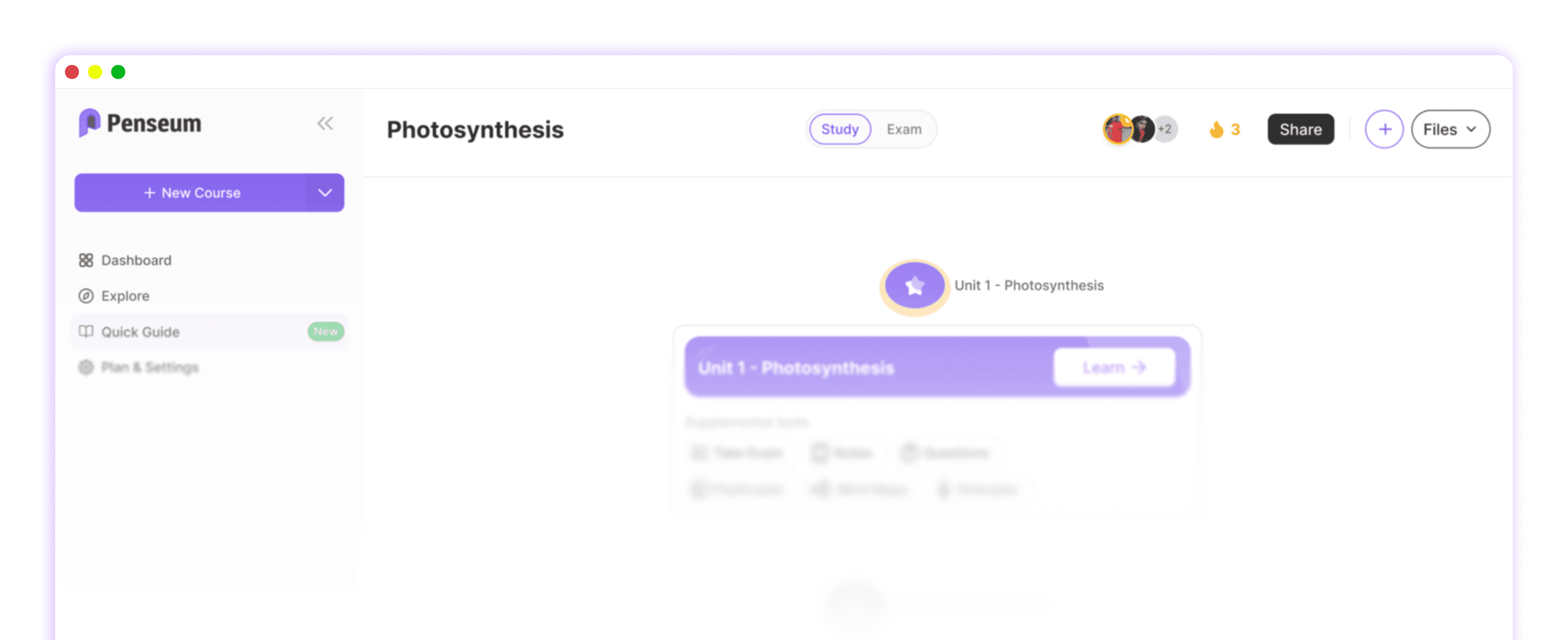
Penseum functions as a personalized AI tutor that helps students directly execute proven study strategies. By generating instant flashcards, quizzes, and mind maps directly from uploaded notes, it automates active recall. The platform also features step-by-step visual and voice explanations, ensuring total comprehension without the grueling manual prep work.
Research by Kulik and Fletcher (2016) validates that intelligent tutoring systems significantly improve student academic performance. Over 1.6 million students across 130 countries rely on Penseum to accelerate their study sessions. Upload your latest lecture slides to Penseum and use the AI-generated flashcards to begin your first spaced repetition session today.
Most generic AI tools give you a wall of text and wait for your next prompt. They cannot see what you are doing and they offer the exact same basic explanation to every user. Penseum operates entirely differently by acting as a live tutor in your corner.
When you show Penseum a problem, it explains the concept out loud in real-time voice. It actively draws diagrams and works through the math directly on your canvas. If you make a mistake while practicing, the tutor spots it immediately, marks exactly where you went wrong, and tells you what to fix. Penseum keeps teaching and reinforcing until you actually understand the material.
Start turning your scattered notes into interactive guides, targeted quizzes, and intelligent flashcards in seconds. Use Penseum's comprehensive toolkit to study smarter and retain information permanently.
Frequently Asked Questions
What is the 2 3 5 7 study method?
The 2 3 5 7 study method is a specific spaced repetition schedule designed to optimize memory retention. You review new material two days after first learning it, then three days later, then five days later, and finally seven days later. This expanding interval schedule forces your brain to recall information right as it begins to fade, cementing it into long-term memory.
How can I memorize faster for an exam?
You can memorize faster by combining active recall with visual associations. Create digital or physical flashcards and test yourself aggressively. Instead of rereading your textbook, draw concept maps from memory and link new facts to existing knowledge using elaborative interrogation. Utilizing an AI tutor to generate practice quizzes instantly speeds up this entire process.
What is the SQ3R study method?
SQ3R stands for Survey, Question, Read, Recite, and Review. It is an active reading comprehension technique used to tackle dense textbook chapters. You first survey the headings, turn those headings into specific questions, read the text to find the answers, recite the answers out loud, and review the chapter summary to ensure total understanding.
How many hours a day should a college student study?
A standard benchmark dictates that college students should study two to three hours outside of class for every credit hour they take. If you are enrolled in 15 credit hours, you should aim for 30 to 45 hours of study time per week. Applying highly efficient active recall strategies often reduces this overall time requirement significantly.
Is it better to study at night or in the morning?
The optimal time to study depends entirely on your personal circadian rhythm and chronotype. Morning sessions benefit from a refreshed brain and fewer social distractions. Night sessions can be effective because sleep consolidates memory immediately after learning. Track your focus levels for one week to determine when your concentration peaks naturally.
[AUTHOR]
Last updated: August 2026
Sources
Karpicke, J. D., & Roediger, H. L. (2008). The critical importance of retrieval for learning. Science. https://pubmed.ncbi.nlm.nih.gov/18276894/
Cepeda, N. J., Pashler, H., Vul, E., Wixted, J. T., & Rohrer, D. (2006). Distributed practice in verbal recall tasks: A review and quantitative synthesis. Psychological Bulletin. https://pubmed.ncbi.nlm.nih.gov/16719566/
Ariga, A., & Lleras, A. (2011). Brief and rare mental "breaks" keep you focused: Deactivation and reactivation of task goals preempt vigilance decrement. Cognition. https://pubmed.ncbi.nlm.nih.gov/21211793/
Fiorella, L., & Mayer, R. E. (2013). The relative benefits of learning by teaching and teaching expectancy. Contemporary Educational Psychology. https://scholar.google.com/scholar?q=The+relative+benefits+of+learning+by+teaching+and+teaching+expectancy
Rohrer, D., & Taylor, K. (2007). The shuffling of mathematics problems improves learning. Instructional Science. https://scholar.google.com/scholar?q=The+shuffling+of+mathematics+problems+improves+learning
Mayer, R. E., & Anderson, R. B. (1992). The instructive animation: Helping students build connections between words and pictures in multimedia learning. Journal of Educational Psychology. https://scholar.google.com/scholar?q=The+instructive+animation:+Helping+students+build+connections
Roediger, H. L., & Karpicke, J. D. (2006). Test-enhanced learning: Taking memory tests improves long-term retention. Psychological Science. https://pubmed.ncbi.nlm.nih.gov/16507066/
Dunlosky, J., Rawson, K. A., Marsh, E. J., Nathan, M. J., & Willingham, D. T. (2013). Improving students' learning with effective learning techniques. Psychological Science in the Public Interest. https://pubmed.ncbi.nlm.nih.gov/26173288/
Chi, M. T. H., Bassok, M., Lewis, M. W., Reimann, P., & Glaser, R. (1989). Self-explanations: How students study and use examples in learning to solve problems. Cognitive Science. https://scholar.google.com/scholar?q=Self-explanations:+How+students+study+and+use+examples
Kulik, J. A., & Fletcher, J. D. (2016). Effectiveness of intelligent tutoring systems: a meta-analytic review. Review of Educational Research. https://scholar.google.com/scholar?q=Effectiveness+of+intelligent+tutoring+systems+a+meta-analytic+review
Related guides
Ready to study smarter?
Start turning your notes into guides, quizzes, and flashcards in seconds.