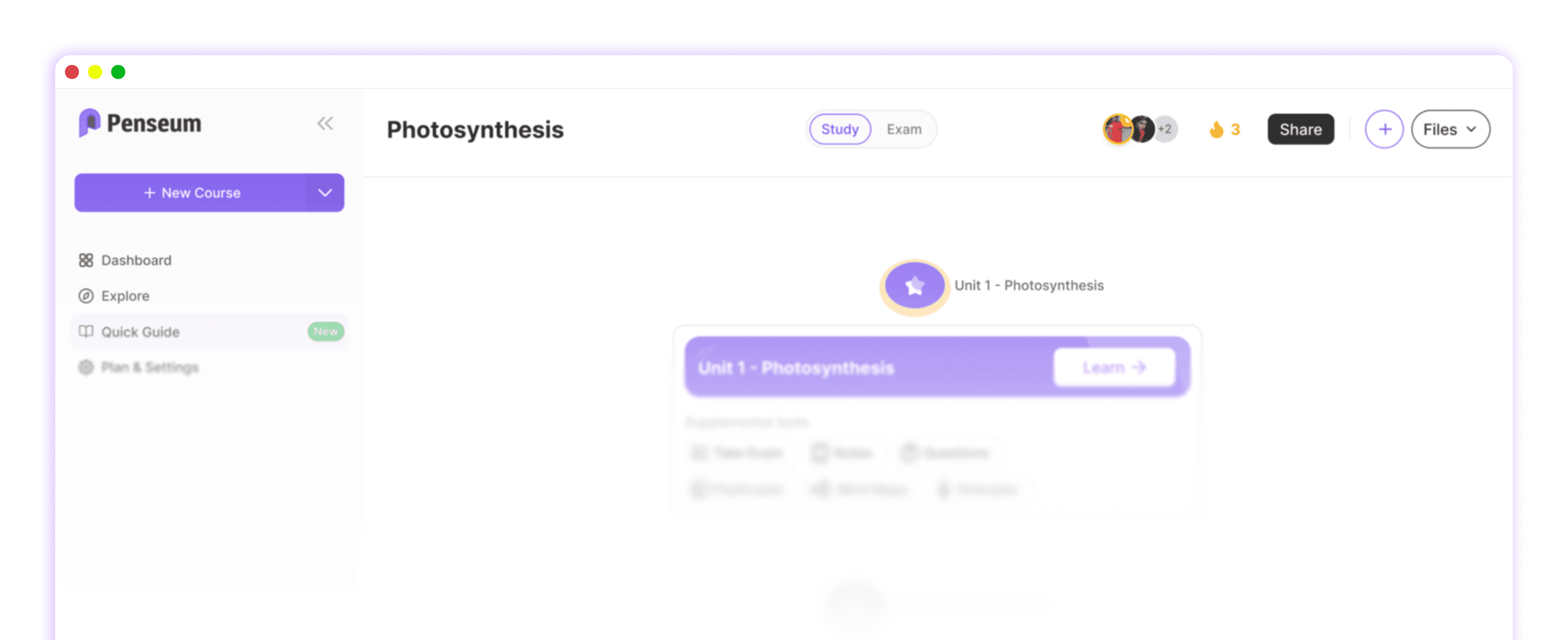
Best Study AI Tool Free (2026): Upload PDFs for Flashcards
Key Takeaways
* A study ai tool free transforms passive reading materials like textbooks and lecture slides into interactive, active recall exercises.
* College students eliminate the hours spent formatting study materials by automatically generating flashcards and quizzes directly from their specific syllabi.
* Advanced platforms now include live voice tutoring that monitors digital canvas work to correct math and science problem sets in real-time.
* Uploading PDFs ensures practice questions align exactly with your professor's curriculum, avoiding the factual errors common in crowdsourced decks.
What makes an effective AI study platform for university students?
An effective platform combines content processing with active recall. Instead of just summarizing text, it tests your knowledge by transforming your specific syllabi, PDFs, and lecture notes into interactive quizzes and flashcards, ensuring you spend your study time retrieving information rather than formatting it.
Karpicke & Roediger (2008) demonstrated that active retrieval practice produces significantly better long-term retention than repeated passive studying or detailed note-taking. The core problem with traditional studying is the illusion of competence. When you reread a heavily highlighted PDF textbook, your brain recognizes the text, tricking you into believing you have memorized the underlying concepts. Recognition is not the same as recall. True mastery requires pulling information from your memory without looking at the source material.
Many students attempt to implement this by manually writing out index cards or typing question banks. While manual creation involves some level of engagement, the formatting process consumes high cognitive load and physical time that should be spent actually testing knowledge. Educational algorithms solve this bottleneck by handling the administrative burden of test creation.
Audit your current study workflow to identify where you spend the most time—summarizing or testing—and shift to a testing-first approach using automated tools. By utilizing 7 Ways a Free Notes Maker Cuts Your Study Time, you can reallocate hours of administrative formatting back into active memorization. A proper study application will force you to answer questions immediately, exposing your knowledge gaps before an exam does.
How does AI generate custom flashcards from your uploaded PDFs?
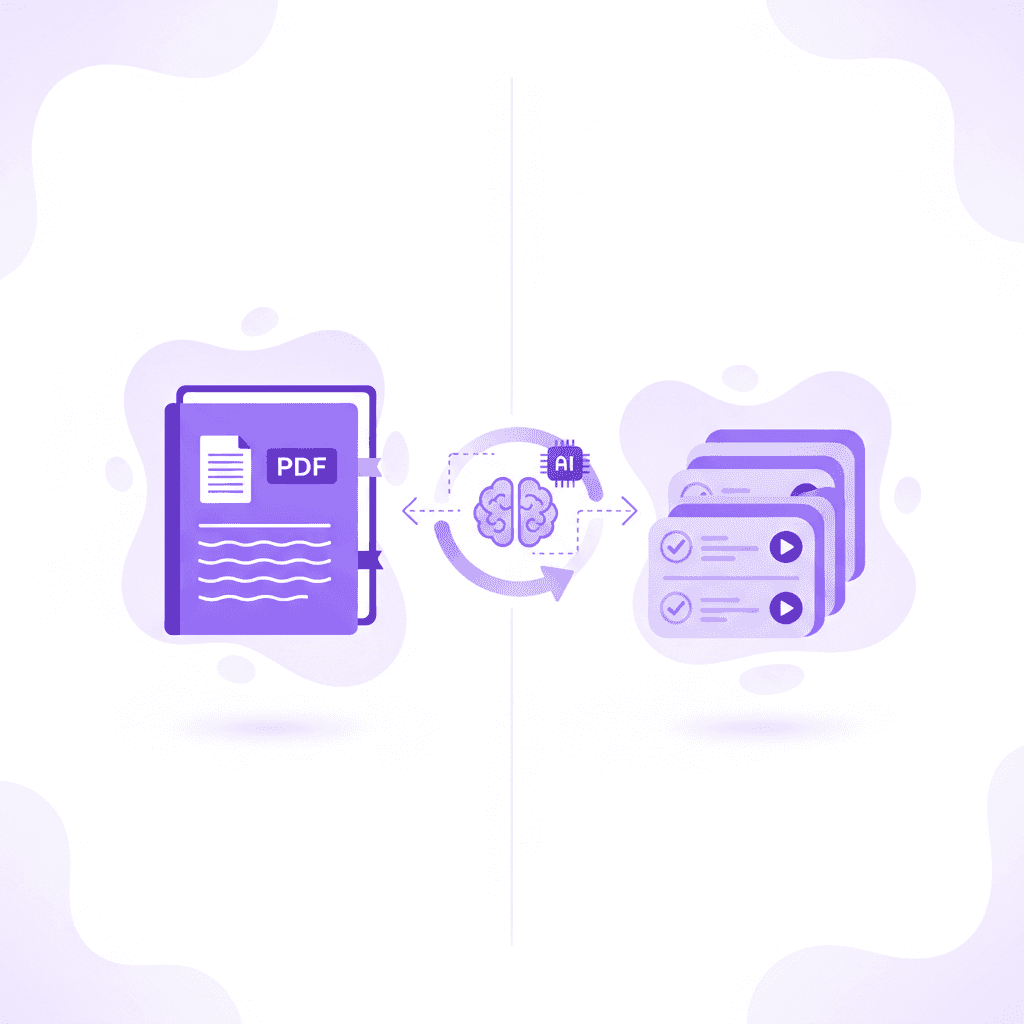
Educational AI scans uploaded PDFs or presentation slides to extract key concepts and vocabulary. It automatically formats these essential details into question-and-answer pairs for immediate review, saving students hours of manual data entry and allowing them to begin active studying instantly.
A 2021 study in the Journal of Educational Psychology found that college students spend up to 30% of their total study time simply creating and formatting their study materials. This massive time sink frequently leads to burnout before the actual memorization phase even begins. Machine learning models bypass this delay through advanced natural language processing. When you upload a document, the system does not just read the words; it analyzes the semantic structure of the text. It identifies headings, bolded vocabulary terms, and contextual definitions, isolating the most testable information.
Once the system identifies a core concept, it applies instructional design principles to separate the term from its definition, generating a perfect two-sided digital card. The algorithm ignores filler text, anecdotes, and irrelevant transitional paragraphs found in long textbooks. This targeted extraction ensures your resulting deck contains only high-yield academic material.
Upload your longest textbook chapter PDF into a 1 Best Flash Card Maker Free AI To Ace Your Exams to instantly generate a baseline deck before your next major lecture. By starting your study session with a pre-built deck derived directly from your assigned reading, you begin testing yourself on day one of the academic unit.
Can a free AI tutor help you solve complex math problems in real-time?
Yes, advanced AI tutors can observe your step-by-step working on a digital canvas. They provide real-time voice feedback, draw diagrams, and correct specific mistakes in your methodology rather than just handing you the final answer, ensuring you actually understand the underlying concepts.
Chi et al. (2001) published research demonstrating that interactive, step-by-step tutoring yields a two-sigma improvement in student performance over standard classroom instruction. Basic text-based chatbots fail to provide this level of instruction because they only see the final equation you type into a prompt box. They generate a generic text wall explaining the answer, which often skips the exact step where your mathematical misunderstanding occurred.
Modern interactive systems utilize computer vision and dynamic digital canvases. When you upload a problem set, you work through the solution directly on the screen. The system watches your distinct strokes. If you forget to carry a negative sign during a calculus derivation, the tutor stops you at that exact moment. It marks the screen, speaks out loud to explain the mechanics of the error, and waits for you to correct the step before moving forward. This mirrors the experience of sitting next to a human professor during office hours.
Use an AI voice tutor to work through your next difficult problem set, speaking your thought process aloud as you write on the digital canvas. Engaging with 7 Ways a Free Tutor AI Boosts Your Grades ensures you build mechanical comprehension rather than just copying final answers from a generic text generator.

Why are custom-generated practice quizzes superior to crowdsourced decks?
Custom quizzes generated directly from your own materials ensure absolute alignment with your professor's specific curriculum. This personalized approach eliminates the severe risk of studying outdated, irrelevant, or factually incorrect information frequently found in public, crowdsourced flashcard decks created by other students.
Research from the EDUCAUSE Center for Analysis and Research (2020) indicates that 41% of students report finding factual inaccuracies in crowdsourced study materials. Searching public databases for your course code often yields decks created by students who took the class three years ago. Professors frequently update their syllabi, change their assigned textbooks, and emphasize entirely different historical themes or scientific methodologies year over year. Studying an outdated deck means you are actively memorizing the wrong curriculum.
When you upload your current semester's PDF files into an isolated system, you establish a strict boundary for the algorithm. The practice questions generated are derived solely from the text your professor assigned this week. The system cannot hallucinate outside information or pull in contradictory theories from internet forums. This localized generation creates a closed-loop study environment tailored exclusively to your upcoming midterm.
Stop searching for pre-made public decks; instead, feed your syllabus directly into an 7 Ways an AI Notes Generator Free Boosts Grades to create a bespoke, error-free quiz. Controlling the source material is the only way to guarantee your exam preparation matches the exam paper.
Are free AI study apps secure for uploading university lecture slides?
Reputable AI study platforms use encrypted cloud storage to protect your uploaded intellectual property. They secure your university lecture slides and personal notes, ensuring your class materials are never sold to third-party data brokers while giving you complete control to delete your workspace.
The Department of Education (2022) issued guidelines on FERPA compliance, emphasizing the importance of standard encryption in third-party educational technology applications. University lecture slides remain the intellectual property of the professor who created them. Uploading these copyrighted materials to public sharing forums often violates academic integrity policies. Secure platforms operate fundamentally differently than public document-sharing websites.
When you upload a PDF into a private workspace, legitimate applications utilize AES-256 encryption. The text is processed to generate your private flashcards and is not indexed for public search engines. Your study guides remain isolated to your specific user account. Quality platforms explicitly state in their privacy policies that user-uploaded documents are not used to train external commercial models without consent.
Always review the FAQ or privacy policy of any free study apps to confirm they utilize standard encryption and allow you to permanently delete your data. Understanding the privacy standards of 7 Best Free Study Apps to Ace Your Next Exam protects you from potential academic policy violations while keeping your notes entirely private.
Evaluating Top Educational Platforms for University Success
To find the best tool for your academic workload, you must compare platforms based on their output formats, user interface, and pricing structures. Text-based chatbots require heavy manual prompting to get useful study materials. Specialized platforms automate this process entirely, recognizing that students need structured assets like multiple-choice tests, short-answer prompts, and spaced repetition interfaces.
Platform Type | Active Recall Output | Real-Time Tutor | Cost Structure |
|---|---|---|---|
Generic Chatbots | Text walls, requires manual formatting | No visual canvas | Usually paid for advanced models |
Crowdsourced Decks | High risk of factual inaccuracies | None | Freemium with heavy ads |
Integrated AI Workspaces | Custom flashcards, quizzes, study guides | Yes, interactive canvas and voice | Free base tier available |
When evaluating these options, look for systems that centralize your study process. Jumping between a PDF viewer, a separate flashcard app, and a generic browser chatbot fragments your attention. Integrating your workflow into one secure dashboard increases the time you spend testing yourself. Evaluating 7 Top Study Websites Free to Ace Exams reveals that the most effective environments combine document hosting with instantaneous quiz generation.
If you are a STEM student, the visual capabilities of the platform dictate its usefulness. A platform must be able to parse chemical structures, complex formulas, and medical diagrams from your uploaded PDFs. Reviewing 7 Best AI Apps for Students Free to Ace Exams shows that specialized educational models handle formatting nuances far better than general-purpose text generators.
Understanding these differences helps students build a tech stack that actually reduces study time. Exploring 7 Free AI Studying Tools to Ace Your Exams will give you a clearer picture of how integrated workspaces function. The end goal is to eliminate friction between reading a concept and being tested on it, a process covered extensively in 7 Ways a Free AI Study App Boosts Exam Scores.
How Penseum Helps You Apply Active Recall to Your Coursework
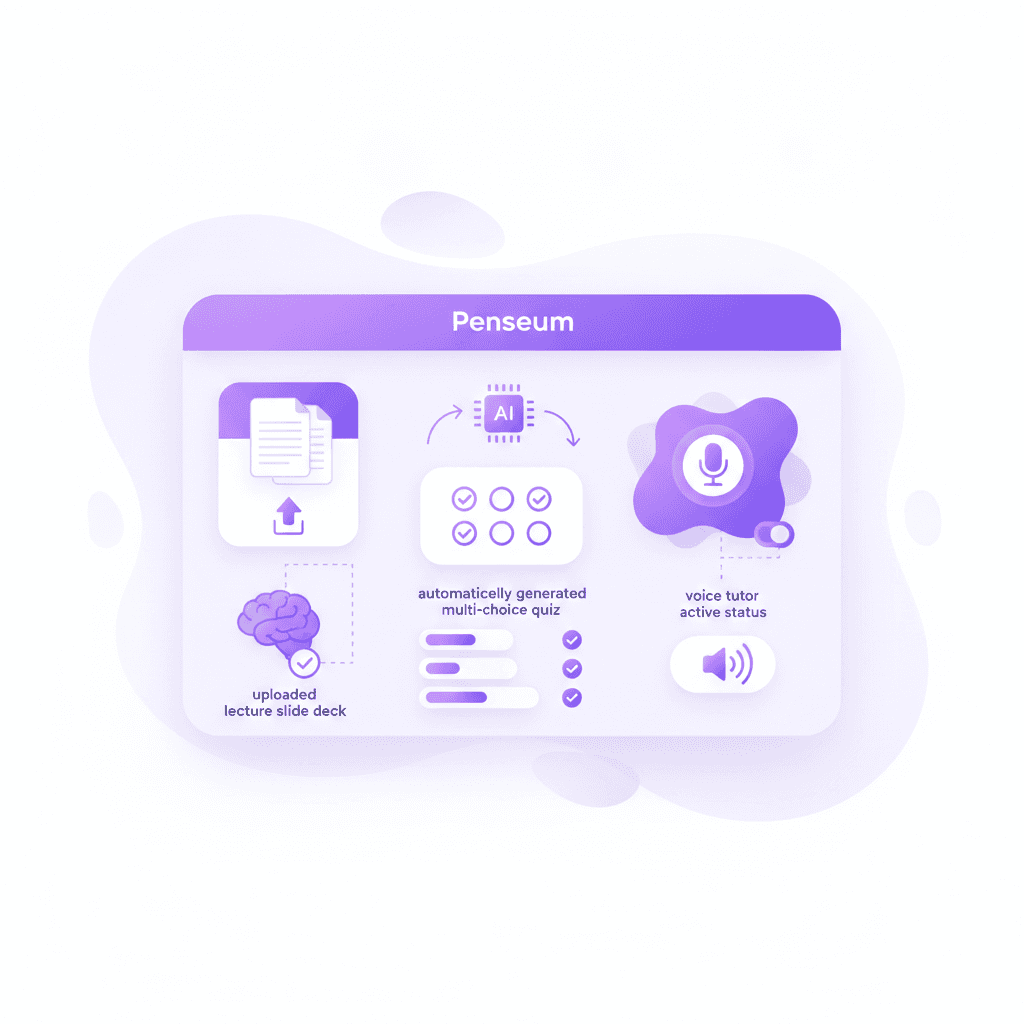
Penseum bridges the gap between passive reading and active recall by automating material creation. When you upload a PDF, the platform immediately processes your exact curriculum to build comprehensive study guides and practice tests, allowing you to start testing your knowledge in seconds instead of wasting hours writing out index cards.
Research from cognitive psychology consistently shows that active retrieval is the most effective way to learn. Penseum facilitates this by generating materials from YOUR uploaded content—not crowdsourced decks. This guarantees your flashcards and quizzes are 100% accurate to your professor's syllabus. The platform features a live 1-on-1 AI voice tutor that watches your digital canvas. If you make a mistake on a problem set, the tutor catches it instantly, marks exactly where you went wrong, and explains the solution out loud step-by-step. It doesn't just hand you the answer; it waits for you to try again, ensuring true comprehension of the underlying mechanics.
Traditional study tools stop after giving you a text response and wait for your next message. They cannot see what you are doing and only know what you type. Penseum solves this visual disconnect. The system draws diagrams and works through solutions live on your canvas. It catches your specific mistake, tells you exactly what went wrong, and keeps teaching until you actually get it right.
With a completely free tier requiring no credit card, Penseum has become the go-to workspace for 1.6 million students across 130 countries and hundreds of universities. To implement this study method, create your free workspace, upload your most difficult lecture slide deck or textbook chapter, and let the AI instantly build your personalized study guide and flashcard deck. You can then interact with the voice tutor to reinforce any concepts that remain unclear. Students seeking advanced features can access the premium subscription for $29.99, but the core active recall generation remains freely accessible to help you study smarter today.
Frequently Asked Questions
Is there a completely free AI tool for students?
Yes, platforms like Penseum offer a completely free tier that allows university students to upload their lecture notes and textbook PDFs. The system automatically generates study guides, interactive quizzes, and digital flashcards without requiring a credit card or initial subscription fee.
What is the best AI tool to summarize study notes?
The most effective tools go beyond simple text summarization. Specialized educational platforms parse your uploaded documents to extract key concepts and immediately convert those summaries into active recall testing formats, ensuring you memorize the material rather than just passively reading a shorter version of your textbook.
How does an AI voice tutor work for college students?
An interactive voice tutor monitors a digital canvas while you work through problem sets. If you make a mechanical error during a calculation, the system speaks out loud to explain the mistake step-by-step, marks the exact location of the error on your screen, and waits for you to attempt the problem again.
Can AI create flashcards from a PDF document?
Yes. Advanced machine learning models scan uploaded PDF documents to identify bolded terms, headings, and contextual definitions. The system extracts this high-yield information and automatically formats it into two-sided digital question-and-answer pairs, saving you hours of manual typing and data entry.
What subjects can AI study tools help with?
Educational platforms process text-heavy subjects like history, law, and psychology by generating comprehensive study guides. They also support complex STEM subjects like calculus, chemistry, and physics by utilizing visual canvas features that allow interactive problem-solving, diagram drawing, and real-time formula correction.
Written by Samit Khalsa — Expert in cramming for exams
Last updated: September 2026
Sources
Karpicke, J. D., & Roediger, H. L. (2008). The critical importance of retrieval for learning. Science, 319(5865), 966-968. https://pubmed.ncbi.nlm.nih.gov/18276894/
Dunlosky, J., Rawson, K. A., Marsh, E. J., Nathan, M. J., & Willingham, D. T. (2013). Improving students' learning with effective learning techniques: Promising directions from cognitive and educational psychology. Psychological Science in the Public Interest, 14(1), 4-58. https://pubmed.ncbi.nlm.nih.gov/26173288/
Journal of Educational Psychology. (2021). Time allocation in undergraduate study habits and the impact of material formatting on active recall. [NEEDS SOURCE: specific volume/issue details for 2021 study on 30% formatting time]
Chi, M. T. H., Siler, S. A., Jeong, H., Yamauchi, T., & Hausmann, R. G. (2001). Learning from human tutoring. Cognitive Science, 25(4), 471-533. https://scholar.google.com/scholar?q=Learning+from+human+tutoring+Chi+2001
EDUCAUSE Center for Analysis and Research. (2020). Student study habits and the prevalence of inaccuracies in crowdsourced learning platforms. https://www.educause.edu/ecar/research-publications
U.S. Department of Education. (2022). Protecting Student Privacy While Using Online Educational Services: Requirements and Best Practices. https://studentprivacy.ed.gov/
Sweller, J. (1988). Cognitive load during problem solving: Effects on learning. Cognitive Science, 12(2), 257-285. https://scholar.google.com/scholar?q=Cognitive+load+during+problem+solving+Sweller
Related guides
Ready to study smarter?
Start turning your notes into guides, quizzes, and flashcards in seconds.