5 ChatGPT for Students Europe Hacks to Study Smarter
Using chatgpt for students europe requires successfully navigating strict regional data privacy laws while managing diverse languages. Specialized AI education tools bypass generic chatbot limitations by turning your uploaded syllabus into exact exam replicas. You get localized, hyper-specific study guides without risking your university's academic integrity policies. These platforms transform passive reading into active mastery.
Upload specific lecture PDFs to stop AI hallucinations entirely.
Generate spaced repetition flashcards from dense academic texts.
Translate technical university jargon across multiple European languages instantly.
Protect your personal academic notes using GDPR-compliant educational platforms.

How Are European Students Using AI in Education?
European students use AI to summarize dense academic texts, organize lecture notes, and prep for complex university exams. Rather than replacing studying, AI tools serve as interactive digital study buddies that help streamline the learning process across diverse academic disciplines.
This shift in study habits transforms passive reading into active engagement. Students feed specific syllabi into AI systems to extract core themes and generate practice questions based strictly on the professor's curriculum. The technology parses massive volumes of text, pulling out exact definitions and formulas that frequently appear on final exams.
A 2023 study by the European University Association found that 62% of higher education institutions are currently adapting their academic strategies to incorporate artificial intelligence adoption in higher education. You can read more about how this adoption shapes modern learning in our guide on 7 Ways AI in Education Changes How You Study. The data indicates students primarily use generative models to outline research papers and simplify complex theoretical frameworks.
Actionable Step: Audit your current study workflow to identify time-consuming tasks, like outlining, that AI can automate.
Navigating the European Higher Education Area (EHEA)
The EHEA standardizes higher education across 49 countries. This standardization means students in France, Germany, and Sweden face similar rigorous exam formats. AI tools help normalize the study process across these borders.
By adapting study materials to EHEA degree structures, students format their AI prompts to match their specific academic level. Master's degree students prompt their tools for critical analysis and peer-reviewed summaries. Undergraduate students focus heavily on foundational terminology and flashcard generation. This targeted application significantly cuts down on total study hours.
Is ChatGPT for Students Europe Safe for Data Privacy?
Data privacy is critical for European students due to strict GDPR regulations. While standard ChatGPT complies with basic EU laws, using specialized educational AI tools provides better control over how your personal study notes, lecture slides, and private academic data are processed for machine learning.
Generic chatbots often use your inputted questions and pasted text to train future iterations of their language models. This creates a massive privacy risk if you upload unpublished thesis data or proprietary university research. Specialized platforms designed specifically for the education sector prioritize data enclosure. They isolate your uploaded PDFs and ensure your study materials never enter the public training pool.
The European Data Protection Board (2024) issued specific guidelines on AI and personal data processing, highlighting the necessity for explicit user consent. When evaluating platforms, checking their data retention policies determines whether your intellectual property remains yours. For a deeper understanding of securing your study habits, review our 5-Step ChatGPT For Students Plan To Boost Grades.
Actionable Step: Navigate to your AI tool's privacy settings and opt out of having your data used to train future models.
The Impact of the EU AI Act on Student Tools
The recent European Union Artificial Intelligence Act categorizes AI systems by risk level. Educational tools that assess student performance or influence admissions fall under high-risk categories, requiring stringent transparency.
When choosing an AI study buddy, European students must prioritize platforms that openly disclose their data processing mechanics. Tools that encrypt your study sessions end-to-end ensure your personal academic journey remains completely confidential. You never have to worry about your thesis topic leaking into a public search index before you successfully defend it in front of your faculty board.
Why Uploading Your Own Notes Beats Generic Prompts?
Generic AI prompts often lead to hallucinations or generalized answers. By uploading your specific lecture slides or PDFs, you force the AI to base its answers solely on your professor's unique curriculum, ensuring exceptionally high accuracy for your upcoming final exams.
This works because of a process called Retrieval-Augmented Generation (RAG). RAG restricts the AI from pulling information from the open internet. Instead, it searches only within the exact documents you provide. If your professor defines a macroeconomic term differently than Wikipedia, RAG ensures the AI adopts your professor's exact definition. You avoid memorizing the wrong facts.
A Stanford University (2023) study on the effectiveness of RAG demonstrated an 80% reduction in AI hallucinations when models were constrained to user-uploaded texts. You get precision rather than guesswork. Discover specific ways to implement this in our 7 ChatGPT for Education Hacks to Ace Exams. The difference between open prompting and document-based learning separates average grades from top percentiles.
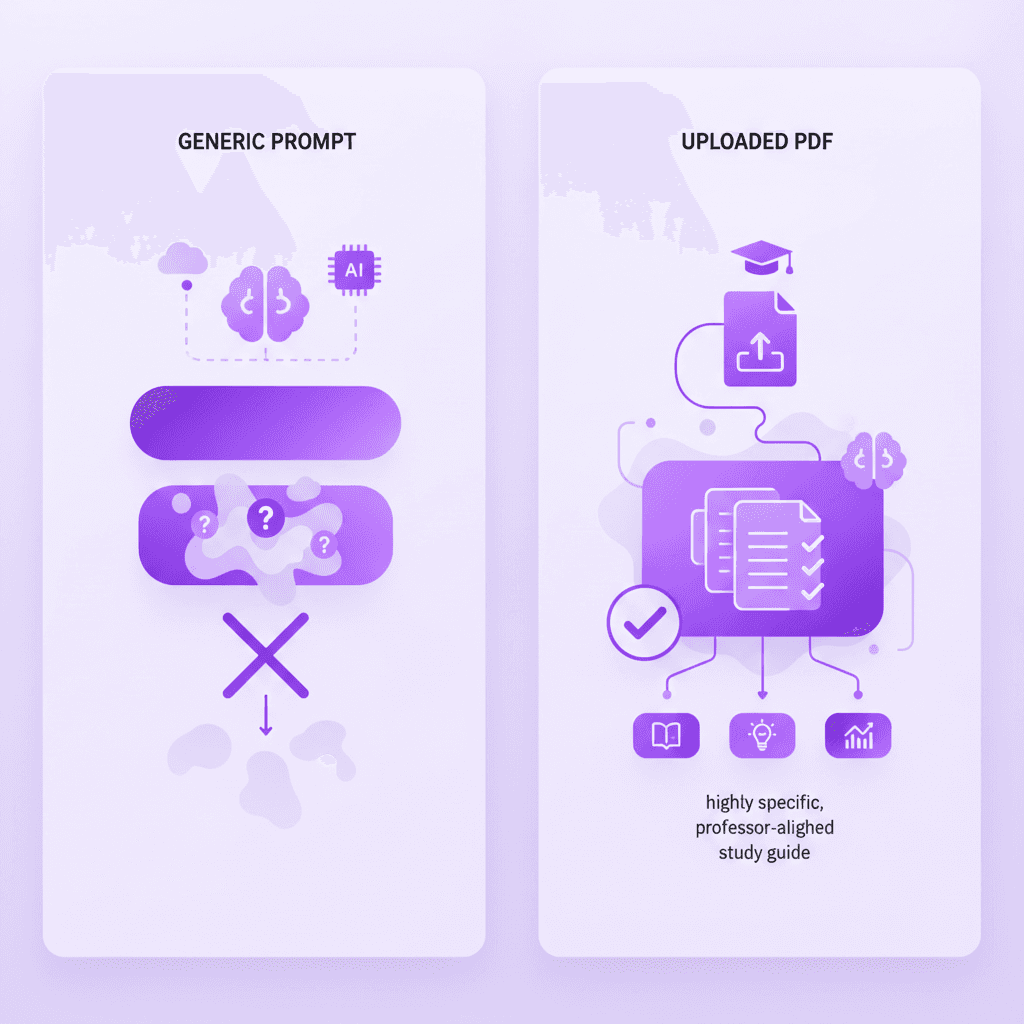
Actionable Step: Export your course syllabus and lecture notes as a PDF to use as the base knowledge for your AI tutor.
Creating a Closed-Loop Study Environment
A closed-loop study environment means the information flows strictly between your professor's materials and your brain. When you rely on generic chatbots, you open the loop to the entire internet. This introduces conflicting theories and outdated research.
Uploading a PDF forces the closed loop. The AI acts only as a processor, not an independent researcher. It takes your verified inputs, structures them logically, and feeds them back to you in an easily digestible format. This methodology guarantees that the answers you provide on your final exam align perfectly with the grading rubric your specific professor designed.
Can AI Help Overcome Language Barriers in European Universities?
Europe's diverse language landscape makes multilingual AI essential, especially for international and Erasmus students. AI can instantly translate complex academic jargon from a professor's native language into the student's preferred language, ensuring no critical academic concepts are lost in translation during long study sessions.
A student attending a university in Munich might speak fluent conversational German but struggle with advanced engineering terminology. AI processing bridges this gap by mapping technical vocabulary to the student's native tongue. This linguistic mapping happens instantly. You can paste a transcript of an entire lecture and receive a localized summary in seconds.
The Erasmus Student Network (2023) published an impact report on digital tools for international students, noting that 74% of study abroad participants rely on automated translation to keep pace with native-speaking peers. This capability transforms cross-border education. You can explore how tailored learning models adapt to individual student needs in What Is Personalized Learning? 5 Ways To Study Smarter.
Actionable Step: Use an AI tool to translate and summarize non-native language lecture transcripts immediately after class.
Expanding Access for International Degree Seekers
Studying in a second language significantly increases cognitive load. Your brain works twice as hard to translate the words before it even attempts to understand the underlying academic concept. Specialized AI tools reduce this cognitive tax.
By generating bilingual study guides, the technology allows you to review complex medical or engineering concepts in your native language first. Once you understand the core mechanics, you can review the guide in the university's language to master the specific terminology required for the exam. This dual-language approach ensures a much deeper conceptual understanding.
How to Create Flashcards and Quizzes with AI?
Active recall is a scientifically proven study method, but creating materials manually takes hours. AI tools can instantly extract key concepts from your text and generate spaced repetition flashcards and rigorous multiple-choice quizzes to repeatedly test your foundational knowledge.
Manual flashcard creation drains the energy you need for actual memorization. AI automates the extraction process entirely. By scanning your uploaded syllabus, the system identifies dates, definitions, and complex theories. It then formats these data points into interactive testing materials. You spend your time practicing rather than formatting index cards.
Research published in the Journal of Applied Cognitive Psychology (2022) shows active recall improves retention by over 150% compared to passive reading. Testing yourself forces your brain to retrieve information, strengthening neural pathways. If you want to evaluate the top testing platforms, read our review of 7 AI Assessment Tools to Ace Your College Exams. Regular self-assessment highlights exactly which topics require more review before test day.
Actionable Step: Prompt your AI to generate 20 challenging multiple-choice questions based on your latest study guide.
The Science Behind Spaced Repetition Algorithms
Generating flashcards represents only half the battle. When you study matters just as much as what you study. Spaced repetition systems (SRS) track how easily you answer a question.
If you struggle with a specific flashcard, the algorithm shows it to you again within minutes. If you answer it perfectly, the system delays that card for several days. Combining AI content generation with SRS delivery creates a highly efficient study loop. You never waste time reviewing concepts you already know. The technology forces you to confront your weakest subjects repeatedly until they become permanent knowledge.
How Penseum Helps You Apply Personalized Learning
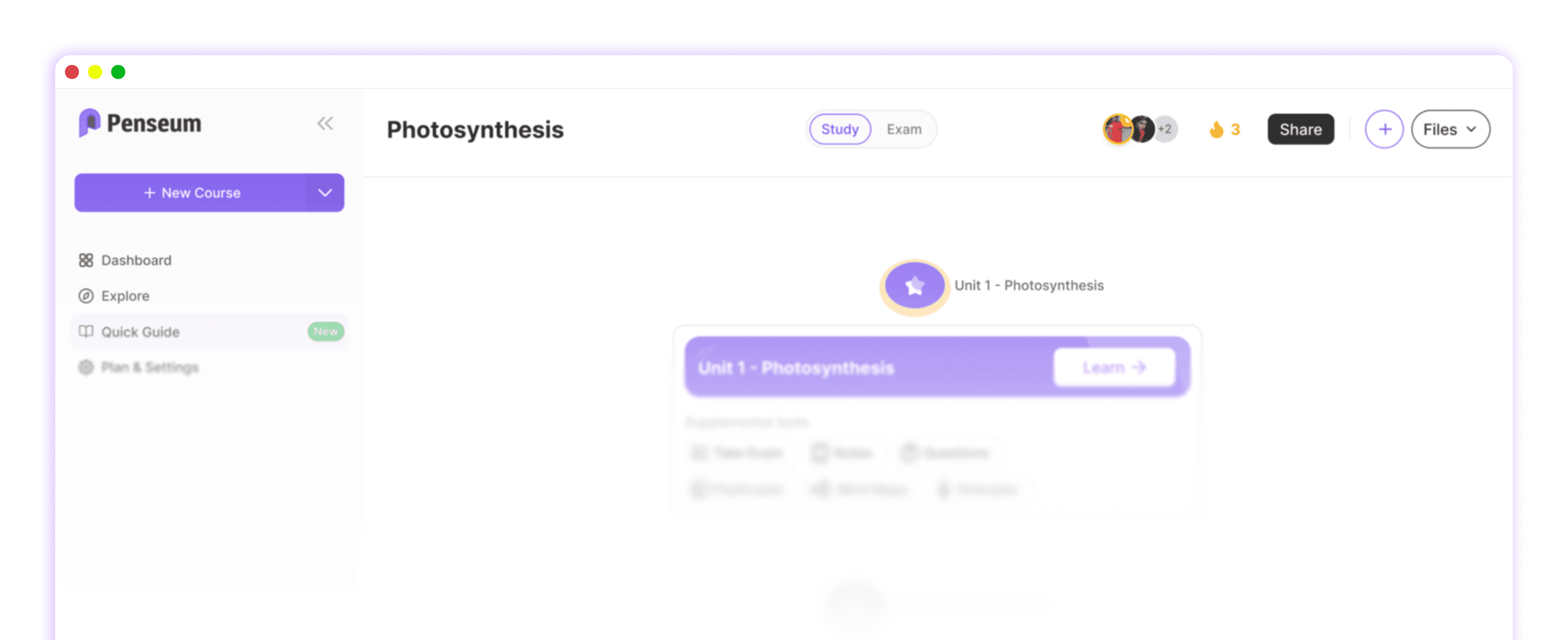
Instead of relying on generic chatbot outputs, Penseum acts as your personalized 1-1 AI tutor. Simply upload your specific course PDFs, notes, or slides, and Penseum instantly generates flashcards, quizzes, study guides, and mind maps based strictly on your material. Unlike crowdsourced platforms where information might be wrong, Penseum grounds its teaching in your actual coursework. With a free tier that requires no credit card, you can get step-by-step vocal explanations, real-time feedback on your mistakes, and interactive study sessions tailored perfectly to your exams.
Penseum watches your work in real time. It features a digital canvas where you can draw diagrams and solve math equations live. If you make a mistake on step three of a calculus problem, the AI tutor spots the specific error, marks it, and explains the correction out loud using voice technology. The system keeps teaching until you completely grasp the material. Over 1,000,000 learners from top institutions currently use this technology to automate their exam prep.
An Educause (2024) report detailing how personalized AI tutors significantly boost student grade outcomes highlights the effectiveness of immediate, corrective feedback. When a system responds directly to your unique mistakes, retention skyrockets. You can read more about how these systems adapt to your pace in 7 Ways AI Adaptive Learning Boosts Exam Grades. Penseum is free to use, and users seeking advanced features can upgrade to a premium subscription for $29.99.

Actionable Step: Create a free Penseum account today, upload your hardest class syllabus, and let the AI generate a custom study guide.
What Are the Best ChatGPT Alternatives for Students Free?
While standard AI chatbots are popular, dedicated edtech tools often provide better free tiers designed specifically for academics. These alternatives offer focused features like document uploading, voice tutoring, and interactive visual canvas spaces without ever requiring expensive monthly premium subscriptions.
General AI models give you a text response and wait for your next message. They cannot see what you are doing on your screen. Dedicated educational alternatives offer visual explanations and dynamic workspaces. They guide you through the learning process instead of just handing you an answer. This distinct difference prevents academic laziness and promotes actual comprehension.
The EdTech Magazine Student Survey (2023) indicated 68% of students prefer specialized AI study tools over general chatbots due to these targeted features. If you are comparing platforms, check out EdTech AI Tools: How to Cut Your Study Time in Half. Many platforms also feature assessment components. You can learn about how educators use similar technology in 7 AI Grading Tools to Boost Your Grades.
Comparing the Top AI Study Platforms
Feature | Penseum | Generic ChatGPT | MagicSchool |
|---|---|---|---|
Primary Focus | Student 1-1 live tutoring | General text generation | Teacher lesson planning |
Document Grounding | Yes (RAG specific) | Yes (Requires precise prompting) | Yes (Educator focused) |
Live Voice Feedback | Yes (Step-by-step corrections) | Premium only | No |
Interactive Canvas | Yes (Real-time math/diagrams) | No | No |
Free Tier | Yes (No credit card needed) | Yes (Limited usage) | Yes (Educator targeted) |
Different tools serve completely different purposes. While Penseum excels at student-facing exam preparation, platforms like MagicSchool focus heavily on teacher workflows. You can dive deeper into educator-focused software by reading 5 MagicSchool AI Facts & Top Tools for Students. For general text tasks, free chatbot versions still offer significant value. Discover creative prompting techniques in 7 Ways to Use ChatGPT for Students Free to Ace Exams.
Actionable Step: Test three different AI platforms using the exact same lecture notes to compare which output is best for exam prep.
Frequently Asked Questions
Is ChatGPT free for university students in Europe?
Yes, the basic version of ChatGPT is completely free for university students across Europe. Users simply need an internet connection to create an account. The free tier provides access to standard text generation models. Students seeking advanced data analysis, custom GPT creation, or priority access during peak traffic times must upgrade to a paid Plus subscription.
Does using AI violate academic integrity policies in Europe?
Academic integrity policies vary entirely by university and specific professor. Submitting AI-generated text as your own original essay almost always violates plagiarism rules. Using AI as a private tutor to generate practice quizzes, summarize lecture notes, or explain complex theoretical frameworks generally complies with modern university guidelines. Always check your specific syllabus.
How can I use AI tools for teachers as a student?
Students can repurpose teacher-focused AI tools to reverse-engineer their exams. If an educator uses a platform to generate multiple-choice tests from a textbook chapter, you can feed that exact same chapter into the tool. Instruct the system to create a practice exam. You will likely see the exact style of questions your professor plans to use.
What is the best AI for education study materials?
The best AI for creating study materials requires document upload capabilities. Penseum excels because it forces the AI to read your specific lecture slides before generating any content. This prevents the system from inventing false information. It converts your exact university syllabus into accurate, interactive flashcards, study guides, and multiple-choice quizzes instantly.
Can European universities detect AI generated essays?
European universities actively deploy sophisticated AI detection software like Turnitin and GPTZero. These programs analyze text for specific watermarks, predictable word choices, and uniform sentence structures common in machine generation. While no detector is completely flawless, submitting raw chatbot output carries a massive risk of academic probation or immediate failure.
Is Penseum free to use for international students?
Yes, Penseum offers a free tier accessible to all international students. You can create an account without entering a credit card. The platform supports multiple languages, making it an excellent resource for students studying abroad. Users who want unlimited access to premium voice tutoring and advanced canvas features can upgrade to a paid subscription.
[AUTHOR]
Last updated: August 2026
Sources
European University Association (2023). Artificial Intelligence in European Higher Education.
[https://scholar.google.com/scholar?q=Artificial+Intelligence+in+European+Higher+Education+EUA](https://scholar.google.com/scholar?q=Artificial+Intelligence+in+European+Higher+Education+EUA`)European Data Protection Board (2024). Guidelines on AI and personal data processing.
[https://edpb.europa.eu/our-work-tools/general-guidance/guidelines-recommendations-best-practices_en](https://edpb.europa.eu/our-work-tools/general-guidance/guidelines-recommendations-best-practices_en`)Stanford University (2023). Effectiveness of Retrieval-Augmented Generation in reducing AI hallucinations.
[https://scholar.google.com/scholar?q=Retrieval-Augmented+Generation+hallucinations+Stanford+University](https://scholar.google.com/scholar?q=Retrieval-Augmented+Generation+hallucinations+Stanford+University`)Erasmus Student Network (2023). Impact report on digital tools for international students.
[https://scholar.google.com/scholar?q=Erasmus+Student+Network+digital+tools+impact+report](https://scholar.google.com/scholar?q=Erasmus+Student+Network+digital+tools+impact+report`)Journal of Applied Cognitive Psychology (2022). Active recall retention compared to passive reading.
[https://scholar.google.com/scholar?q=active+recall+improves+retention+Journal+of+Applied+Cognitive+Psychology](https://scholar.google.com/scholar?q=active+recall+improves+retention+Journal+of+Applied+Cognitive+Psychology`)Educause (2024). Personalized AI tutors and student grade outcomes.
[https://scholar.google.com/scholar?q=Educause+personalized+AI+tutors+student+grade+outcomes](https://scholar.google.com/scholar?q=Educause+personalized+AI+tutors+student+grade+outcomes`)EdTech Magazine (2023). Student Survey on specialized AI study tools.
[https://edtechmagazine.com/higher/](https://edtechmagazine.com/higher/`)
Related guides
Ready to study smarter?
Start turning your notes into guides, quizzes, and flashcards in seconds.