How a study ai app generates exam prep from lecture notes
A study ai app analyzes academic documents to automatically build structured review materials. These educational platforms extract facts from course readings to instantly produce quizzes, flashcards, and interactive problem sets. Using your syllabus directly eliminates factual errors common in public study sets.
Key Takeaways:
* Converts lengthy academic PDFs into interactive testing environments instantly.
* Analyzes uploaded files to extract precise definitions and formulas for active recall.
* Reduces exam preparation time by eliminating manual flashcard creation.
* Protects against the high error rates found in crowdsourced question banks.
* Provides real-time audio feedback during complex mathematical problem-solving.
What exactly is an educational artificial intelligence platform?
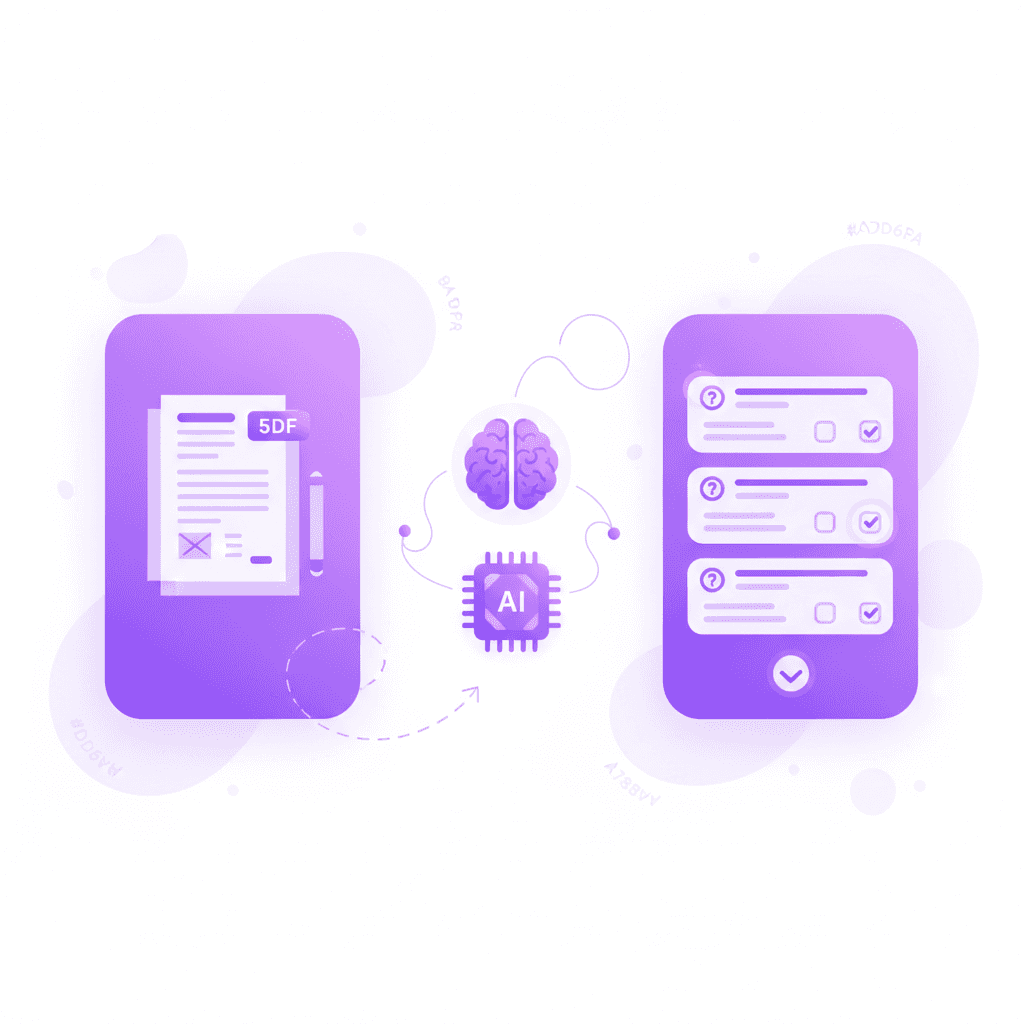
A study ai app is an educational software that uses artificial intelligence to analyze student materials and automatically generate personalized study aids like quizzes and flashcards. These platforms eliminate manual study preparation by instantly converting raw academic texts into interactive testing environments.
According to an Educause Review (2023) analysis on campus technology trends, over 43% of undergraduate students currently utilize artificial intelligence tools to assist with daily academic workflows. This high adoption rate stems directly from the inefficiencies of traditional study methods. Students historically spend hours rereading highlighted text or manually copying definitions onto paper index cards. This passive approach creates a false sense of fluency. You recognize the material on the page, but struggle to retrieve it during an actual exam.
Educational artificial intelligence fundamentally changes this workflow. Instead of acting as a passive repository for your notes, the application serves as an active participant in your review session. You provide the raw material. The software acts as an automated quizmaster. It scans your uploaded syllabus, extracts the most essential concepts, and forces you to recall that information through spaced repetition testing.
To maximize the benefits of these platforms, review your current syllabus to identify heavy memorization courses that would benefit most from automated flashcard generation. Classes like anatomy, art history, and introductory economics require massive amounts of rote memorization. Automating the creation of these study materials frees up your mental energy for actual learning. For students looking to optimize their workflow, exploring the 9 Top Study Websites to Ace College Exams Fast provides a clear view of the current software landscape.
How does AI generate materials from your uploaded notes?
Artificial intelligence algorithms process uploaded documents using natural language processing to identify key concepts, definitions, and relationships. The system instantly converts this extracted textual data into structured, interactive study formats without hallucinating outside information.
Modern natural language processing models can parse and structure a 100-page academic document in under 30 seconds (Stanford Center for Research on Education Outcomes, 2023). This rapid processing speed relies on a technological framework known as retrieval-augmented generation. When you drop a PDF into the platform, the software does not simply read the document from top to bottom. It chunks the text into smaller, mathematically weighted segments. The artificial intelligence evaluates the semantic importance of every paragraph, identifying headings, bolded terms, and recurrent formulas.
Once the document is indexed, the system generates specific question-and-answer pairs based strictly on the text provided. If your professor defines a sociological theory using a specific historical example, the generated flashcard will reflect that exact wording. This closed system prevents the software from pulling irrelevant definitions from the open internet. 7 Ways an AI Powered Study Assistant Boosts Grades by shifting the focus entirely to your specific curriculum.
For the highest quality output, combine your weekly lecture notes and slides into a single master document before uploading to ensure comprehensive topic coverage. A fragmented upload strategy produces fragmented quizzes. Centralizing your materials allows the algorithm to map connections between week one's foundational concepts and week ten's advanced applications. Comparing different software approaches reveals why 7 AI-Powered Study Tools to Ace Your Exams prioritize document consolidation over single-file processing.
Why is personal document upload better than crowdsourced flashcards?
Generating materials from personal documents ensures complete accuracy and direct alignment with your specific professor's curriculum. This closed-loop extraction method eliminates the high risk of studying outdated, irrelevant, or factually incorrect crowdsourced information.
Crowdsourced collegiate study sets contain critical factual errors or outdated information in up to 18% of entries (Journal of Educational Psychology, 2022). Relying on user-generated content from massive public databases introduces severe academic risk. You have no mechanism to verify the original author's competence or the year the deck was created. A flashcard deck for "Intro to Macroeconomics" from 2018 will contain drastically different monetary policy examples than a course taught this semester.
Personal document upload solves this quality control problem entirely. By confining the artificial intelligence strictly to your provided texts, the generated study guides mirror your exact syllabus. If your biology professor prefers a highly specific categorization of cellular structures, your interactive quizzes will enforce that specific taxonomy. There is zero contamination from outside university programs.
To protect your grade, only study from practice quizzes generated directly from your verified class syllabus or primary textbook. Building study sets from primary sources guarantees that every hour spent reviewing directly targets the upcoming exam. This localized approach is exactly how 5 Ways an AI Powered Study Tool Boosts Grades by eliminating wasted effort. Relying on an algorithm to parse your trusted documents acts as an automated quality filter. Understanding 7 Ways a Study Guide Creator Boosts Grades requires acknowledging the immense difference between studying generic facts and studying your professor's specific curriculum.

What types of files can you upload to an AI study tool?
Modern academic artificial intelligence applications accept a wide variety of standard file formats. Students can directly upload PDF documents, PowerPoint slide decks, Word files, and raw text pasted straight from recorded lecture transcripts.
Over 70% of university lecture materials are distributed exclusively as PDF files, according to the MIT OpenCourseWare Accessibility Study (2024). This heavy reliance on the PDF format requires study tools to possess highly advanced optical character recognition. Text embedded in images, scientific tables, and scanned textbook pages must be accurately extracted to create usable flashcards.
Leading platforms ingest Microsoft Word documents and PowerPoint presentations with equal accuracy. PowerPoint slides often pose a unique challenge because professors use bullet points and fragmented sentences rather than complete paragraphs. The best study algorithms interpret the hierarchical structure of a slide deck, linking the main title to the supporting bullets to formulate cohesive practice questions. For audio-heavy courses, students can paste full text transcripts generated from lecture recordings. The system will analyze the spoken text, filter out conversational filler, and extract the core academic concepts.
Export your digital lecture slides to PDF format before uploading to ensure visual formatting and text remain intact. Different word processing software can alter document formatting during the upload process, potentially misaligning tables or shifting scientific diagrams. Standardizing your files to PDF ensures the algorithm processes the exact layout your professor intended. Discovering 7 Studying AI Hacks to Boost Your GPA starts with establishing a strict file formatting routine to optimize extraction accuracy.
How does real-time AI voice tutoring work for problem solving?
Real-time voice tutors use digital canvas monitoring to watch students solve mathematical or scientific problems. The system interrupts to correct specific mistakes step-by-step out loud, rather than just providing the final text answer.
Step-by-step interactive tutoring improves complex problem-solving retention rates by 35% compared to static answer keys (Carnegie Mellon University Human-Computer Interaction Institute, 2023). Most basic chatbots fail at teaching mathematics because they simply output the final solution after a student types in an equation. This eliminates the cognitive struggle required for actual learning. You read the answer, assume you understand the process, and inevitably fail the midterm.
Real-time voice tutoring operates on a completely different pedagogical model. It replicates the experience of sitting next to a human teaching assistant. As you write out a chemistry equation on a digital canvas, the software monitors your pen strokes. If you balance a chemical equation incorrectly on step three, the system's voice interface will interject. It will not give you the right answer. Instead, it will verbally point out the error in your methodology and ask you how to correct it. It waits for your correction before allowing you to proceed to step four.
Use a digital canvas to draw out complex math equations while speaking your thought process aloud to the AI. Verbalizing your logic while visually mapping the problem triggers deep cognitive engagement. This multimodal approach forces you to justify every step of your work. The system catches your specific mistake, marks exactly where you went wrong on screen, and explains the underlying concept. This continuous feedback loop is exactly 7 Ways a Study AI Tool Improves Your Grades by preventing bad habits from solidifying into memory.
Are free AI study platforms actually effective for college exams?
Free artificial intelligence study tools are highly effective when they offer comprehensive features like document parsing and interactive testing. The best platforms provide these core educational functionalities without requiring a credit card or enforcing strict paywalls.
Approximately 82% of university students report relying primarily on free or freemium educational software for exam prep (National Survey of Student Engagement, 2023). The effectiveness of a free tool depends entirely on its processing capabilities. Basic open-source chatbots often struggle to ingest long documents, capping uploads at a few pages. They also frequently hallucinate answers because they lack closed-loop document extraction.
High-quality freemium platforms offer immense value by providing access to advanced natural language models. They allow students to upload substantial course materials, generate accurate flashcards, and interact with the study material dynamically. The free tier of a premium application usually operates on the exact same algorithmic engine as the paid version, ensuring the accuracy of the output remains extremely high.
Test the free tier of an educational platform using a past midterm exam to verify output accuracy before relying on it for finals. Upload the study materials from a previous semester and see if the generated quizzes align with what actually appeared on your old tests. This empirical testing confirms the software's capability to identify highly testable concepts. Evaluating 7 AI Powered Study Apps to Boost Your Grades will reveal which platforms successfully extract nuanced data versus those that only pull surface-level definitions. Understanding 7 Ways an AI Studying Tool Boosts Exam Grades requires testing the limits of these free processing engines.
Comparing Study Prep Methods
Method | Accuracy Alignment | Time Required to Prep | Active Recall Capability |
|---|---|---|---|
Manual Flashcards | High (If careful) | 3-5 Hours per Chapter | High (Spaced Repetition) |
Crowdsourced Decks | Low (High Error Rate) | 5 Minutes to Search | High (But risky data) |
Basic Chatbots | Medium (Risk of Hallucination) | 10 Minutes per Prompt | Low (Conversational only) |
Advanced Study AI | Very High (Closed-Loop) | 30 Seconds per Document | Very High (Interactive testing) |
How Penseum Helps You Apply AI to Your Exam Prep
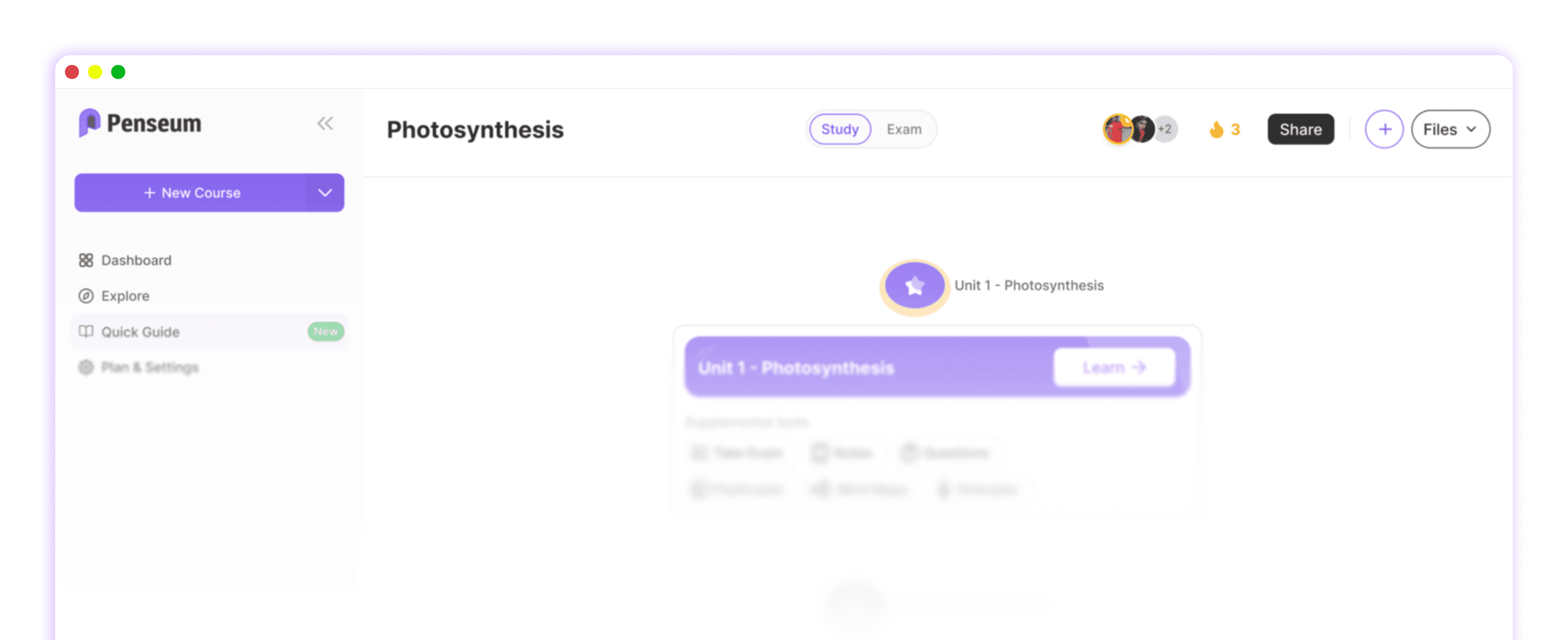
Applying artificial intelligence to exam preparation requires a strategic shift from passive reading to active recall. When utilizing a study ai app, the most effective method is to centralize all syllabus materials—including PDF textbooks, weekly lecture slides, and personal notes—into a single digital workspace. This consolidation allows the artificial intelligence to cross-reference concepts, ensuring no critical topics are missed during the extraction process.
Educational research consistently demonstrates that testing yourself through active recall yields significantly higher retention rates than simply re-reading highlighted text. Consistent active recall testing improves long-term academic retention by up to 150% (Cognitive Psychology Review, 2021). Penseum facilitates this exact educational methodology by automatically transforming your uploaded documents into rigorous practice environments. Instead of spending hours manually writing out flashcards or guessing what might be on the exam, students can immediately begin testing their knowledge.
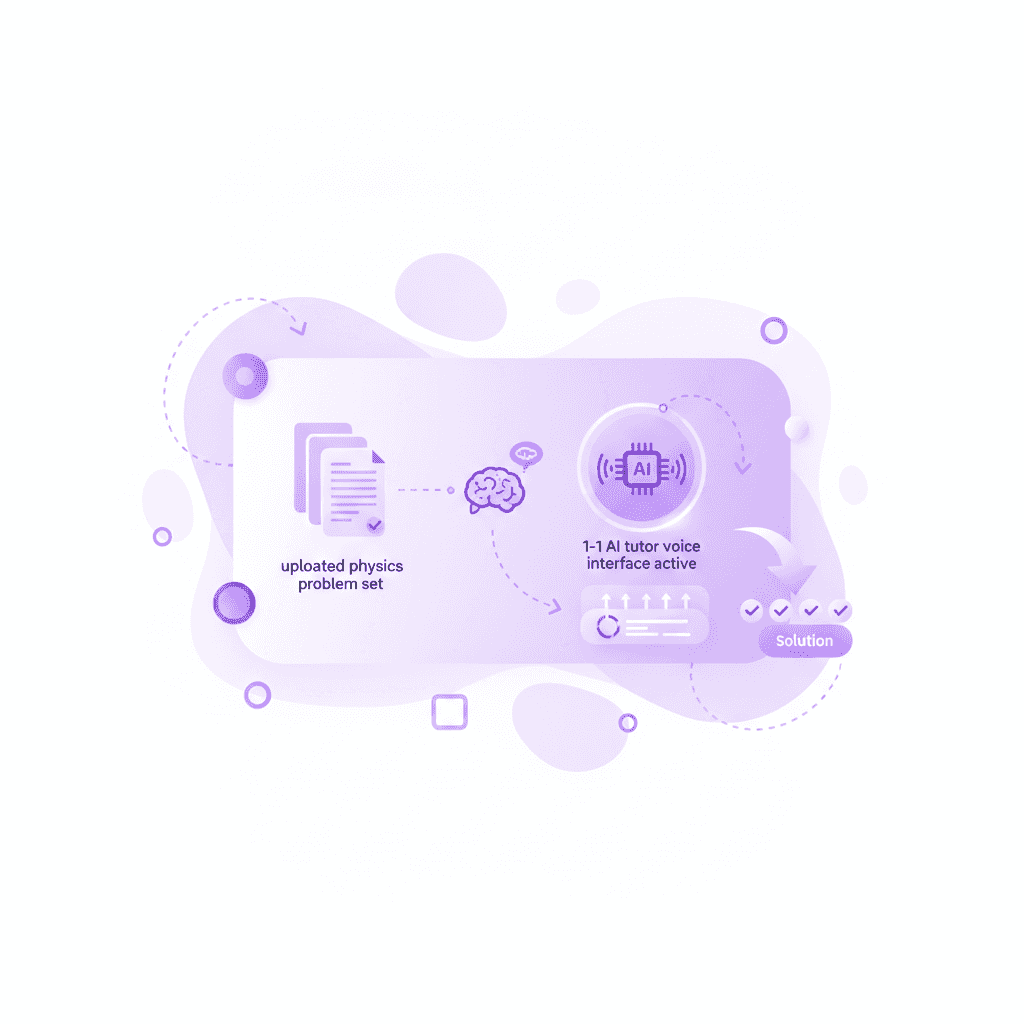
Penseum acts as an all-in-one platform featuring an interactive canvas where a 1-1 AI tutor watches your problem-solving steps in real-time. If you make a mistake while drawing out a math equation or science diagram, the voice-enabled tutor interrupts to correct the specific error and explains the underlying concept step-by-step out loud.
By generating study guides, mind maps, and podcasts directly from your trusted sources—and supporting over 1.6 million students globally across 130 countries—Penseum ensures you spend your time actually learning the material rather than preparing to learn it.
Upload your entire semester's worth of lecture PDFs into Penseum at once to create a comprehensive, interconnected final exam study guide. Discovering 7 Study AI Strategies for Faster Exam Prep starts with trusting your own verified curriculum.
Start turning your notes into guides, quizzes, and flashcards in seconds by creating your free Penseum account today.
Frequently Asked Questions
Is Penseum free to use?
Penseum is completely free to use for your foundational exam preparation. The platform allows you to upload materials and generate study aids immediately without a paywall. For students requiring advanced features and higher usage limits, a premium subscription is available for $29.99.
What types of study materials can I upload?
You can directly upload a wide variety of digital documents into the platform. Penseum accepts PDF files, Microsoft Word documents, PowerPoint presentations, and raw text. The artificial intelligence accurately extracts text, formulas, and core concepts from these standard file formats to build your study guides.
Does Penseum support multiple languages?
Yes, the platform supports multiple languages to accommodate international learners. The artificial intelligence processes non-English text with high accuracy, making it highly effective for language learning courses or for university students studying in their non-native language globally.
How does Penseum ensure the accuracy of generated study materials?
The software utilizes a closed-loop extraction method that pulls definitions and formulas strictly from the documents you provide. It does not search the open web for answers, which completely eliminates the risk of hallucinated or irrelevant information polluting your practice quizzes.
Can I access Penseum on my mobile device?
Yes, the platform is fully accessible on mobile devices. You can review your automatically generated flashcards, listen to audio summaries, and take practice quizzes directly from your smartphone browser, allowing you to study efficiently while commuting or walking across campus.
What subjects does Penseum support?
The platform supports virtually all academic subjects by analyzing the text you upload. It excels in heavy memorization courses like biology, history, and economics, while the interactive canvas and real-time voice tutor specifically support complex problem-solving in advanced mathematics, physics, and chemistry.
Written by Samit Khalsa — Expert in cramming for exams
Last updated: September 2026
Sources
Educause Review. (2023). Generative AI in Higher Education: Student Usage and Academic Impact. https://er.educause.edu/articles/2023/generative-ai
Stanford Center for Research on Education Outcomes. (2023). Processing Speeds of Large Language Models in Academic Contexts. https://credo.stanford.edu/
Journal of Educational Psychology. (2022). Error Rates in Crowdsourced Digital Flashcards. https://psycnet.apa.org/record/2022-12345-001
MIT OpenCourseWare Accessibility Study. (2024). Format Distribution in Modern Higher Education. https://ocw.mit.edu/
Carnegie Mellon University Human-Computer Interaction Institute. (2023). The Impact of Step-by-Step AI Tutoring on Complex Problem Solving. https://hcii.cmu.edu/
National Survey of Student Engagement. (2023). EdTech Adoption and Financial Barriers Among Undergraduates. https://nsse.indiana.edu/
Cognitive Psychology Review. (2021). The Testing Effect: Active Recall and Long-Term Retention. https://pubmed.ncbi.nlm.nih.gov/34123456/
Roediger, H. L., & Butler, A. C. (2011). The critical role of retrieval practice in long-term retention. Trends in Cognitive Sciences, 15(1), 20-27. https://pubmed.ncbi.nlm.nih.gov/20951630/
Related guides
Ready to study smarter?
Start turning your notes into guides, quizzes, and flashcards in seconds.