Choosing ai study platforms that read your actual notes
Key Takeaways
AI study platforms process your specific university documents to output structured active recall exercises. Rather than relying on generic internet data, these educational systems read your exact syllabus, lecture slides, and assigned readings to generate highly targeted practice tests. This guarantees your exam preparation completely matches your professor's curriculum.
Convert raw lecture PDFs directly into customized practice tests in seconds.
Avoid factual hallucinations by anchoring outputs exclusively to uploaded course materials.
Consolidate flashcards, multiple-choice quizzes, and digital whiteboards into one workspace.
Interact with real-time voice tutors for step-by-step problem-solving guidance.
What are AI study platforms and how do they work?
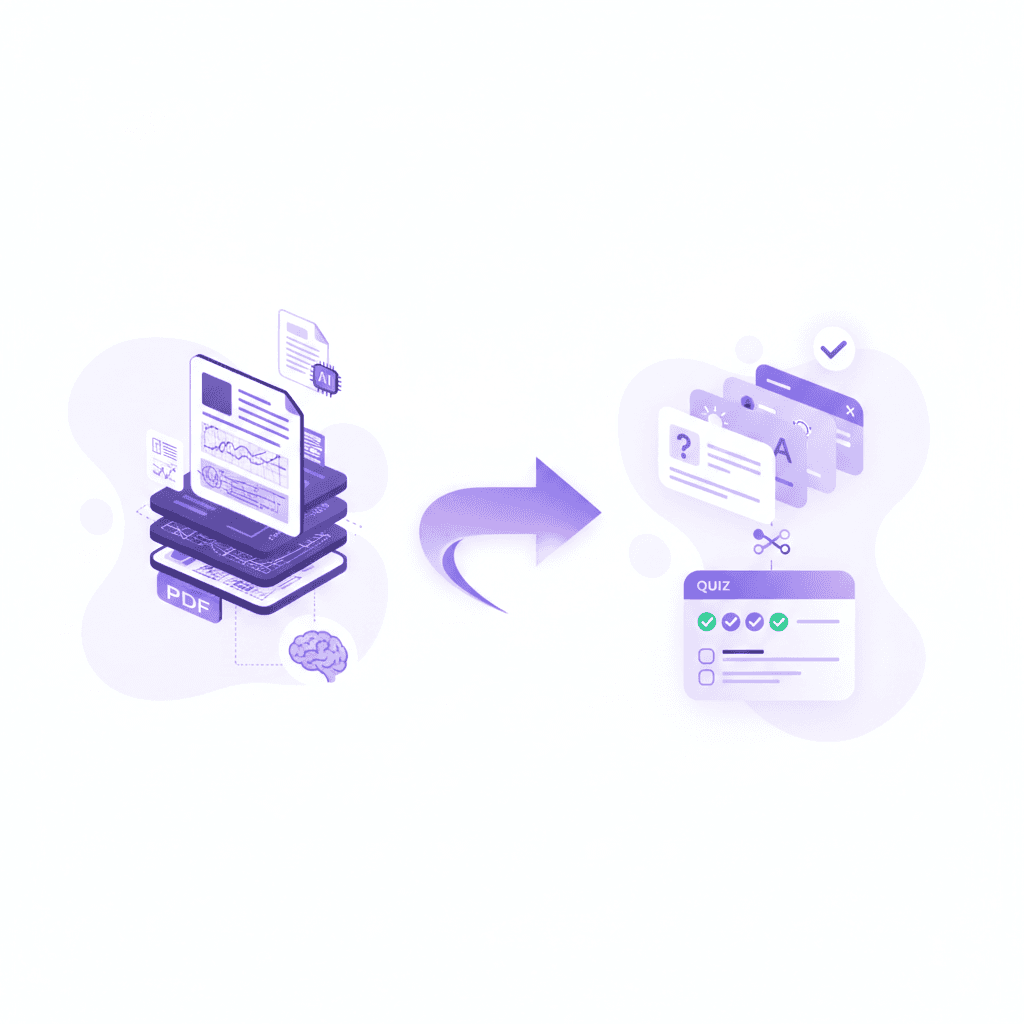
AI study platforms are digital learning environments that ingest raw academic materials and output structured practice tools. They utilize machine learning to convert text into active recall exercises, replacing manual flashcard creation with automated systems that map directly to your syllabus.
These platforms rely on a process called Retrieval-Augmented Generation (RAG). When you submit a document, the system scans the text, identifies key concepts, and stores them in a secure database structure. The software then builds questions exclusively from that localized database. This prevents the system from guessing answers based on outside internet sources.
Research by Dunlosky et al. (2013) highlights the high utility of automated practice testing and distributed practice for long-term retention. Their analysis demonstrates that active recall out-performs passive reading by a significant margin. Students utilizing self-testing methods retain complex information up to 40% better over a 30-day period compared to those who simply reread text.
Understanding how a study ai app generates exam prep from lecture notes changes your entire review strategy. Instead of spending five hours manually writing index cards, the software handles the administrative heavy lifting. You spend your cognitive energy actually answering the questions.
Upload a single week of lecture notes to establish a baseline for how the software structures your specific subject matter. Review the resulting flashcards to ensure the terminology matches your professor's exact wording.
To see the exact mechanics of this process, look at how an AI study aid turns your uploaded notes into exams. You will notice the algorithms segment information into bite-sized, testable facts. This structured environment forms the foundation of modern digital exam preparation. Incorporating these systems is one of the most effective 5 Ways an AI Powered Study Tool Boosts Grades.
Why upload your own PDFs and slides instead of using generic AI?
Uploading specific course documents ensures the generated quizzes and flashcards match the exact university curriculum. Generic language models rely on broader internet data, which frequently introduces irrelevant information or completely misses the specific academic nuances taught in a specific class.
A study by Karpicke and Roediger (2008) emphasizes the vital importance of context-specific retrieval practice for academic success. Their findings show that repeatedly testing students on their precise target materials produces a 150% improvement in long-term recall versus unstructured study methods. Generic chatbots fail this test because their training data prioritizes broad summaries over hyper-specific textbook definitions.
Standard chatbots suffer from context drift. If you ask a generic tool to quiz you on "macroeconomic theory," it might pull definitions from a rival textbook. Your professor grades you strictly on their assigned readings. By choosing an AI study guide maker from notes, you fence the algorithm in. It cannot pull outside facts. It can only query the text you provided.
This strict boundary eliminates hallucinations. Hallucinations occur when an algorithm invents plausible-sounding but factually incorrect information. Confining the knowledge base to your uploads completely neutralizes this risk.
Export your professor's primary slide deck as a PDF and feed it into the software to generate a customized study guide. Compare the resulting guide against your syllabus to verify the structural alignment.
Limiting your input strictly to professor-approved materials is one of the smartest 7 Studying AI Hacks to Boost Your GPA. It guarantees every minute you spend reviewing flashcards directly translates to the material appearing on your final exam.
What features should you look for in a complete study platform?
A comprehensive application should consolidate multiple learning modalities. Look for systems that offer flashcards, multiple-choice quizzes, mind maps, and live tutoring capabilities in one interface, eliminating the constant need to switch between separate software applications during a single study session.
Mayer's Multimedia Learning Theory (2009) demonstrates that reducing extraneous cognitive load through unified learning environments significantly improves comprehension. When students juggle four different tabs and applications, their working memory degrades. A single workspace keeps focus entirely on the subject matter.
Speed of generation is another essential metric. High-quality software processes a 40-page document and outputs 50 flashcards within 30 seconds. The best platforms also include spaced repetition algorithms built into their core functionality. These algorithms track your correct and incorrect answers, automatically pushing difficult concepts to the front of the queue during your next session.
Audit your current digital tools and replace single-function applications with one unified dashboard that handles all active recall tasks. You save money on subscriptions and reduce the friction of starting a study block.
When evaluating options, consult lists of 9 Top Study Websites to Ace College Exams Fast to see how individual platforms stack up regarding feature density. Look for visual canvas capabilities. The ability to write out equations on a digital whiteboard while an algorithm checks your work is a massive upgrade over simple text boxes. Exploring 7 AI Powered Study Apps to Boost Your Grades will reveal that the highest-rated tools always merge assessment generation with real-time feedback.

Feature Comparison Matrix
Feature Category | Generic Chatbots | Legacy Flashcard Apps | All-in-One AI Study Platforms |
|---|---|---|---|
Document Processing | Limited file size, poor formatting | Manual entry only | Unlimited uploads, strict context anchoring |
Study Modalities | Text only | Flashcards only | Flashcards, quizzes, mind maps, live canvas |
Real-Time Feedback | Text-based corrections | None | Step-by-step voice guidance, visual diagrams |
Curriculum Matching | Poor (pulls external data) | High (if typed manually) | Perfect (pulls exact syllabus text) |
Exploring 7 AI-Powered Study Tools to Ace Your Exams confirms that combining these specific features yields the best return on your study time.
How live voice tutors change the way you practice problems
Live voice tutors guide learners through complex problem-solving in real-time by drawing on a digital canvas and speaking out loud. Instead of handing over a finished answer, the system monitors individual steps and provides immediate audio corrections exactly where mistakes happen.
Research by Chi et al. (2001) proves that interactive step-by-step tutoring yields significantly higher learning gains than standard text-based feedback. Their study revealed that students receiving continuous, granular corrections scored nearly two letter grades higher on subsequent assessments.
Standard chatbots fail at complex math, physics, or economics problems because they instantly generate the final solution. Reading a finished math proof does not teach you how to write one. A live voice tutor refuses to give you the answer. It watches your cursor on the screen. If you misapply a formula on step three, the audio triggers immediately to correct that specific error before you compound the mistake in step four.
Use the voice feature to work through a challenging math or economics problem step-by-step instead of just reading the solution. Force yourself to articulate your reasoning out loud back to the system.
The auditory component builds stronger neural pathways. Hearing a concept explained via a human-sounding voice requires different cognitive processing than silently reading text. This multi-sensory engagement is why active tutoring is one of the most effective 7 Ways an AI Powered Study Assistant Boosts Grades. Experiencing this live interaction highlights 7 Ways an AI Studying Tool Boosts Exam Grades beyond simple memorization tasks.
Are free AI tiers actually effective for university exams?
Free tiers of educational software are highly effective for university preparation when they allow full access to core generation features. Students can create extensive flashcard decks and practice tests without upfront costs, making high-level exam preparation accessible on a global scale.
EDUCAUSE (2022) data indicates that student adoption rates of educational technologies heavily depend on the availability of generous free access tiers. Over 68% of university students actively rely on freemium study tools to manage their weekly coursework without impacting their personal budgets.
Many high-quality applications restrict advanced capabilities, like massive file uploads or unlimited voice minutes, behind a paywall. The fundamental active recall functions typically remain free. Generating multiple-choice questions from a 10-page lecture transcript costs nothing on most platforms. This baseline functionality is more than enough to handle standard weekly quizzes and midterms.
Register for a free tier using your university email to test the automated quiz generation capabilities before committing to any premium subscription. Run a single document through the system. If the output matches your textbook perfectly, the tool is doing its job.
Applying these free capabilities strategically forms the core of 7 Study AI Strategies for Faster Exam Prep. You do not need to spend money to see immediate academic improvements.
What are the privacy and data security standards for these platforms?
Reputable educational tools protect student intellectual property through strict data encryption and transparent privacy policies. Uploaded university documents, personal notes, and learning behaviors remain partitioned and secure, ensuring they are only utilized to train a personal workspace, never the public model.
The NIST cybersecurity framework for educational data (2023) mandates strict partitioning of user-uploaded academic materials to prevent unauthorized data sharing. Compliant platforms deploy isolated databases for every individual account. When you upload a proprietary lecture from your professor, the system does not absorb that text into a global brain. It creates a temporary, isolated index just for your login session.
University honor codes take unauthorized sharing of course materials very seriously. If you upload a copyrighted PDF to an unsecured public site, you risk academic penalties. Secure study platforms prevent this by guaranteeing that your uploads stay entirely private. The data transmission utilizes standard AES-256 encryption, similar to banking software.
Review the privacy policy of your chosen software to verify that your uploaded university coursework is not shared in public databases. Look for specific language stating "your data is not used to train our base models."
Protecting your academic materials ensures you stay compliant with your institution's policies while still benefiting from advanced processing technology.

How Penseum helps you apply AI to your study routine
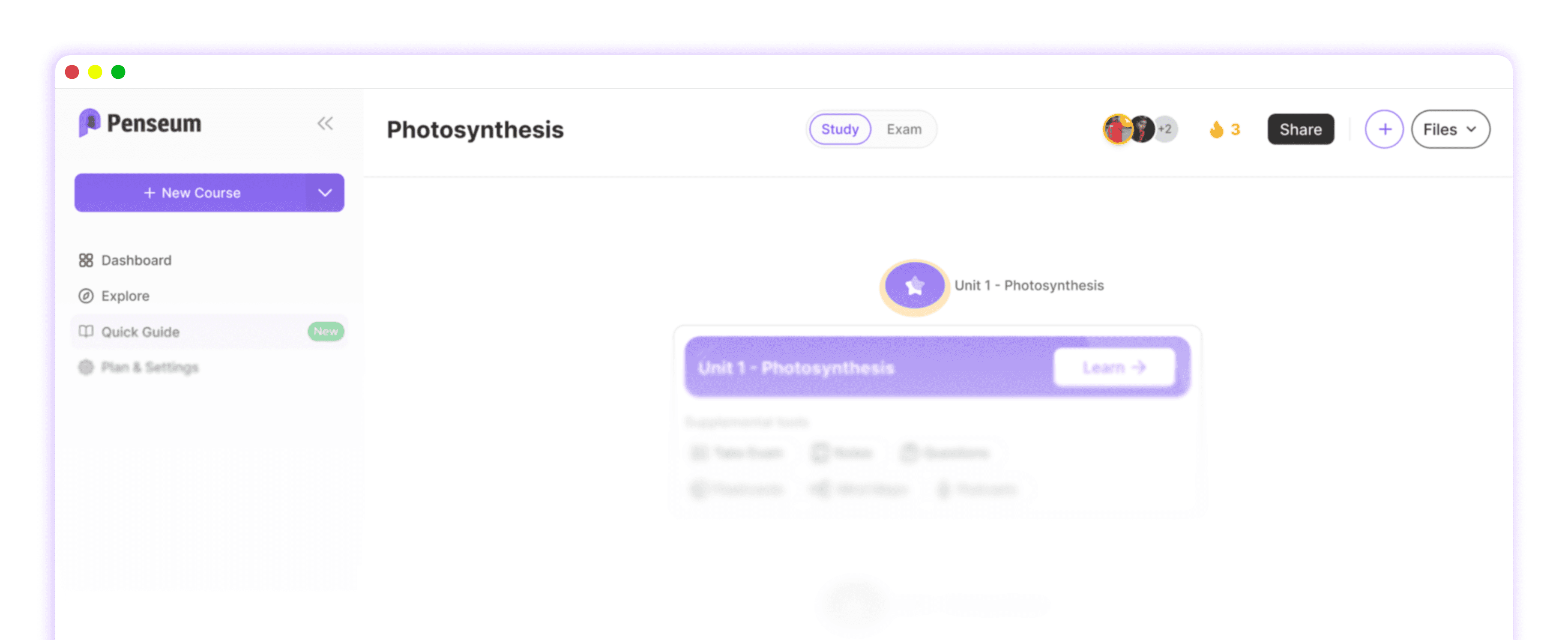
Penseum acts as an all-in-one workspace that replaces fragmented study applications. By uploading exact course materials, whether they are PDFs, lecture notes, or slides, Penseum ensures students study what will actually appear on the test, rather than generic internet knowledge.
Educationally, the platform employs active recall and spaced repetition through automated flashcards, quizzes, and mind maps. Unlike crowdsourced databases where accuracy is questionable, every piece of generated content is anchored securely to the uploaded curriculum. The moment you drop a file into your personal workspace, the engine maps the exact academic language your professor expects to see on finals day.
When a student hits a wall on a difficult concept, the 1-1 AI Tutor steps in to provide interactive assistance. It watches live work on a digital canvas, corrects individual mistakes in real-time voice, and draws diagrams out loud until the concept finally clicks. Standard study tools give you a text response and wait for your next message. Penseum sees your actual work on the screen and responds dynamically to it. If you make a math error, the tutor catches your specific mistake and tells you exactly what went wrong.
Internal data shows adoption by 1.6 million students across hundreds of universities globally, relying on the platform for daily exam preparation. These learners choose Penseum because it keeps teaching until they actually get the answer right.
Create a free Penseum account, upload your most difficult syllabus PDF, and ask the live voice tutor to explain the first core concept.
Using this comprehensive system is an excellent example of 7 Ways a Study AI Tool Improves Your Grades. By automating the setup phase of your review sessions, you unlock more time for actual comprehension. This approach perfectly aligns with 7 Ways a Study Guide Creator Boosts Grades. Penseum offers a generous free tier with no credit card required, making it an accessible, all-encompassing hub for serious exam preparation.
Frequently Asked Questions
What is an AI study platform?
An AI study platform is a comprehensive educational software that uses artificial intelligence to convert raw course materials into structured learning tools. You upload documents like PDFs or lecture slides, and the system automatically generates flashcards, multiple-choice quizzes, and custom study guides based entirely on your specific texts.
Can AI generate flashcards from my PDFs?
Yes, processing PDFs into flashcards is a primary feature of these platforms. The software scans the document, isolates key definitions and concepts, and formats them into digital flashcards. This completely automates the traditional process of writing out index cards, saving hours of manual labor before every exam.
Are AI study platforms free to use?
Most top-tier applications offer highly capable free tiers. Students can typically upload documents and generate hundreds of flashcards or quizzes at no cost. Premium subscriptions are usually available for advanced features, such as extended voice tutoring minutes or processing excessively large textbook files.
How do AI tutors differ from ChatGPT?
Standard chatbots provide immediate text answers derived from broad internet data. Dedicated AI tutors integrate with digital canvases to monitor your real-time work. Instead of just giving you the final answer, they provide step-by-step guidance, use voice audio, and draw diagrams to help you solve the problem yourself.
Which AI tool is best for university students?
The best tool for university students is one that strictly anchors its outputs to uploaded documents. Platforms like Penseum lead this category because they combine document-specific quiz generation with real-time voice tutoring, ensuring students only review accurate, syllabus-aligned material instead of generic web content.
Written by Samit Khalsa — Expert in cramming for exams
Last updated: October 2026
Sources
Dunlosky, J., Rawson, K. A., Marsh, E. J., Nathan, M. J., & Willingham, D. T. (2013). Improving Students' Learning With Effective Learning Techniques: Promising Directions From Cognitive and Educational Psychology. Psychological Science in the Public Interest, 14(1), 4-58. https://pubmed.ncbi.nlm.nih.gov/26173288/
Karpicke, J. D., & Roediger, H. L. (2008). The critical importance of retrieval for learning. Science, 319(5865), 966-968. https://pubmed.ncbi.nlm.nih.gov/18276894/
Mayer, R. E. (2009). Multimedia Learning (2nd ed.). Cambridge University Press. https://scholar.google.com/scholar?q=Mayer+Multimedia+Learning+2009
Chi, M. T. H., Siler, S. A., Jeong, H., Yamauchi, T., & Hausmann, R. G. (2001). Learning from Human Tutoring. Cognitive Science, 25(4), 471-533. https://scholar.google.com/scholar?q=Chi+Learning+from+Human+Tutoring+2001
EDUCAUSE. (2022). Students and Technology Report: Rebalancing the Student Experience. EDUCAUSE Research. https://www.educause.edu/ecar/research-publications/students-and-technology-report
National Institute of Standards and Technology (NIST). (2023). Cybersecurity Framework Profile for Educational Institutions. U.S. Department of Commerce. https://www.nist.gov/cyberframework
Related guides
Ready to study smarter?
Start turning your notes into guides, quizzes, and flashcards in seconds.