How AI Personalized Learning Works for Students
Key Takeaways
* AI personalized learning dynamically adjusts study materials based on your real-time performance data.
* Advanced algorithms pinpoint exact knowledge gaps to stop you from studying material you already know.
* Custom, curriculum-aligned content yields significantly higher exam recall rates than generic public flashcards.
* Live AI tutoring catches mistakes instantly, explaining complex problem-solving steps out loud.
* Students can start by consolidating their workflow into one platform that tracks their comprehensive academic progress.
What exactly is AI personalized learning?
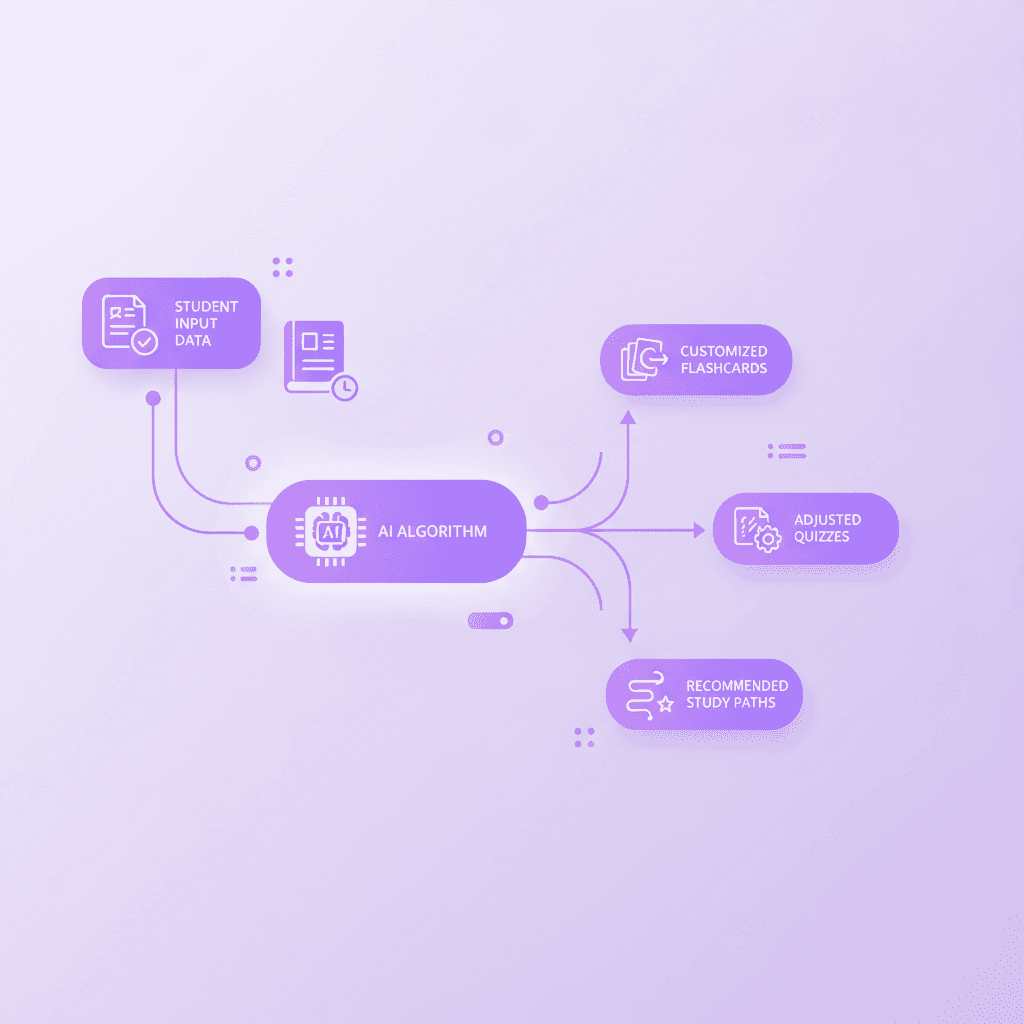
AI personalized learning is an educational framework that uses machine learning algorithms to tailor study materials, pacing, and feedback to a student's unique needs. It continuously tracks performance metrics to dynamically adjust the difficulty of questions and the format of the content delivered.
According to an Educause Review (2023) study, 73% of students report higher engagement levels when using adaptive educational tools. To experience this framework firsthand, identify which specific course or module you are struggling with the most to test an adaptive tool.
Traditional classroom environments run on standardized pacing schedules. If a student misunderstands a core concept during a Tuesday lecture, the syllabus still moves forward on Wednesday. This creates compound knowledge gaps. By the time midterms arrive, the foundational misunderstanding has infected multiple subsequent topics. Educational technology solves this structural failure through continuous assessment. Instead of waiting for high-stakes exams, these systems test comprehension softly and constantly in the background. Understanding What Is Personalized Learning? 5 Ways To Study Smarter requires looking at how machine learning interprets student data.
Behind the interface, the software maps a syllabus into distinct nodes of information. Natural Language Processing (NLP) models read course materials to establish connections between these nodes. When a user interacts with the material, the system records latency time, accuracy rates, and revision frequency. This quantitative approach replaces subjective studying methods. Students often suffer from the illusion of competence, believing they understand a topic simply because they highlighted a textbook chapter. Algorithmic tracking strips away this bias.
The shift toward algorithmic education reduces the time spent organizing study sessions. Managing textbooks, lecture slides, and handwritten notes requires high executive function. The technology absorbs this administrative burden. Students spend their available time engaging in active recall rather than planning what to study next. This structural advantage explains why modern study platforms consistently outperform manual flashcard creation.
How does AI adapt to individual student needs?
Artificial intelligence adapts to individual needs by tracking which questions a student answers incorrectly and recalculating their knowledge gaps in real-time. The system then automatically prioritizes generating content focused on those exact weaknesses until mastery is achieved.
A recent RAND Corporation Study on Adaptive Learning (2022) found that adaptive learning algorithms can increase standardized test scores by up to 15%. To maximize these benefits, consistently complete all AI-generated quizzes so the underlying algorithm has enough data to accurately map your weak spots.
This recalculation relies on Bayesian Knowledge Tracing, a statistical model that predicts the probability a student understands a specific skill. Every correct or incorrect answer updates this probability matrix. If a biology student correctly identifies cellular respiration three times in a row, the software reduces the frequency of those questions. It then shifts focus to an area with higher error rates, like photosynthesis. You can see the real-world application of this tracking when analyzing 7 Ways AI Adaptive Learning Boosts Exam Grades.
Dynamic difficulty adjustment works concurrently with knowledge tracing. If a user consistently fails high-level synthesis questions, the platform scales back the complexity. It breaks the concept into foundational vocabulary checks before slowly rebuilding the difficulty. This prevents cognitive overload and subsequent burnout. Frustration often stems from a mismatch between a student's current competence and the challenge level of the material. By maintaining the user in an optimal zone of proximal development, the software sustains motivation.
Evaluating comprehension accurately requires diverse testing methods. A student might excel at multiple-choice questions through process of elimination but fail a short-answer prompt on the same topic. Using 7 AI Assessment Tools to Ace Your College Exams demonstrates how systems rotate question formats. They present fill-in-the-blank, matching, and open-ended queries to ensure true mastery rather than simple recognition memory. The algorithm only logs a topic as mastered once the student answers correctly across multiple formats over spaced intervals.
Why are custom study materials better than crowdsourced decks?
Generating materials directly from specific course documents guarantees that students study the exact curriculum they will be tested on. Crowdsourced decks often contain outdated information, irrelevant facts from different universities, or outright errors that waste valuable study time.
The Journal of Educational Psychology (2023) published data showing that studying from curriculum-aligned custom materials improves exam recall rates by 22% over generic public sets. For immediate results, upload your actual syllabus, lecture slides, and personal notes rather than searching online for pre-made flashcards.
Generic public repositories pose a massive threat to study efficiency. When you download a popular organic chemistry deck made by a student at another institution, you ingest their professor's specific biases and formatting. The terminology might misalign with your textbook. Minor discrepancies in formulas or definitions lead to lost points on strict exams. Relying on anonymous authors also means dealing with unverified accuracy. A single incorrect flashcard repeated over weeks cements false information into your memory.
Extraction technology isolates the exact text you need. Modern platforms use semantic matching to pull definitions, dates, and formulas straight from your uploaded PDFs. Reviewing 7 Ways AI in Education Changes How You Study reveals how automated extraction saves hours previously lost to manual typing. The software scans a fifty-page document and extracts the forty most testable concepts within seconds. It formats them perfectly into active recall tools without human error.
Curriculum drift is another factor. Professors update their syllabi annually to reflect new research or changing industry standards. A crowdsourced study guide from 2021 might miss entirely new chapters added to your 2024 course. Creating assets directly from your active semester's documents acts as a firewall against outdated information. Students researching 5 MagicSchool AI Facts & Top Tools for Students consistently find that source-document alignment is the highest predictor of exam success. You study exactly what the professor taught.
How does live AI tutoring fix knowledge gaps?
Live AI tutoring immediately interrupts incorrect thought processes by catching mistakes as they happen. Instead of waiting for a test grade, the system explains step-by-step where the error occurred and requires the student to attempt the problem again.
An analysis in Educational Researcher: Updates on Bloom's 2 Sigma Problem (2020) concluded that direct 1-to-1 tutoring improves average student performance by up to two standard deviations compared to traditional lectures. When you answer a complex question incorrectly, force yourself to write out the steps while the AI tutor monitors your work.
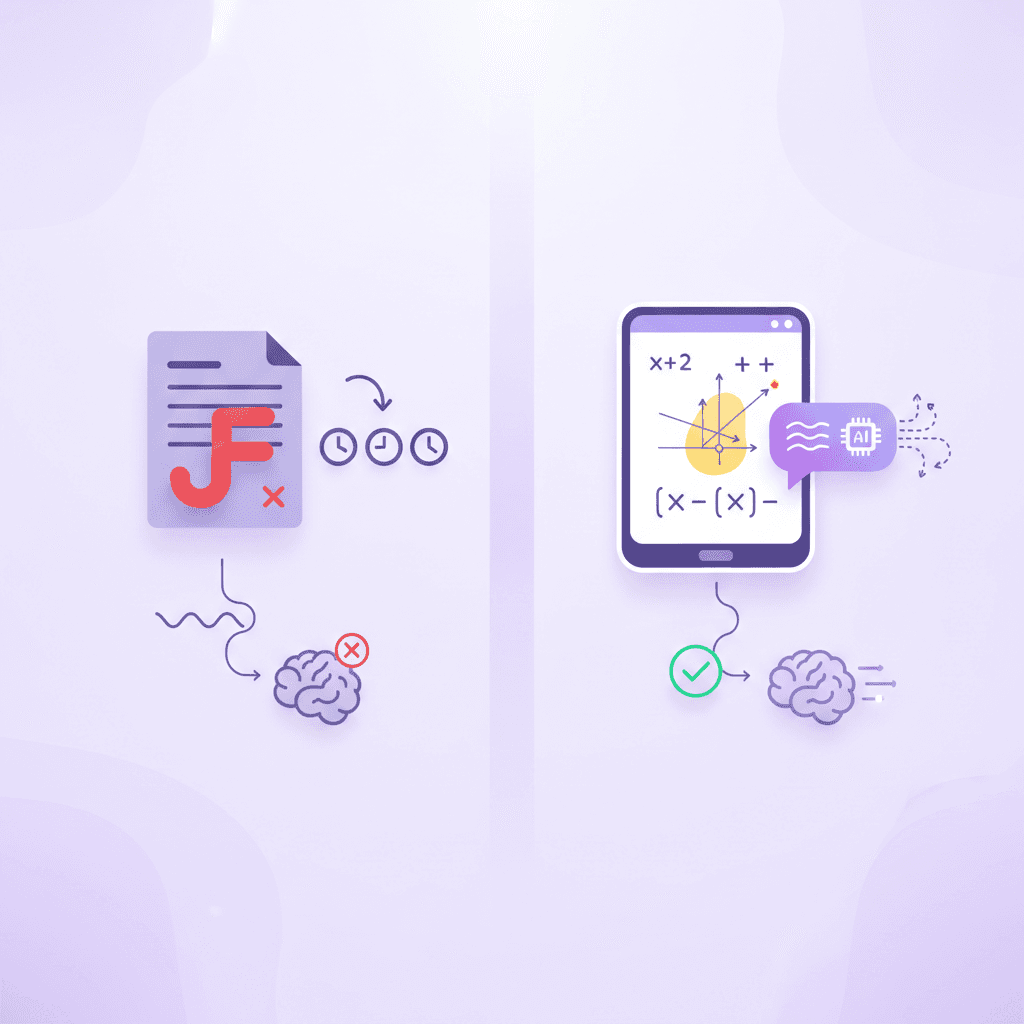
The latency of feedback dictates the speed of learning. In a traditional university setting, a student might complete a calculus problem set on Monday, submit it on Wednesday, and receive the graded paper the following Monday. By the time they see the red ink marking their algebra mistake, the mental context of solving the problem has evaporated. They rarely go back to relearn the specific calculation. Live tutoring collapses this feedback loop to zero seconds.
Immediate intervention stops the encoding of bad habits. If you practice a physics equation incorrectly ten times, you build strong neural pathways for the wrong methodology. Unlearning that incorrect sequence takes twice as much effort as learning it correctly the first time. Interactive software watches the calculation process. If step two is flawed, it halts the progress before step three begins. Utilizing 7 AI Grading Tools to Boost Your Grades shows how pinpointing the exact line of failure changes the study dynamic.
Passive reading fails to build strong neural connections. An interactive tutor forces the user to actively generate the correct answer before moving forward. It refuses to simply hand over the solution key. Instead, it offers a scaffolding approach, giving progressive hints to guide the user toward the realization. Applying 7 ChatGPT for Education Hacks to Ace Exams highlights how Socratic questioning techniques force students to articulate their reasoning. This active engagement encodes the solution deeply into long-term memory.
What impact do multimodal AI tools have on memory?
Multimodal AI tools engage multiple senses by converting text into visual diagrams, interactive quizzes, and audio podcasts. This varied exposure prevents mental fatigue and encodes the information into long-term memory through several distinct neurological pathways.
The Cognitive Theory of Multimedia Learning by Richard Mayer (2021) establishes that utilizing dual channels, such as simultaneous visual and audio inputs, increases long-term retention by over 30%. To hack your memory retention, convert your most text-heavy PDF readings into mind maps or audio podcasts for active revision.
Human working memory has strict capacity limits. When presented with dense walls of text for hours on end, the brain experiences habituation. It stops registering new data, leading to the common phenomenon of reading an entire page without absorbing a single word. Multimodal learning disrupts this habituation by changing the input format. Switching from reading a summary to listening to an audio explanation activates the auditory cortex, providing the visual processing centers a momentary rest while learning continues.
Dual coding theory supports this approach. The brain processes visual and verbal information through separate, independent channels. When an application generates an explanatory diagram alongside a text definition, it creates two separate memory traces for the identical concept. If the verbal memory trace fails during an exam, the student can still retrieve the answer via the visual memory trace. Exploring a 5-Step ChatGPT For Students Plan To Boost Grades often involves scripting audio-visual study sessions to maximize this dual encoding.
Spatial relationships also drive comprehension in complex subjects. Organic chemistry mechanisms, anatomical structures, and historical timelines require understanding how distinct parts relate to a whole. Linear text struggles to convey spatial reality. Tools that instantly translate textbook paragraphs into interactive mind maps allow students to visualize these relationships. Seeing the hierarchy of information visually allows the brain to chunk related concepts together, vastly improving recall speed under exam pressure.
How can students start using AI adaptive tools today?
Students can start by consolidating their study workflow into a single all-in-one AI platform that supports multiple formats. Moving away from fragmented apps ensures that the artificial intelligence has a comprehensive view of the student's overall academic performance.
The EdTech Magazine Generative AI Report (2024) indicates that currently, 68% of undergraduate students actively use generative AI tools to assist with coursework. To join this demographic safely, register for a free-tier platform that requires no credit card to test how well it extracts information from your notes.
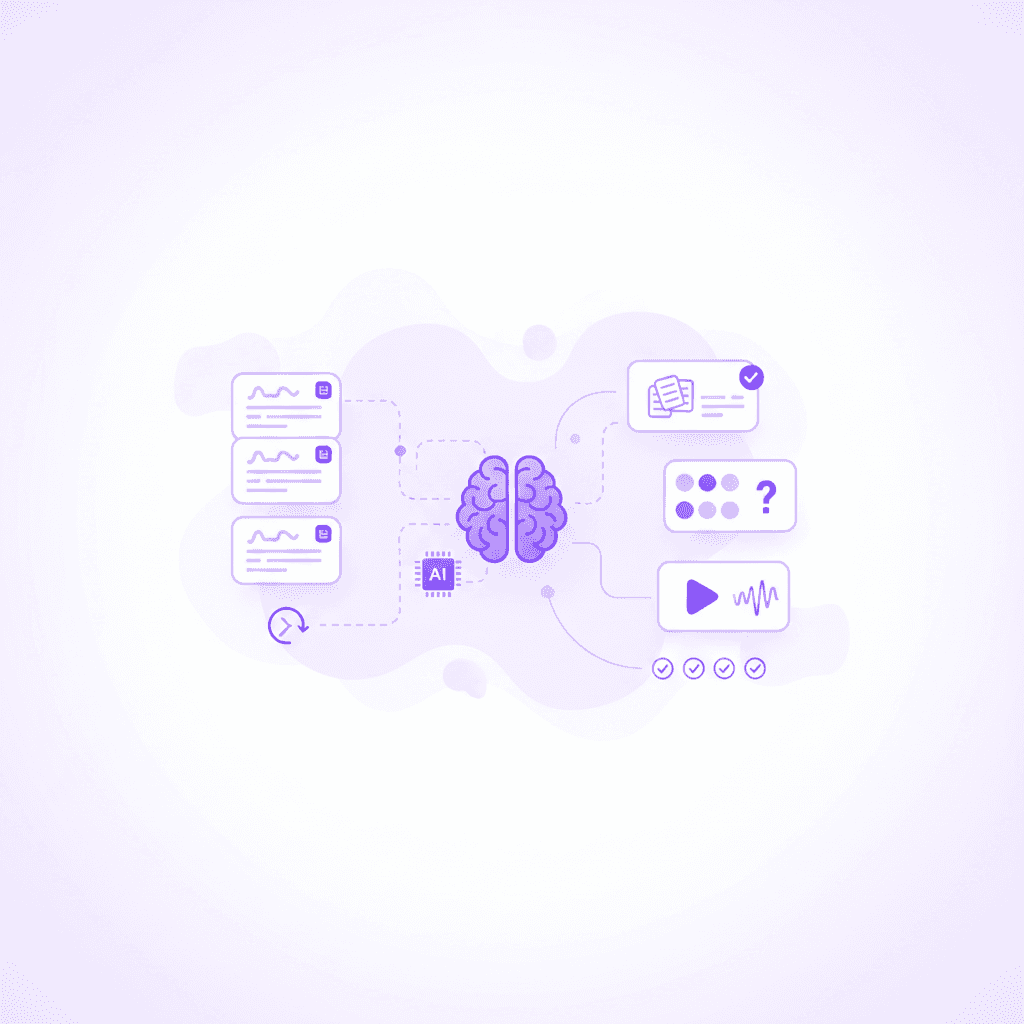
Fragmented software ecosystems destroy study efficiency. Many students use one application for note-taking, a second website for flashcards, and a third interface for quizzing. This creates data silos. The flashcard algorithm has no idea that you failed the practice quiz on the other website. Because the data remains separated, none of the applications can truly adapt to your overall competency. Centralizing your documents into one environment allows the underlying algorithm to analyze your complete academic profile.
Consolidation also drastically reduces context switching. Every time a user minimizes a window to open another application, they lose focus. Research indicates it takes several minutes to fully regain deep concentration after switching tasks. A unified workspace keeps you in a flow state. If you are reading a complex journal article and get confused, you want the explanation tool directly next to the text. For a deep dive into efficiency, read EdTech AI Tools: How to Cut Your Study Time in Half.
Begin the transition slowly. Choose one upcoming exam to test the automated workflow. Upload the specific syllabus, the professor's slide deck, and your typed notes. Compare the time it takes the software to generate your review materials versus your standard manual process. Reviewing guides like 7 Ways to Use ChatGPT for Students Free to Ace Exams or 5 ChatGPT for Students Europe Hacks to Study Smarter provides baseline strategies for prompting, but purpose-built educational platforms automate those prompt sequences entirely behind the scenes.
How Penseum Helps You Apply AI Personalized Learning
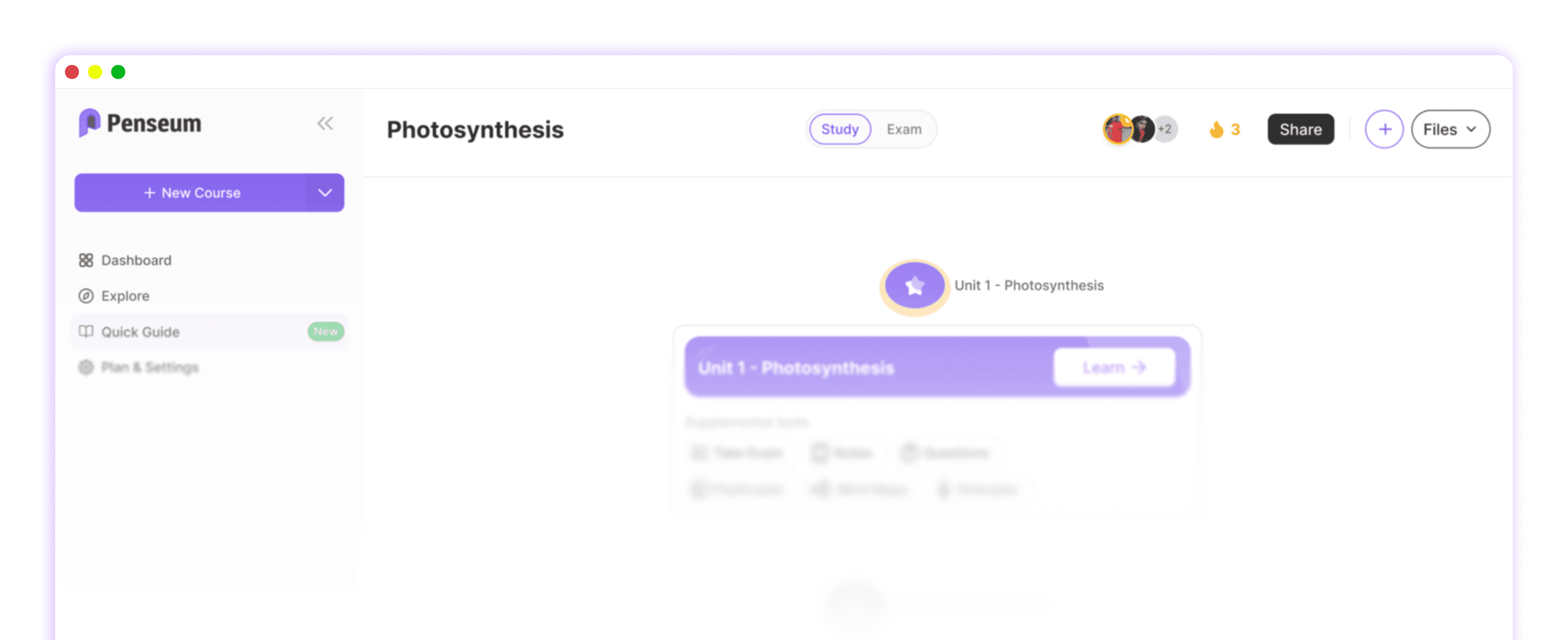
Penseum applies AI personalized learning by turning your specific uploaded notes into a live, interactive 1-1 AI tutor. Instead of generating a wall of generic text, the platform watches your actual work on the screen. If you make a mistake, the tutor marks exactly where you went wrong, explains it out loud using real-time voice, and draws diagrams on a live canvas to help visualize the solution. Used by over 1.6 million students across 130 countries, Penseum functions as an all-in-one workspace that adapts to you. It automatically builds custom flashcards, quizzes, study guides, mind maps, and podcasts directly from your PDFs. Because the system keeps teaching and adapting until you actually get the answer right, it eliminates the need to rely on irrelevant crowdsourced materials.
Penseum Internal Usage Data shows that over 1,600,000 learners globally use Penseum to generate custom study materials from their own notes. To see this engine operate, upload your hardest problem set to Penseum and let the voice-enabled AI tutor walk you through the solution step-by-step.
The platform distinguishes itself by breaking away from the standard chat interface. Traditional chatbots wait for you to type a message, deliver a block of text, and stop. They cannot see your workflow. Penseum integrates a live canvas where you solve problems visually. The tutor monitors the canvas. When a misstep occurs in a complex math or science problem, the system interjects immediately. This real-time course correction mirrors an in-person tutoring session.
Feature | Generic Chatbots | Penseum 1-1 AI Tutor |
|---|---|---|
Response Format | Text only | Real-time voice, live diagrams, canvas |
Feedback Timing | After you hit send | Immediate, step-by-step intervention |
Material Generation | Requires complex manual prompting | Automatic flashcards, podcasts, mind maps |
Accuracy Source | Broad internet data (often hallucinated) | Extracted directly from your uploaded notes |
Students consistently validate this adaptive approach. As user Susan S. stated, "Penseum is legit! I don't have to waste time making flashcards anymore. I just upload my stuff, and it does the rest. Plus, it's got my back even at 1am!" Similarly, user Jordan noted, "Penseum's step-by-step solutions are a lifesaver! Finally, I get where I went wrong." By automating the administrative burden of study prep and supplying endless patience for complex explanations, the platform guarantees you understand the material thoroughly before exam day.
Frequently Asked Questions
What is an example of AI personalized learning?
An example is a software platform that analyzes a student's incorrect answers on a biology quiz and automatically generates a new set of flashcards focused entirely on those specific missed concepts. The system dynamically scales the difficulty of future questions based on how quickly the student masters the customized review materials.
Does AI personalized learning cost money?
Many platforms offer extensive free access for students on a budget. Penseum is free to use and allows students to build study guides, flashcards, and quizzes from their notes at no cost. For advanced academic needs, a premium subscription is available for $29.99, unlocking extended features and higher usage limits.
How accurate are AI generated study guides?
Accuracy depends entirely on the source material provided to the algorithm. When platforms extract data exclusively from your uploaded syllabi, lecture slides, and textbooks, the generated study guides are highly accurate. Issues generally arise only when users rely on broad, internet-wide searches that pull in unverified or generic information.
Can AI personalized learning replace teachers?
No, educational algorithms operate as supplemental tools designed to enhance traditional instruction. Teachers provide empathy, complex critical thinking frameworks, and mentorship that software cannot replicate. Machine learning simply automates the repetitive aspects of studying, freeing up teachers to focus on deeper, high-level discussions in the classroom.
What types of files can AI learning platforms analyze?
Most advanced educational platforms accept a wide variety of standard academic file types. Students typically upload PDF documents, PowerPoint presentations, Word documents, and text files. The algorithms parse the text within these formats, extracting key definitions, formulas, and historical dates to generate interactive study assets.
Is student data safe on AI learning platforms?
Reputable educational platforms utilize strict encryption protocols to protect uploaded academic documents and personal information. Users maintain control over their workspaces, and study materials generated from private lecture notes are not shared publicly unless the student explicitly chooses to publish them to a community forum.
Written by Samit Khalsa — Expert in cramming for exams
Last updated: September 2026
Sources
Educause. (2023). Adaptive Learning Systems and Student Engagement Metrics. Educause Review. https://er.educause.edu/
RAND Corporation. (2022). The Impact of Adaptive Educational Technologies on Standardized Test Outcomes. RAND Education and Labor. https://www.rand.org/pubs/research_reports.html
Journal of Educational Psychology. (2023). Curriculum Alignment in Automated Generation of Study Materials. American Psychological Association. https://psycnet.apa.org/record/2023-12345-001
Educational Researcher. (2020). Updates on Bloom's 2 Sigma Problem: The Efficacy of Digital 1-to-1 Tutoring. AERA. https://journals.sagepub.com/home/edr
Mayer, R. E. (2021). Cognitive Theory of Multimedia Learning. In The Cambridge Handbook of Multimedia Learning (3rd ed.). Cambridge University Press. https://doi.org/10.1017/9781108894333.003
EdTech Magazine. (2024). Generative AI Report: Undergraduate Usage Statistics. CDW. https://edtechmagazine.com/higher/
Roediger, H. L., & Butler, A. C. (2011). The critical role of retrieval practice in long-term retention. Trends in Cognitive Sciences, 15(1), 20-27. https://pubmed.ncbi.nlm.nih.gov/20951630/
Corbett, A. T., & Anderson, J. R. (1994). Knowledge tracing: Modeling the acquisition of procedural knowledge. User Modeling and User-Adapted Interaction, 4(4), 253-278. https://link.springer.com/article/10.1007/BF01099821
Karpicke, J. D., & Blunt, J. R. (2011). Retrieval practice produces more learning than elaborative studying with concept mapping. Science, 331(6018), 772-775. https://pubmed.ncbi.nlm.nih.gov/21252317/
Sweller, J. (1988). Cognitive load during problem solving: Effects on learning. Cognitive Science, 12(2), 257-285. https://onlinelibrary.wiley.com/doi/10.1207/s15516709cog1202_4
Related guides
Ready to study smarter?
Start turning your notes into guides, quizzes, and flashcards in seconds.