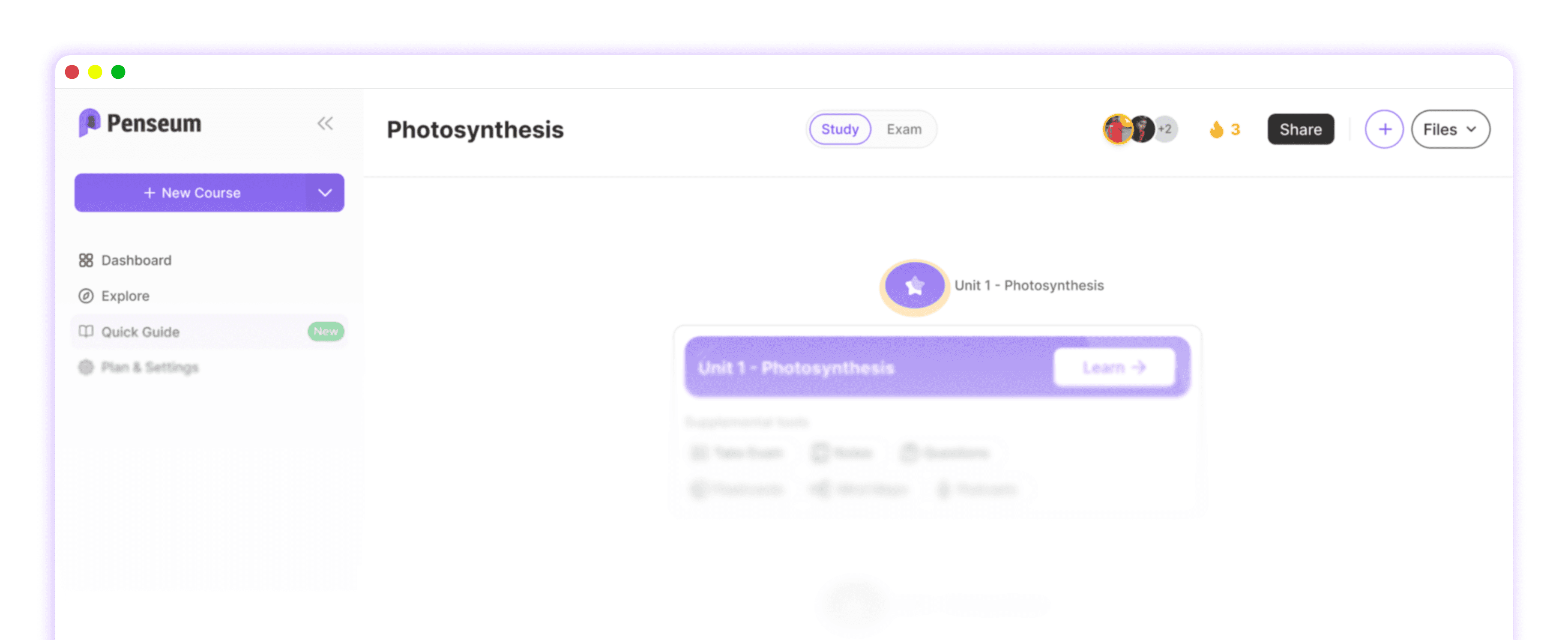
How mind mapping for students organizes complex topics
Key Takeaways
* Mind mapping for students transforms linear notes into spatial hierarchies, improving memory retrieval during high-stress exams.
* Visual frameworks rely on dual coding, engaging both linguistic and spatial memory centers simultaneously.
* Centralizing a main thesis and branching into keywords reduces reading review time heavily.
* Digital AI study platforms enhance mapping by instantly extracting core concepts from dense syllabi.
What is a visual study map?
A mind map is a hierarchical diagram used by students to visually organize information. Starting with a central concept, it branches outward into related subtopics, keywords, and images, completely replacing linear bullet points with a spatial layout that shows how different theories connect.
This framework shifts learning from passive reading to active structuring. Educational researchers Farrand, Hussain, and Hennessy (2002) found that implementing spatial diagrams increases factual recall during examinations by at least 10%. To immediately apply this, start your next diagram with a single core topic placed in the exact center of a blank landscape page.
Moving away from standard top-to-bottom writing forces your brain to categorize information by relevance. Primary branches represent broad categories, while secondary twigs hold granular details. This branching structure perfectly mimics how the human brain naturally associates ideas.

Most university lectures progress chronologically, leaving students with pages of disconnected facts. By reviewing 7 Note Taking Methods for Exam Success, you quickly see why spatial arrangements outperform standard lists. Standard lists hide the relationships between variables. Visual webs expose them immediately.
If you struggle with dense material, comparing this technique with 5 Cornell Notes Examples for Better Exam Prep reveals a stark difference. The Cornell method excels at isolating questions and summaries. Spatial diagrams excel at synthesizing entire chapters into single, digestible overviews. For tech-focused learners, replicating this spatial web is often the primary goal when exploring 7 Notion For Students Tips To Boost Your Grades.
Why does visual mapping improve memory retention?
Visual mapping improves memory retention through dual coding, which processes information using both visual and verbal channels simultaneously. By combining text with spatial placement, students create multiple cognitive pathways to the same piece of information, making retrieval significantly faster during high-pressure exams.
The psychological foundation for this rests on Allan Paivio's Dual Coding Theory (1971). His research, supported by modern cognitive science, indicates that approximately 65% of the population are visual learners who benefit measurably from graphical layouts over text. To harness this effect, assign a specific color to each main branch of your diagram to create a stronger visual anchor for memory retrieval.
Our short-term memory can only hold a few isolated items at once. When you group related terms onto a single colorful branch, you engage a process called "chunking." The brain stops seeing ten separate vocabulary words and instead sees one cohesive group. Reviewing 7 Mind Mapping Examples for Better Grades demonstrates exactly how effective chunking transforms chaotic study sessions into organized reviews.
Relying purely on text creates a single point of failure during a test. If you forget a specific sentence, the information is lost. When studying with spatial branches, forgetting a word does not break the chain. You can often remember the word's location on the page, its associated color, or the neighboring concepts, which triggers the target memory.
This multi-sensory approach builds structural knowledge. You are no longer just memorizing what a concept is; you are mapping out exactly where it lives in the broader context of the subject.
How do you build a spatial map from dense textbooks?
To build a mind map from dense textbooks, you must first identify the chapter's primary thesis and make it your central node. Next, skim the text for major headings to form primary branches, extracting only the most critical keywords and formulas rather than writing full sentences.
Adhering to Tony Buzan's Mind Map Framework (1993) requires strict discipline with word counts. His methodology shows that extracting keywords into branches reduces future reading review time by up to 40% compared to re-reading chapters. As a strict rule, limit each branch's text to a maximum of three words to force concise summarization and prevent overcrowding.
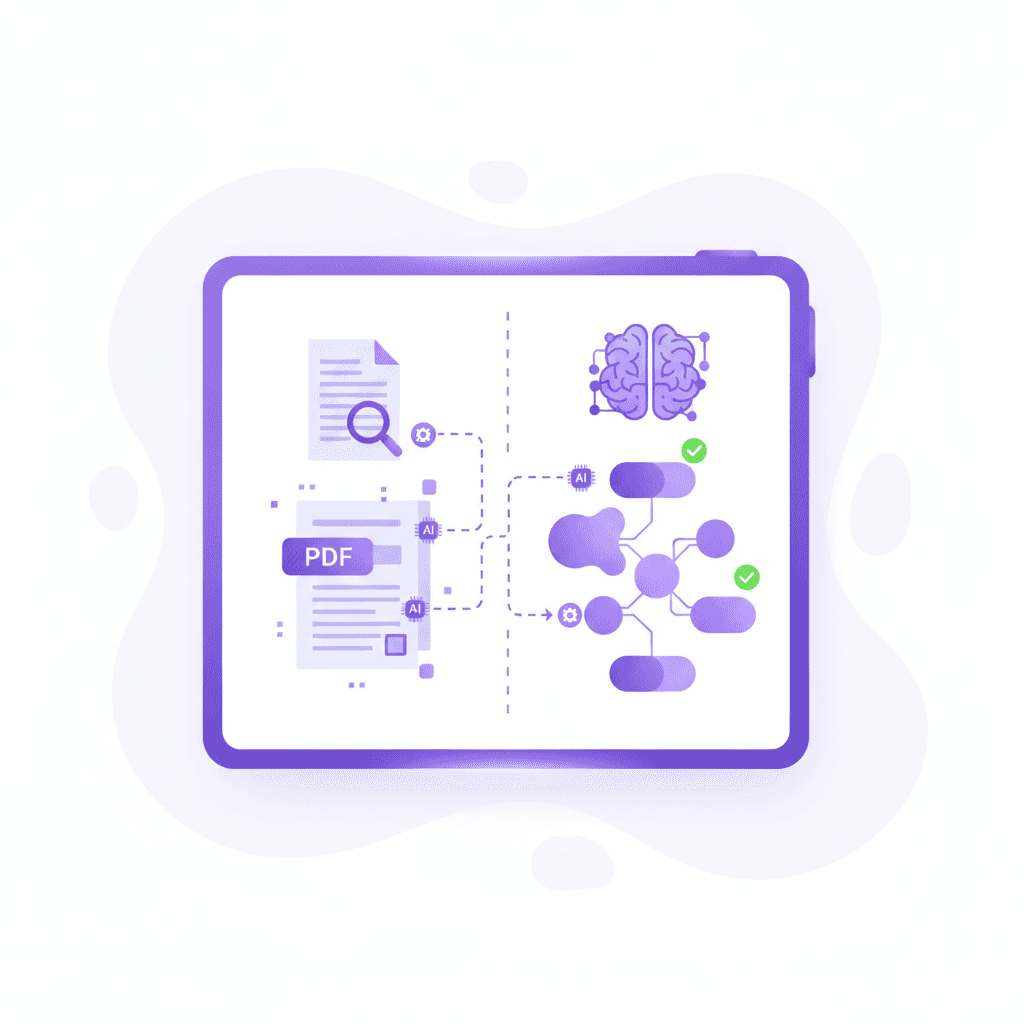
Students often trap themselves by copying entire textbook paragraphs onto their spatial diagrams. This defeats the purpose entirely. You want to trigger memory, not read a transcript. When looking for strategies in 7 Tips on How to Take Notes From a Textbook Fast, the most consistent advice is to filter out filler words.
Start your mapping session by previewing the chapter's summary and bolded vocabulary. These elements dictate your primary branches. Once the skeleton is built, read the actual paragraphs to find the supporting data for your secondary branches. This top-down extraction aligns well with the 5 Steps: Outline Method of Note-Taking for Better Grades, but offers a much clearer visual hierarchy.
If a concept requires a full sentence to explain, it likely needs to be broken down into three separate, smaller branches. Forcing yourself to distill complex paragraphs into single nouns and verbs is an intense active recall exercise. The actual process of building the diagram creates the long-term memory.
When should you use spatial maps instead of linear notes?
You should use mind mapping instead of linear notes when studying overarching systems, brainstorming essay structures, or comparing multiple theories. Linear notes work well for chronological facts, but spatial diagrams are essential when you need to understand the complex relationships and hierarchies between different academic variables.
Educational psychologists Nesbit & Adesope evaluated Learning with Concept and Knowledge Maps (2006). They discovered that students using spatial nodes map conceptual relationships 20% more accurately than those relying on traditional lists. To test this advantage, use a hierarchical diagram specifically for your final exam review to visualize the entire semester's curriculum on one page.
Certain subjects demand different structural approaches. Memorizing historical dates often fits a linear timeline perfectly. However, understanding the multi-faceted causes of a historical war requires branches showing economic, social, and political triggers side-by-side. Recognizing when to switch strategies is a core principle found in 7 Best Note-Taking Methods for Better Grades.
Many students mix formats depending on the phase of their study cycle. You might take rapid linear notes during a fast-paced lecture. Later that evening, you convert those messy linear notes into a structured spatial diagram to solidify the concepts. This workflow resolves the constant debate discussed in 5 Handwritten vs Typed Notes Truths for Better Grades.
For subjects requiring deep synthesis, visualizing the architecture of the information is mandatory. Comparing frameworks in 5 Best Cornell Notes Template Layouts for A+ shows that while templates guide questioning, spatial webs dictate the actual flow of logic.
What are the differences between mind maps and concept maps?
The primary difference is structure and flow. Mind maps radiate outward from a single central topic in a tree-like structure, ideal for brainstorming. Concept maps connect multiple distinct concepts in a complex, downward-flowing network with specific linking words explaining the exact relationship between the nodes.
The foundational research by Novak & Cañas on the Theory Underlying Concept Maps (2008) highlights this structural divergence. Their data indicates that concept maps typically involve 2 to 3 cross-links per node, while mind maps keep a strict 1-to-many hierarchy. To upgrade your visual notes, add specific action verbs on the connecting lines if you transition a basic radial diagram into a complex network map.
Feature | Mind Maps | Concept Maps | Best Academic Use Case |
|---|---|---|---|
Origin Point | Single central node | Multiple top-level nodes | Brainstorming vs. Systems analysis |
Structure flow | Radial (outward in all directions) | Hierarchical (top-down flow) | Organizing essays vs. Mapping biology |
Connecting Lines | Simple lines showing association | Arrows with specific linking verbs | Rapid note-taking vs. Deep theoretical study |
Complexity | Low to medium | High (multiple cross-links) | Memorizing vocabulary vs. Understanding physics |
Radial layouts prioritize speed and unfiltered association. When a professor introduces a brand new topic, a central hub with radiating branches captures the broad strokes perfectly. You do not need to know exactly how subtopic A affects subtopic B yet.
Network-style diagrams prioritize exact logic. Medical students mapping the cardiovascular system must know precisely how blood flows between organs. Using 5 Concept Map Strategies to Ace Your Exams ensures that every arrow has a specific directional meaning. Mixing up a causal relationship on a network diagram highlights an immediate gap in your understanding.
Optimizing exam prep with digital spatial mapping
Modern learning environments often push students toward digital ecosystems over physical paper. Digital spatial mapping tools allow for infinite canvas expansion, preventing the classic problem of running out of room on the edge of a notebook page.
Transitioning from analog paper requires selecting the right software environment. A common question among university freshmen involves choosing the right ecosystem, often leading to research on the 7 Best Note Taking App For Students To Ace Exams. Infinite canvas apps allow students to zoom in on granular details and zoom out to see the macro structure of a twelve-week course.
Physical handwriting still holds distinct cognitive benefits, primarily through motor-memory activation. To capture both benefits, many top-tier students utilize a tablet and stylus. Examining the 7 Best iPad Note Taking App Tools For A+ Grades reveals that drawing branches by hand on a digital screen offers the best of both physical retention and digital flexibility.
For students on tight budgets, premium software is not strictly necessary to build effective visual hierarchies. Reviewing options like the 5 Best Note Taking App For Students Free To Ace Exams shows plenty of free vector-based drawing tools. Alternatively, knowledge graph software operates on similar spatial principles. Advanced workflows detailed in 6 Obsidian for Students Tips (Study Smarter) explain how internal linking creates automated digital webs of your linear text notes.
Ultimately, mastering 7 Tips on How to Take Good Notes for Top Grades means choosing a system that removes friction. Your tool should allow you to drag, drop, and reorganize branches instantly as your understanding of the curriculum evolves.
How Penseum helps you apply spatial note-taking
Transitioning from traditional bullet points to visual webs requires a significant shift in how you process academic information. The hardest part of mind mapping for students is knowing which concepts are important enough to become primary branches and which are just supporting details.
Educational research shows that structuring information hierarchically reduces cognitive load, allowing your brain to focus on actual understanding rather than transcribing the professor's words verbatim. Based on Sweller's Cognitive Load Theory (1988), structuring information visually and interactively can reduce mental fatigue by up to 30% during long study sessions. Upload your longest PDF syllabus into your free Penseum workspace to instantly identify the core themes for your next visual diagram.
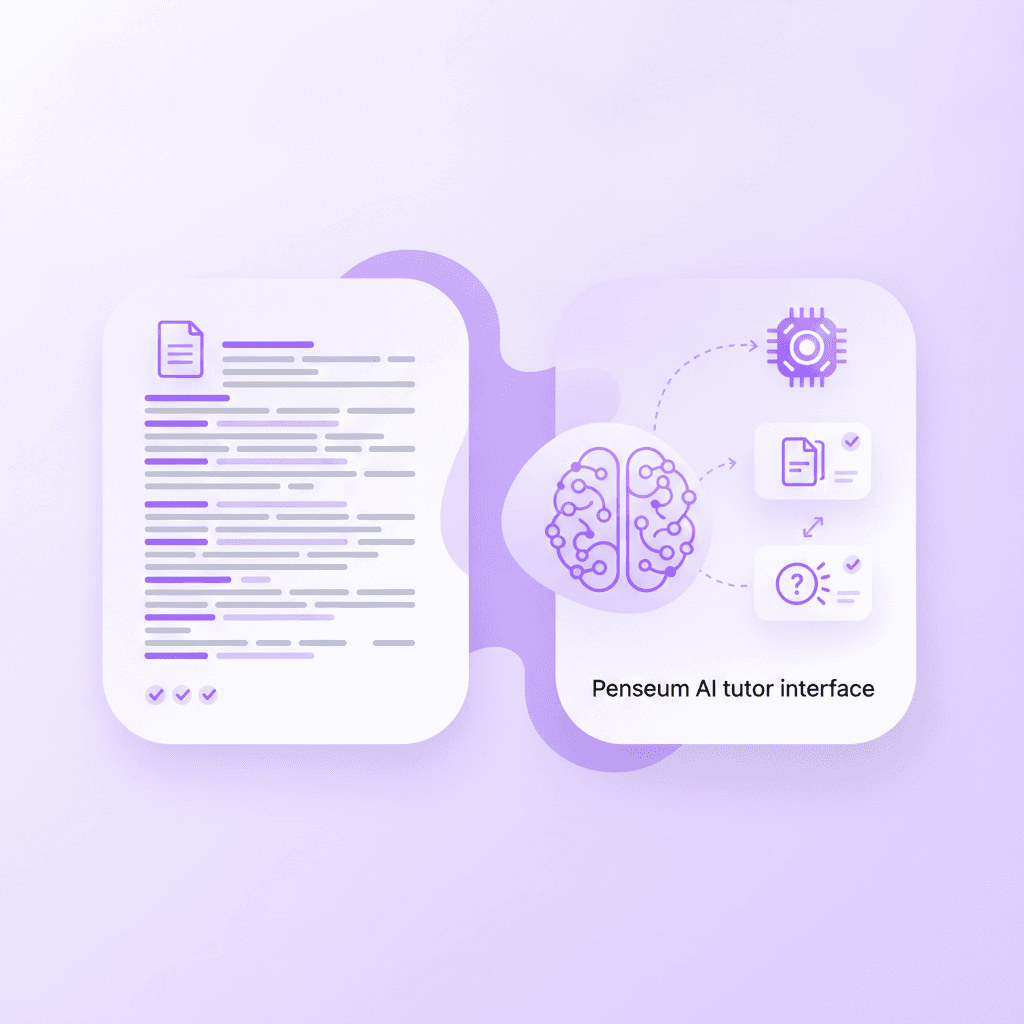
To build highly effective study materials, you need to synthesize your notes into distinct categories, test your recall of those categories, and identify the exact gaps in your knowledge base. This is exactly where Penseum bridges the gap between raw notes and active studying. Rather than manually sorting through hundreds of dense textbook pages to find your primary branches, you can upload your PDFs, lecture slides, or typed notes directly into Penseum.
The platform acts as your personal 1-1 AI tutor, instantly organizing your uploaded content and generating personalized quizzes and flashcards based on the actual material you need to learn. If you're struggling to understand how a complex topic connects on your map, the interactive canvas allows the AI tutor to draw diagrams and work through solutions live, in real-time voice.
Used by over 1.6 million learners, Penseum doesn't just give you a generic text response; it watches your actual work, catches specific mistakes, and explains the problem out loud until the concept finally clicks, all available on a free tier. Ready to study smarter? Start turning your notes into guides, quizzes, and flashcards in seconds.
Frequently Asked Questions
Do mind maps actually work for studying?
Yes, mind maps are highly effective for studying because they force learners to actively process and structure information. Creating a spatial diagram requires identifying relationships between concepts, which engages higher-order thinking and significantly improves long-term memory retrieval compared to passively reading linear textbook notes.
What is the best mind mapping software for college?
The best mind mapping software depends on your specific needs, but popular digital options include Miro, XMind, and Lucidchart. These platforms allow infinite canvas space, easy editing, and cloud syncing. Many students prefer an all-in-one AI study platform that automatically generates study materials from uploaded lecture slides.
Can you use a mind map for math and science?
Absolutely. While often associated with humanities, a visual layout is excellent for math and science. Students place a core formula or scientific law in the center node and branch out into specific use cases, variable definitions, common calculation mistakes, and step-by-step visual proofs to understand the underlying mechanics.
Are handwritten diagrams better than digital ones?
Handwritten diagrams often provide a stronger cognitive benefit due to the physical act of drawing, which enhances muscle memory and retention. Digital platforms offer infinite space, easy reorganization, and the ability to integrate multimedia. Many students combine both by using stylus-based tablets to handwrite on a digital canvas.
How should a student review visual maps before a test?
To review visual maps before a test, students practice active recall by covering the outer branches and trying to name the subtopics based solely on the central node. Re-drawing the entire diagram from memory on a blank whiteboard is one of the most rigorous ways to test conceptual understanding.
Written by Samit Khalsa — Expert in cramming for exams
Last updated: September 2026
Sources
Farrand, P., Hussain, F., & Hennessy, E. (2002). The efficacy of the 'mind map' study technique. Medical Education. https://pubmed.ncbi.nlm.nih.gov/12028392/
Paivio, A. (1971). Imagery and verbal processes. Holt, Rinehart, and Winston. https://scholar.google.com/scholar?q=Paivio+Dual+Coding+Theory+1971
Buzan, T. (1993). The Mind Map Book: How to Use Radiant Thinking to Maximize Your Brain's Untapped Potential. BBC Books. https://scholar.google.com/scholar?q=Buzan+Mind+Map+Book+1993
Nesbit, J. C., & Adesope, O. O. (2006). Learning with concept and knowledge maps: A meta-analysis. Review of Educational Research. https://scholar.google.com/scholar?q=Nesbit+Adesope+Learning+with+concept+and+knowledge+maps+2006
Novak, J. D., & Cañas, A. J. (2008). The Theory Underlying Concept Maps and How to Construct and Use Them. Institute for Human and Machine Cognition. https://scholar.google.com/scholar?q=Novak+Canas+Theory+Underlying+Concept+Maps+2008
Mueller, P. A., & Oppenheimer, D. M. (2014). The pen is mightier than the keyboard: Advantages of longhand over laptop note taking. Psychological Science. https://journals.sagepub.com/doi/10.1177/0956797614524581
Sweller, J. (1988). Cognitive load during problem solving: Effects on learning. Cognitive Science. https://scholar.google.com/scholar?q=Sweller+Cognitive+load+theory+1988
Related guides
Ready to study smarter?
Start turning your notes into guides, quizzes, and flashcards in seconds.