7 Tips: How to study for exams in 7 days & pass
Organizing a compressed timeline requires discarding passive reading and adopting high-efficiency cognitive strategies. Figuring out how to study for exams in 7 days demands a strict daily schedule, focused intervals, and intensive retrieval practice.
Structure your week: Dedicate four days to learning, two days to reviewing, and one day to testing.
Replace reading with recall: Use active retrieval to force your brain to remember concepts.
Compress repetition: Review the hardest topics every morning and evening.
Automate your prep: Use AI tools to generate study materials instantly and save hours.

Day 1: How do you build a 7-day study schedule?
Organizing your schedule is the critical first step when figuring out how to study for exams in 7 days. Break your syllabus into distinct topics, allocating the first four days to learning new material, days five and six for review, and day seven for practice tests.
Most students fail compressed study sessions because they lack specific daily targets. Saying you will "study biology" is an unstructured goal that invites procrastination. You need explicit boundaries. If you have ten chapters to cover, you must mathematically divide them across your first four days. This means completing 2.5 chapters daily before you are allowed to stop. Establishing strict micro-deadlines prevents the final-day panic that ruins exam performance.
Data backs up this structured approach. Goal-setting theory demonstrates that highly specific targets yield massive performance advantages. Research published by Edwin Locke (1968) on task motivation established a fundamental behavioral metric. Students who set specific, challenging academic goals perform roughly 20% better than those with vague plans.
Mapping out your timeframe is non-negotiable. You cannot rely on spontaneous motivation when facing a one-week deadline. You must treat your study blocks like fixed appointments. If you want to follow the 7 Study Schedule Steps for Better Grades, you need absolute clarity on what you are doing at 9:00 AM versus 2:00 PM.
Creating this structure removes decision fatigue. You never waste mental energy wondering what to read next. Mastering 7 Steps on How to Study for Better Exam Grades starts with eliminating the friction between sitting down and actually working.
Actionable step: Map out your 7-day study schedule on a digital calendar, assigning specific chapters and learning objectives to Days 1 through 4. Block out exact start and end times for every single session.
Days 2-3: What are the best study methods for rapid learning?
Active recall is the absolute best study method for rapid learning. Instead of passively re-reading notes, force your brain to retrieve information from memory. This strengthens neural pathways and ensures you actually understand the concepts rather than just recognizing them on the page.
Reading a textbook feels productive, but it builds a dangerous illusion of competence. You recognize the words, so your brain tricks you into believing you know the material. True learning only happens when you extract information from your mind without external prompts. The struggle of trying to remember a formula or a historical date is the exact biological mechanism that cements that fact into your long-term memory.
Empirical evidence heavily supports this technique. A landmark study by Karpicke & Roediger (2008) in the journal Science measured the exact impact of retrieval practice. Their data showed that retrieval practice improves long-term memory retention by up to 150% compared to simply re-reading text.
Applying this requires a fundamental shift in how you interact with your notes. After finishing a chapter, you must immediately test yourself. You can try out the 8 Best Study Techniques For Higher Grades by writing out everything you know on a whiteboard from memory alone. When you inevitably get stuck, that failure identifies exactly which sections you need to review.
The most efficient learners spend 20% of their time reading and 80% of their time self-testing. If you are exploring the 7 Best Study Methods to Ace Your Exams, self-testing will always rank at the top. Incorporating these 9 Effective Study Strategies to Boost Grades means choosing the uncomfortable friction of active recall over the easy comfort of highlighting text.
Actionable step: Close your textbook and write down everything you remember about a complex topic on a blank sheet of paper, then check for gaps. Use a red pen to correct your mistakes so they stand out during your next review.
Day 4: How can you maintain focus while studying intensive material?
Maintaining focus requires managing cognitive load and preventing mental fatigue. The best strategy is working in concentrated intervals separated by short breaks. This prevents burnout during an intensive 7-day cram session and keeps your brain processing incoming information at peak efficiency.
The human brain cannot sustain high-level concentration indefinitely. Attempting to read complex academic material for four hours straight leads to diminishing returns. By hour three, your reading speed drops, your comprehension falters, and you stop forming strong memories. To survive a one-week study sprint, you must pace your cognitive energy.
Short diversions actually improve attention spans. A behavioral study by Dr. Alejandro Lleras (2011) at the University of Illinois investigated how the brain processes sustained tasks. The findings revealed that sustained cognitive attention drops significantly after 40 minutes of continuous studying without a break.
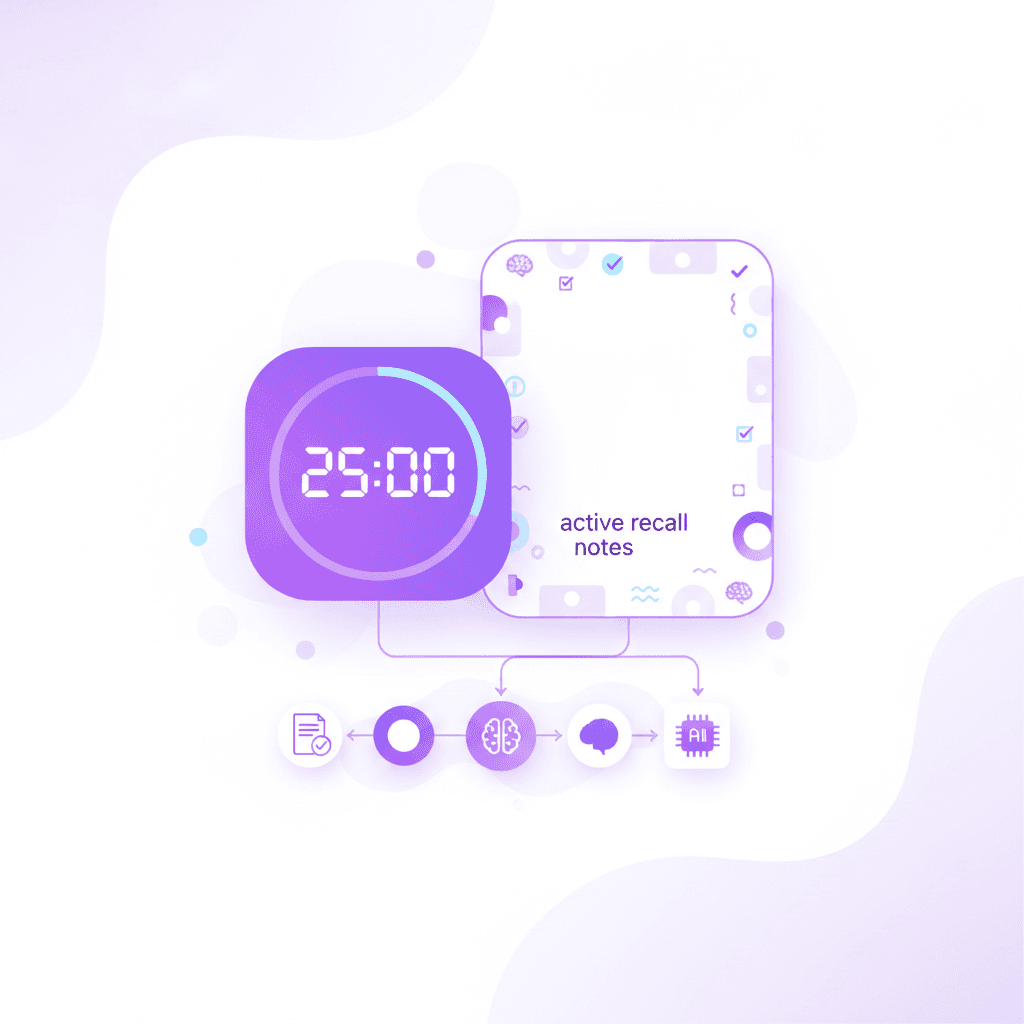
The solution is the pomodoro method. By capping your focus at 25 or 50 minutes, you force urgency into your session. You work faster because the timer is ticking. The mandatory break that follows allows your brain's default mode network to process and organize the information you just absorbed.
Mastering the 5 Pomodoro Technique Steps to Study Faster means strictly enforcing your breaks. Do not check social media during this time. Step away from your desk, stretch, or look out a window to rest your eyes. If you need 7 Ways: How to Focus While Studying to Ace Exams, managing these intervals is your strongest defense against exhaustion. It remains one of the top 7 Ways: How To Study Effectively For Better Grades because it respects your biological limits.
Actionable step: Implement the pomodoro technique by studying with intense focus for 25 minutes, followed immediately by a 5-minute break away from your screen. After four cycles, take a longer 15-minute break.
Day 5: How do you use spaced repetition in a one-week window?
While typically used over months, spaced repetition works in a 7-day window by reviewing difficult concepts at increasing intervals within the week. Review a topic on Day 1, again on Day 3, and finally on Day 5 to lock it securely into short-term memory before testing.
Your brain naturally discards information it deems unimportant. This biological process is designed to prevent cognitive overload, but it works against you during exam week. Spaced repetition hacks this system. By repeatedly exposing yourself to the same material just as you are about to forget it, you signal to your brain that the information is essential for survival.
The math behind memory decay is well documented. Hermann Ebbinghaus's foundational research on the Forgetting Curve (1885) established the exact rate of memory loss over time. His experiments demonstrated that without active repetition, the human brain forgets approximately 70% of new information within just 24 hours.
To counteract this in a compressed timeline, you must build micro-cycles. Study a new chapter at 9:00 AM. Review the core concepts of that chapter at 8:00 PM the same day. Touch base with it again two days later. This repeated exposure interrupts the forgetting curve and resets your retention back to 100%.
Applying 5 Spaced Repetition Tips for Better Grades requires discipline. You cannot just read new material every day. You must allocate specific blocks in your schedule solely for looking backward. Combining these techniques, as outlined in 5 Active Recall and Spaced Repetition Tips for Exams, provides the strongest possible framework for retaining dense academic material.
Actionable step: Identify the hardest concepts from your syllabus and review them every morning and evening to simulate a compressed spaced repetition cycle. Use flashcards to make these daily reviews faster.
Day 6: How Penseum helps you apply active recall instantly
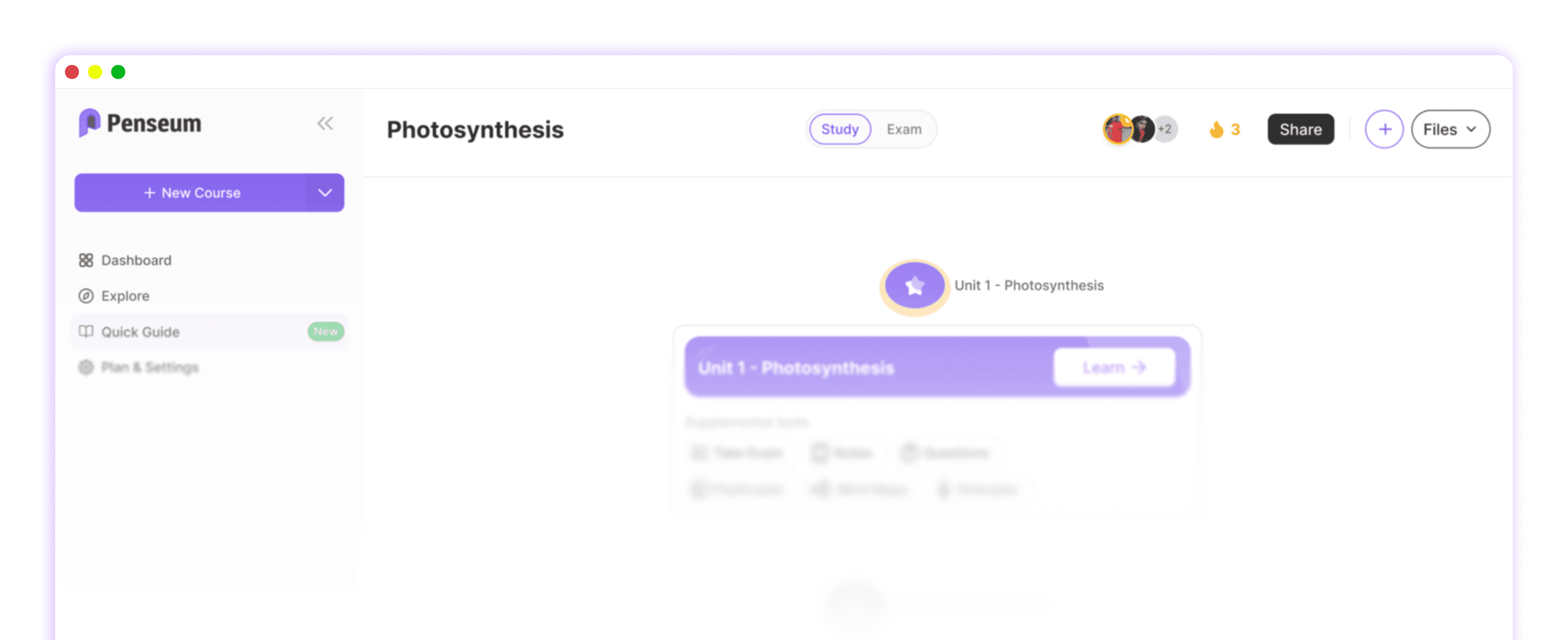
When you only have seven days, building study guides manually wastes precious time. Penseum is an AI tutor that instantly generates personalized flashcards, quizzes, and mind maps directly from your uploaded slides. You can skip prep work and immediately focus on testing your knowledge.
Education research consistently shows that the speed and quality of feedback determine how fast a student learns. Creating flashcards takes hours of low-level cognitive effort. Testing yourself with those flashcards is where the actual high-level learning occurs. Students facing tight deadlines often spend 70% of their week organizing materials and only 30% studying them.
Immediate error correction changes this dynamic entirely. Professor John Hattie’s synthesis of 800 meta-analyses on learning (2009) evaluated the distinct factors that drive student achievement. The data confirmed that receiving immediate, corrective feedback accelerates the learning process by roughly 30%.
This is where AI radically alters exam preparation. Upload your 40-page PDF lecture slides into Penseum. The platform immediately extracts the core concepts and builds your quizzes. You bypass the administrative work entirely.
When you get a math or chemistry problem wrong, standard AI chatbots just hand you a text block with the correct answer. Penseum operates differently. It functions as a live 1-on-1 tutor. It sees your actual work on the digital canvas. It explains your specific problem in a real-time voice, pointing out exactly where your formula broke down. It will then wait, asking you to try again until you master the concept.
Feature | Manual Study Prep | Standard AI Chatbots | Penseum AI Tutor |
|---|---|---|---|
Material Generation | Takes 3-5 hours | Requires manual prompting | Instant from uploaded PDFs |
Feedback Speed | Delayed until graded | Fast, but text-only | Real-time voice correction |
Problem Solving | Solo troubleshooting | Gives the final answer | Explains step-by-step out loud |
Error Tracking | Non-existent | Generic explanations | Spots exact mistakes on canvas |
You can utilize these features to execute 7 Tips on How to Memorize Faster for Exams. Instead of reading textbook summaries, engage with a tool that forces you to answer questions live. Applying 3 Secret Study Tips to Ace Your Exams is much easier when a tutor is actively guiding your session at 2:00 AM.
Actionable step: Upload your PDFs to Penseum and use the real-time voice AI tutor to work through problems out loud until you get them right. Let the software build your flashcards so you can spend your sixth day entirely on practice questions.
Day 7: How should you prepare the day before the exam?
The day before your exam should focus entirely on mock testing and light review, not learning new material. Simulate the exam environment, complete practice questions without looking at your notes, and prioritize a full night of rest to consolidate your memory.
Cramming new chapters 24 hours before a test yields terrible results. Your brain requires time and sleep to move information from short-term holding into long-term storage. If you try to stuff complex new theories into your head at the last minute, you risk displacing the foundational knowledge you spent the last six days building.
Sleep is the ultimate biological study tool. Neuroscience proves that pulling an all-nighter actively sabotages your grade. Dr. Matthew Walker’s extensive research on sleep and memory consolidation (2017) revealed exactly how sleep deprivation damages academic performance. His studies showed that sleep deprivation reduces the brain's ability to absorb and retain new information by nearly 40%.
Your final day must be spent simulating the exact conditions of the test. Sit at a clean desk. Put away your phone. Set a timer for the exact duration of your upcoming exam. Take a full practice test without any study aids. This state-dependent practice ensures that the stress of the real exam environment won't cause you to blank out.
Review your mistakes calmly, then close your books by early evening. Managing 7 Steps: How to Study for Exams and Ace Finals involves knowing when to stop working. The most successful students rely on 7 Secrets to the Best Way to Study for Exams which include strict sleep hygiene. Trust the process you built following these 7 Steps: How to Study for Finals & Ace Exams, eat a good meal, and let your brain rest.
Actionable step: Take a full-length, timed practice exam mimicking real test conditions, review your mistakes, and ensure you get at least 8 hours of sleep. Stop all studying by 7:00 PM the night before the test.
Frequently Asked Questions
Is it possible to study for an exam in 7 days?
Yes, you can successfully prepare for an exam in seven days by using highly structured time management and aggressive active recall. A one-week timeframe requires you to abandon passive reading and highlighting. You must immediately divide your syllabus into manageable daily chunks, focus on self-testing, and use spaced repetition to lock in difficult concepts before test day.
How many hours a day should you study for a week before an exam?
Most university students should aim for 4 to 6 hours of deeply focused study time per day during a seven-day cram week. Pushing beyond six hours often leads to severe cognitive fatigue and diminishing returns. Breaking these hours into 25-minute concentrated intervals with short breaks keeps your brain fresh and maximizes memory retention.
What is the best way to study a lot of material in a short time?
The most efficient method is combining the pomodoro technique with retrieval practice. Do not try to read every page of the textbook. Identify the core concepts, generate flashcards or practice questions immediately, and test yourself continuously. Using AI tools to generate these study guides from your notes can save hours of preparation time.
Should I stay up all night to study for an exam?
No, pulling an all-nighter actively harms your exam performance. Sleep is required for the brain to consolidate new information into long-term memory. Staying awake for 24 hours impairs your cognitive function, reaction time, and recall ability to the same degree as being legally intoxicated. Always prioritize a minimum of seven hours of sleep before a test.
How do I memorize things faster for exams?
Force your brain to recall information rather than just reading it. Write out concepts from memory on a blank sheet of paper, a process known as the brain dump method. Reviewing the most difficult material right before you go to sleep and immediately after you wake up also speeds up the memorization process through targeted spaced repetition.
Written by Samit Khalsa — Expert in cramming for exams
Last updated: September 2026
Sources
Locke, E. A. (1968). Toward a theory of task motivation and incentives. Organizational Behavior and Human Performance, 3(2), 157-189. https://scholar.google.com/scholar?q=Locke+1968+Goal+Setting+Theory
Karpicke, J. D., & Roediger, H. L. (2008). The critical importance of retrieval for learning. Science, 319(5865), 966-968. https://pubmed.ncbi.nlm.nih.gov/18276894/
Ariga, A., & Lleras, A. (2011). Brief and rare mental "breaks" keep you focused: Deactivation and reactivation of task goals preempt vigilance decrements. Cognition, 118(3), 439-443. https://pubmed.ncbi.nlm.nih.gov/21211793/
Ebbinghaus, H. (1885). Memory: A contribution to experimental psychology. Annals of Neurosciences, 20(4), 155-156. https://pubmed.ncbi.nlm.nih.gov/25206141/
Hattie, J. (2009). Visible Learning: A synthesis of over 800 meta-analyses relating to achievement. Routledge. https://scholar.google.com/scholar?q=Hattie+2009+Visible+Learning
Walker, M. P. (2017). Why We Sleep: Unlocking the Power of Sleep and Dreams. Simon and Schuster. https://scholar.google.com/scholar?q=Matthew+Walker+Why+We+Sleep+2017
Related guides
Ready to study smarter?
Start turning your notes into guides, quizzes, and flashcards in seconds.